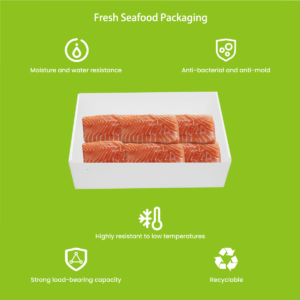
Why Fresh Seafood Demands Dedicated Packaging — Not Frozen, Not Dry
Fresh seafood is not frozen seafood. The packaging requirements are fundamentally different, and using the wrong box for the wrong temperature zone is one of the most common — and most costly — mistakes in seafood logistics.
Three temperature zones, three packaging realities:
| 区域 |
温度 |
Product State |
Primary Risk |
Packaging Priority |
| Iced Fresh |
0–4°C |
整条鱼放在碎冰上 |
Ice-melt drowning; bacterial growth at 4°C+ |
Drainage + waterproof + antimicrobial |
| Chilled Fresh |
-1–2°C |
Gutted/filleted on gel packs |
Dehydration; surface drying |
Moisture retention + sealed barrier |
| 《冰雪奇缘》 |
-18 to -25°C |
Blast-frozen blocks/individual |
Freezer burn; thaw-refreeze |
Insulation + vapor barrier + deep-cold rigidity |
Why “fresh” packaging cannot be repurposed from frozen:
- Ice melt management. Fresh seafood is shipped on crushed ice (0.5–1.0 kg ice per kg of fish). That ice melts — producing 0.5–1.0 liters of meltwater per kg of product over a 24-hour shipment. A frozen-seafood box has no drainage because frozen product produces no liquid. A fresh-seafood box without drainage drowns the product in bacterial soup: at 4°C+ in standing meltwater, total viable count (TVC) doubles every 4–6 hours.
- Antimicrobial surface. Fresh seafood is the most microbiologically volatile protein in the food supply. Total viable count on freshly caught fish is 10²–10⁴ CFU/g — but reaches 10⁶–10⁷ CFU/g (spoilage threshold) in 24–48 hours at 4°C, and in 8–12 hours at 10°C. Cardboard and EPS foam surfaces cannot be sanitized between uses; they harbor biofilms that accelerate bacterial growth. PP corrugated boxes can be sanitized with chlorine (100–200 ppm) or peracetic acid (200–400 ppm) between every shipment.
- Stacking in wet conditions. Fresh seafood boxes are stacked in ice slurry, standing meltwater, and condensation. Cardboard loses 40–60% of its stacking strength when wet. EPS foam cracks under point loads. PP corrugated maintains full stacking strength (up to 30 kg per box, 8–10 layers high) in saturated conditions.
归根结底: If your seafood is fresh (0–4°C, on ice), you need a box designed for ice melt, drainage, and antimicrobial performance. A frozen-food box, a dry-goods box, or a cardboard box will not work.
Looking for frozen seafood packaging? Our 海鲜礼盒 hub page covers all temperature zones, including frozen transport. For fish-specific packaging across iced, chilled, and frozen zones, see our 鱼类包装箱 页面。.
技术规格
| 参数 |
规格 |
| 材料 |
聚丙烯(PP)波纹中空板 |
| Food Contact Grade |
FDA 21 CFR 177.1520 / EU 10/2011 / GB 4806.7-2016 |
| 板材厚度 |
3 mm (shellfish) / 4 mm (standard) / 5 mm (heavy finfish) |
| 标准尺寸 |
600×400×200 mm / 600×400×150 mm / 400×300×150 mm / Custom |
| 自定义尺寸范围 |
300×200×100 mm to 1200×600×400 mm |
| 温度范围 |
-20°C 至 +80°C |
| Drainage |
Integrated floor channels + side/bottom drain ports (20–30 mm) |
| 通风 |
8–15% sidewall (species-dependent) |
| 堆叠高度 |
8–10 layers (wet conditions, up to 30 kg/box) |
| 再利用循环 |
200+ |
| 闭合方法 |
Ultrasound seal / Interlocking tabs / Stapling |
| 打印 |
丝网印刷(1–4色) / 数码丝网印刷(全彩) |
| 最小起订量 |
无 |
4 Fresh Seafood Categories, 4 Box Requirements
Fresh seafood is not one product — it is four product families, each with different handling, drainage, and structural requirements. A box designed for whole finfish will crush shellfish; a box designed for shrimp will not drain ice melt from a whole salmon.
| Category |
Species Examples |
Key Handling Risk |
盒式设计优先级 |
推荐版块 |
See Dedicated Page |
| Finfish (Round & Flat) |
Salmon, cod, sea bass, red snapper, sole |
Ice-melt drowning; scale loss; belly burst in stacked fish |
Deep drainage channels; reinforced corners for 30 kg+ loads; smooth interior walls |
4–5 mm, 600×400 mm |
鱼类包装箱 |
| Shellfish (Bivalves) |
Oysters, mussels, clams, scallops |
Shell-edge fracture; purge water contamination; suffocation in standing water |
Shallow profile; fine drainage mesh floor; ventilation ≥ 10% for live product respiration |
3–4 mm, 400×300 mm |
冰镇海鲜礼盒 |
| Crustaceans |
Shrimp, prawns, lobster, crab, crawfish |
Antenna/appendage breakage; black spot (melanosis) from oxidation; rapid TVC spike at >4°C |
Individual cell compartments; antioxidant-friendly surface; tight temperature seal |
3–4 mm, with dividers |
虾盒 |
| Cephalopods |
Squid, octopus, cuttlefish |
Skin abrasion; ink contamination; slime buildup causing slip hazards |
Smooth interior walls; separate ink drainage compartment; non-slip exterior base |
3–4 mm, sealed corners |
— |
决策规则: Match the box to the species’ weakest point. Finfish need drainage; shellfish need ventilation; crustaceans need compartmentation; cephalopods need smooth walls. One box cannot serve all four.
Key Features of PP Corrugated Fresh Seafood Boxes
Ice-Melt Waterproof & Drain-Ready
Fresh seafood on ice generates 0.5–1.0 liters of meltwater per kg of product per 24-hour shipment. PPBOXY fresh seafood boxes are engineered to manage this water, not just survive it:
- 100% waterproof construction — closed-cell PP does not absorb meltwater, fish blood, or purge water. The box stays structurally rigid even when fully saturated.
- Integrated drainage channels — molded channels in the box floor direct meltwater to drain ports, keeping product elevated above the liquid line. Without drainage, fish sitting in 4°C+ meltwater reaches spoilage TVC (10⁶–10⁷ CFU/g) in 24–48 hours.
- Drain port options — side-wall or bottom drain ports (20–30 mm diameter) allow continuous drainage during transport, or can be plugged for sealed chilled shipments (-1 to 2°C on gel packs).
Antimicrobial & Food-Safe
- Food contact certified: FDA 21 CFR 177.1520, EU 10/2011, GB 4806.7-2016 — all materials comply with direct food contact regulations for fish and seafood.
- Sanitizable between uses: PP surfaces can be cleaned with chlorine (100–200 ppm), peracetic acid (200–400 ppm), or quaternary ammonium (150–400 ppm) — eliminating biofilms, bacteria, and odor between shipments. Cardboard and EPS foam cannot be sanitized.
- Non-porous surface: PP does not harbor bacteria in micro-cracks or pores. Cardboard’s cellulose fibers provide microbial attachment sites that survive surface cleaning.
Strong Low-Temperature Performance
- Full rigidity at 0°C: PP corrugated maintains 100% of its room-temperature stacking strength at 0–4°C. Cardboard absorbs moisture from ice melt and loses 40–60% of its stacking strength in the same conditions.
- No brittleness at -20°C: Unlike some plastics that become brittle at freezer temperatures, PP retains flexibility and impact resistance down to -20°C — making these boxes safe for accidental freezer exposure during cold-chain transfers.
- No off-gassing: PP does not release volatile organic compounds (VOCs) at any temperature in the seafood cold chain. EPS foam can release styrene monomer at temperatures above 30°C — a contamination risk during loading-dock handling.
Reusable 200+ Cycles — Cost Per Trip Under $0.03
- 重复使用: PPBOXY fresh seafood boxes withstand 200+ shipment cycles with no loss of structural integrity or food-safety compliance.
- 每次行程费用: 按每单位典型成本计算, 3–8,aPPfreshseafoodboxused200timescosts3–8,aPPfreshse简体中文(大陆)afoodboxuse简体中文(大陆)d200tim简体中文(大陆)escosts0.015–0.04 per trip. An EPS foam box at 1.50–3.00issingle−use(costpertrip=1.50–3.00iss在gle−use简体中文(大陆)(costpertrip=1.50–3.00). Waxed cardboard at 2.00–4.00lasts1–2trips(costpertrip=2.00–4.00lasts1–2trips(costpertrip=1.00–4.00). PP is 25–200× cheaper per shipment over its lifetime.
- Fold-flat return: Empty boxes fold flat for return shipping, reducing return-freight volume by 75–80% vs. rigid EPS foam boxes that must be shipped back full-size or disposed of.
Customizable Sizes, Colors & Branding
- Species-specific sizes: From 400×300×150 mm (individual shellfish portions) to 1200×600×400 mm (whole tuna loin transport).
- Color-coded species identification: Standard industry practice — blue for finfish, green for shellfish, red for crustaceans, yellow for cephalopods — enables instant visual sorting at auction houses and processing plants.
- Screen and digital printing: 1–4 color screen printing or full-color digital printing for brand logos, species identification, lot numbers, and handling instructions.
PP Fresh Seafood Boxes vs EPS Foam vs Waxed Cardboard vs Wooden Crates
| 属性 |
PP 瓦楞板 |
EPS泡沫 |
上蜡纸板 |
木箱 |
| 防水 |
✅ 100% |
✅ |
⚠️ Wax coating only |
❌ 吸水 |
| Ice Melt Drainage |
✅ Integrated channels |
⚠️ Drilled holes |
❌ No drainage |
⚠️ Gaps only |
| Antimicrobial Surface |
✅ Sanitizable |
❌ Cannot sanitize |
❌ Cannot sanitize |
❌ 吸附细菌 |
| Food Contact Certified |
✅ FDA/EU/GB |
⚠️ Varies |
⚠️ Not after wax |
✅ |
| Stacking Strength (wet) |
8–10层 |
3–4层 |
4–6层 |
6–8 layers |
| Low-Temp Rigidity |
✅ 0°C to -20°C |
✅ |
❌ Softens when wet |
⚠️ Warps when wet |
| 再利用循环 |
200+ |
1(易碎) |
1–2 |
50–100 |
| 每次行程费用 |
$0.015–0.04 |
$1.50–3.00 |
$1.00–4.00 |
$0.08–0.20 |
| VOC Off-Gassing Risk |
无 |
⚠️ Styrene at >30°C |
⚠️ Wax volatiles |
无 |
| 定制品牌标识 |
✅ 全彩 |
⚠️ 仅限标签 |
⚠️ 数量有限 |
⚠️ 仅限盖章 |
| Fold-Flat Return |
✅ 75–80% volume savings |
❌ Rigid, disposable |
❌ Single-use |
❌ Rigid |
| 可回收 |
✅ (#5 PP) |
❌ (landfill) |
⚠️ Wax-contaminated |
✅ |
| Typical Cost/Box |
$3–8 |
$1.50–3.00 |
$2.00–4.00 |
$8–15 |
决策规则: For any fresh (0–4°C) seafood shipment that requires ice-melt drainage, antimicrobial surface, more than 5 reuse cycles, or fold-flat return logistics, PP is the only material that satisfies all four simultaneously. EPS foam fails on drainage and reuse; waxed cardboard fails on waterproofing and reuse; wooden crates fail on drainage, antimicrobial performance, and cost.
Need a box for a specific species? Our 塑料瓦楞虾箱 is purpose-built for shrimp and prawn cold chain logistics. For iced transport at 0–4°C, see our 冰镇海鲜礼盒.
常见问题解答
1: What is the difference between fresh seafood packaging and frozen seafood packaging?
Fresh seafood (0–4°C) is shipped on crushed ice, which melts during transport, producing 0.5–1.0 liters of meltwater per kg of product per 24 hours. Fresh seafood boxes require integrated drainage channels and antimicrobial surfaces to manage this meltwater. Frozen seafood (-18 to -25°C) produces no liquid, so frozen boxes do not need drainage. Using a frozen-food box for fresh seafood results in product sitting in bacterial meltwater; using a fresh-seafood box for frozen product is over-specified and adds unnecessary cost.
Q2: Can PP fresh seafood boxes be used with crushed ice?
Yes — this is their primary use case. PP corrugated boxes are 100% waterproof and designed to hold product directly on crushed ice. The integrated drainage channels and drain ports direct meltwater away from the product, keeping it elevated above the liquid line. Cardboard boxes absorb ice melt and lose structural integrity; EPS foam boxes crack under the weight of ice and product.
Q3: How do you sanitize PP seafood boxes between uses?
Wash with chlorine solution (100–200 ppm available chlorine), peracetic acid (200–400 ppm), or quaternary ammonium compound (150–400 ppm), then rinse with clean water. PP’s non-porous surface allows complete removal of biofilms, bacteria, and fish oils. This sanitization process takes 3–5 minutes per box and can be automated in processing plants with spray-wash systems. Cardboard and EPS foam cannot be sanitized at all.
Q4: What size fresh seafood box do I need?
It depends on your product type and shipment volume: Finfish (salmon, cod) typically use 600×400×200 mm boxes for 10–15 kg loads. Shellfish (oysters, mussels) use 400×300×150 mm boxes for 5–8 kg loads. Crustaceans (shrimp, lobster) use 400×300×150 mm or 600×400×150 mm boxes with internal dividers. Cephalopods (squid, octopus) use 600×400×200 mm boxes with smooth interior walls. All sizes are customizable — contact us with your specific requirements.
Q5: How many times can a PP fresh seafood box be reused?
200+ transport cycles with no loss of structural integrity or food-safety compliance. At a typical unit cost of 3–8, this works out to3–8,thisw或ksoutto0.015–0.04 per trip — compared to EPS foam at 1.50–3.00 per trip (single-use) or waxed cardboard at1.50 –3.00 per trip (s在gleuse简体中文(大陆)) 或 waxed cardboard at 1.00 –4.00 per trip (1–2 uses). For seafood processors shipping daily, the cost savings compound to thousands of dollars per year.
Fresh Seafood Packaging