Why Honeycomb? The Hexagonal Advantage Over Every Other PP Sheet Structure
Nature does not build randomly. The hexagonal cell is the most efficient load-distributing structure per unit of material — which is why beehives, aircraft floor panels, and Formula 1 crash structures all use it. When this geometry is replicated in polypropylene, the result is a panel that delivers compression strength 3× higher than a standard hollow sheet at equivalent thickness, while using less raw material than a solid plastic sheet of the same rigidity.
A PP honeycomb board consists of three layers:
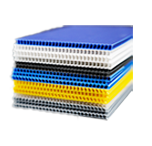
- Two outer face sheets — flat or bubble-finished PP surfaces that provide impact resistance, weatherproofing, and a clean appearance.
- One honeycomb core — a grid of hexagonal PP cells (cell diameter typically 8–14 mm) bonded between the faces, creating thousands of vertical load-bearing columns per square meter.
This is fundamentally different from a hollow (twin-wall) sheet, which uses parallel rectangular chambers, or a corrugated sheet, which uses a single-wall sinusoidal profile. The hexagonal cell distributes compressive force across six walls simultaneously — no single wall carries the full load, no single failure point compromises the panel.
Practical implication: If your application involves stacking, palletizing, or any vertical load — honeycomb is the only PP sheet structure engineered for that specific force vector. Hollow and corrugated sheets are designed for flexural loads (bending), not compressive loads (crushing).
Specifications
| Parameter |
Value |
| Material |
Polypropylene Copolymer (PP) |
| Core Structure |
Hexagonal honeycomb |
| Cell Diameter |
8 / 10 / 12 / 14 mm |
| Thickness Range |
5 / 8 / 10 / 12 / 15 / 20 / 25 / 30 mm |
| Standard Sheet Size |
1220 × 2440 mm (4 × 8 ft) |
| Custom Sheet Size |
Up to 2100 × 6000 mm |
| Surface Finish |
Flat / Bubble (embossed) |
| Face Sheet Color |
White, Black, Blue, Gray, Custom |
| Compression Strength (10 mm) |
≥ 0.8 MPa |
| Bending Stiffness (10 mm) |
≥ 15 N·m |
| Moisture Absorption |
< 0.02% |
| Operating Temperature |
-20°C to +80°C |
| Chemical Resistance |
Acids (pH 2–12), Alkalis, Salts |
| Recyclable |
✅ (#5 PP) |
| OEM/ODM |
Support |
| MOQ |
None |
Honeycomb vs Hollow vs Corrugated — Three Structures, Three Jobs
Most buyers encountering PP sheet products for the first time assume that “honeycomb,” “hollow,” and “corrugated” are different words for the same thing. They are not. Each structure is optimized for a different primary load:
| Property |
Honeycomb Board |
Hollow Sheet |
Corrugated Sheet |
| Core Structure |
Hexagonal cells |
Rectangular chambers |
Sinusoidal single wall |
| Primary Load Vector |
Compression (vertical) |
Flexural (bending) |
| Compression Strength |
★★★★★ |
★★☆☆☆ |
★★☆☆☆ |
| Bending Stiffness |
★★★★☆ |
★★★★★ |
★★★☆☆ |
| Weight (per m², 5 mm) |
~750 g |
~800 g |
~650 g |
| Max Thickness Available |
5–30 mm |
2–12 mm |
2–10 mm |
| Surface Finishes |
Flat / Bubble |
Flat only |
Flat only |
| Best For |
Stacking, partitions, bulkheads |
Signage, printing, displays |
Protection, packaging wraps |
| Price Range (per sheet) |
$4–18 |
$2–10 |
$1.50–8 |
| Recyclable |
✅ (#5 PP) |
✅ (#5 PP) |
✅ (#5 PP) |
Decision rule: If your project involves stacking weight on the panel (bulkheads, partitions, load-bearing dividers), choose honeycomb. If your project involves bending the panel (signs, printed displays), choose hollow. If your project involves wrapping or protecting surfaces (floor covers, wall guards), choose corrugated.
Need hollow or corrugated sheets instead? For signage, printing, and display applications, see our PP Hollow Board — the signage & display specialist. For surface protection and packaging wraps, see our PP Corrugated Sheet — the versatile workhorse.
Key Features of PP Honeycomb Board
Hexagonal Compression Strength — 3× Hollow Sheet
The defining advantage of honeycomb structure is compression resistance. Each hexagonal cell acts as a miniature column, transferring vertical force through six walls simultaneously rather than a single wall or a sinusoidal curve.
Typical compression performance at 10 mm thickness:
- PP honeycomb board: ≥ 0.8 MPa (8.2 t/m²)
- PP hollow sheet: ≈ 0.25 MPa (2.6 t/m²)
- Corrugated cardboard: ≈ 0.15 MPa (1.5 t/m²)
This 3× compression advantage makes honeycomb the only PP sheet structure suitable for stacked load applications — automotive bulkheads that must resist cargo shift forces, partition walls that bear their own weight across spans, and packaging dividers that separate heavy components in transit.
Lightweight at Scale — 50% Lighter Than Wood, 20% Lighter Than Hollow Sheet
Despite its compression superiority, honeycomb board achieves this strength with less material per cubic centimeter than a solid panel of equivalent rigidity:
- 50% lighter than wood panels (MDF, plywood) at the same thickness — reducing shipping costs, simplifying manual handling, and lowering vehicle fuel consumption in automotive applications.
- 20% lighter than PP hollow sheet at the same compression rating — because the hexagonal geometry uses material more efficiently than rectangular chambers.
- 70% lighter than solid PP sheet at equivalent bending stiffness — the honeycomb core acts as a spacer that maximizes the moment of inertia without adding mass.
In automotive and logistics applications, every kilogram saved translates directly to fuel savings and payload capacity. A honeycomb partition wall that replaces a 12 kg plywood bulkhead with a 6 kg PP panel saves 6 kg per vehicle — multiplied across a fleet of thousands, the annual fuel savings are substantial.
Flat & Bubble Surface Finishes
PPBOXY honeycomb board is available in two surface configurations:
- Flat finish: Smooth, uniform surface ideal for laminating, printing, or applying adhesive-backed graphics. Preferred for visible interior applications like office partitions and display backing.
- Bubble (embossed) finish: Textured surface with a subtle dimpled pattern that hides minor scratches and scuffs. Preferred for high-traffic applications like warehouse partitions and automotive bulkheads where cosmetic wear is expected.
Both finishes provide the same structural performance — the choice is purely aesthetic and functional based on the end-use environment.
Waterproof, Chemical & Corrosion Resistant
As a closed-cell polypropylene structure, honeycomb board is inherently:
- Waterproof: Zero moisture absorption (< 0.02% by weight) even after 72-hour immersion at 23°C. Will not swell, warp, or lose structural integrity in humid environments — unlike MDF (6–9% moisture absorption) or plywood (8–12%).
- Chemical resistant: Resistant to acids (pH 2–12), alkalis, salts, and most organic solvents. Suitable for use in chemical processing plants, battery compartments, and marine environments.
- Corrosion proof: No metal components, no rust, no galvanic corrosion. Will not corrode in contact with aluminum or steel frames — a critical advantage in automotive body-in-white applications where dissimilar metal contact is common.
Applications: Where Honeycomb Structure Is Non-Negotiable
Automotive Bulkheads & Interior Partitions
In vehicle manufacturing, bulkheads must simultaneously satisfy three demands: structural rigidity (resist cargo shift forces during braking), weight minimization (every kilogram impacts fuel economy and payload), and moisture resistance (spills, condensation, and wash-down procedures).
PP honeycomb board is the standard material for this application because it is the only PP sheet structure that meets the compression requirement. Hollow and corrugated sheets flex under cargo shift loads — honeycomb resists them.
Common automotive applications:
- Cargo area bulkheads and partition walls
- Seat back panels and interior trim substrates
- Underbody shields and wheel well liners
- Battery compartment enclosures (EV applications)
Related product: For fire-rated automotive partitions, see our PP Flame Retardant Board — UL 94 V-0 rated for engine bay and battery compartment applications.
Construction Partitions & Wall Panels
Temporary and permanent partition walls in commercial and industrial buildings require panels that are self-supporting (minimal framing), lightweight (reduced structural load on floors), and moisture-proof (no mold growth in humid climates).
PP honeycomb board replaces traditional partition materials with measurable advantages:
- vs. Gypsum board: 70% lighter, waterproof (gypsum crumbles when wet), and installable without wet trades (mud, tape, sanding).
- vs. Plywood: No formaldehyde off-gassing, no rot, no termite risk. Fully recyclable at end of life.
- vs. Glass partition: Fraction of the cost, zero breakage risk, and comparable acoustic dampening when paired with insulation.
Heavy-Duty Packaging & Load-Bearing Dividers
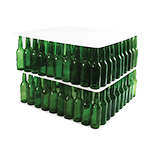
When packaging heavy components — automotive parts, industrial equipment, glass bottles, or electronics — internal dividers must bear the weight of adjacent products without collapsing. This is a compression load, not a bending load, which means hollow sheet dividers will fail where honeycomb dividers perform.
PPBOXY honeycomb board is used as:
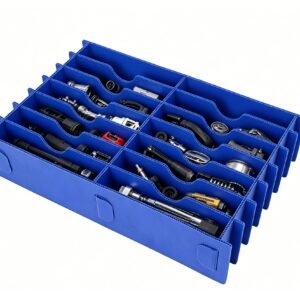
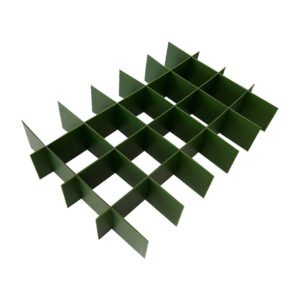
- Layer pads for stacking heavy products in export packaging (see our Plastic Layer Pads for standard-weight applications)
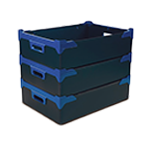
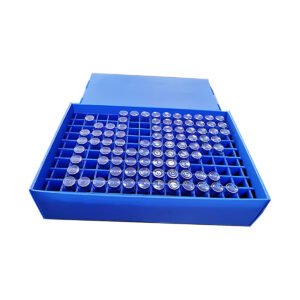
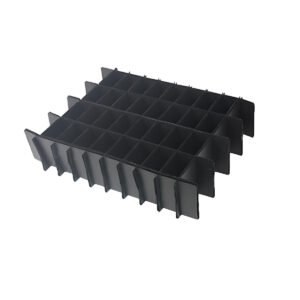
- Vertical dividers in returnable transport packaging (RTP) that must resist lateral forces during transit
- Base panels in large custom boxes that must support the entire weight of the packaged product
Signage Backing & Display Structures
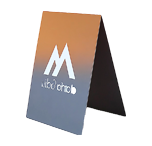
For large-format signage and display structures, honeycomb board serves as a rigid backing substrate — providing dimensional stability without the weight of solid plastic or the warping tendency of foam board.
- Trade show booth walls: Lightweight panels that can be assembled by one person, printed with high-resolution graphics via UV flatbed printing.
- Retail display backdrops: Rigid, warp-free backing for freestanding POP displays.
- Outdoor sign backing: Weatherproof substrate for coroplast-faced signs that require additional rigidity in high-wind environments.
Note: For most standard signage applications (yard signs, real estate signs, directional signs), our PP Hollow Board is the more cost-effective choice. Honeycomb is justified only when the sign must span a large area without sagging or when additional wind-load rigidity is required.
Frequently Asked Questions
Q1: What is the difference between PP honeycomb board and PP hollow sheet? A1: The core structure. PP honeycomb board uses a hexagonal cell core (like a beehive) that distributes compressive force across six walls per cell — making it 3× stronger under vertical loads. PP hollow sheet uses parallel rectangular chambers optimized for bending stiffness and printability, making it the better choice for signage and display. If your application involves stacking or load-bearing, choose honeycomb. If it involves printing or bending, choose hollow.
Q2: What compression strength does PP honeycomb board achieve? A2: Typical compression strength at 10 mm thickness is ≥ 0.8 MPa (approximately 8.2 tonnes per square meter). This is roughly 3× the compression strength of a standard PP hollow sheet at equivalent thickness. Exact values vary by cell size, face sheet thickness, and core density — contact us with your load requirements for a precise specification.
Q3: Can PP honeycomb board be used for automotive bulkheads? A3: Yes. PP honeycomb board is widely used in automotive cargo area bulkheads, seat back panels, and interior partitions. It meets the three critical requirements for this application: structural rigidity under cargo shift forces, weight minimization for fuel economy, and moisture resistance for wash-down procedures. For engine bay or battery compartment bulkheads that require fire resistance, use our PP Flame Retardant Board (UL 94 V-0 rated) instead.
Q4: What thicknesses and cell sizes are available? A4: PPBOXY offers PP honeycomb board in thicknesses from 5 mm to 30 mm. Cell diameters range from 8 mm to 14 mm depending on thickness and application requirements. Surface finishes are available in flat and bubble (embossed) options. Custom dimensions up to 2100 × 6000 mm are available — standard sheet size is 1220 × 2440 mm (4 × 8 ft).
Q5: Is PP honeycomb board recyclable? A5: Yes. PP honeycomb board is made from 100% polypropylene (recycling code #5), the same resin in both the face sheets and the core. It can be ground and reprocessed into new PP products through standard plastics recycling streams. There are no mixed materials, adhesives, or contaminants that would complicate the recycling process.
PP Honeycomb Board