What Makes PP Flame Retardant Board Fire-Safe?
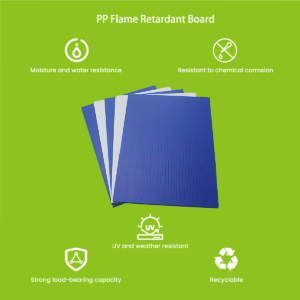
A PP flame retardant board is a corrugated polypropylene sheet treated with fire-retardant additives that achieve self-extinguishing performance — the board will not sustain combustion once the ignition source is removed. This is fundamentally different from “fire-resistant” materials that merely slow flame spread; a self-extinguishing board actively stops burning.
How flame retardancy works in PP:
Untreated polypropylene has a Limiting Oxygen Index (LOI) of approximately 17–18%, meaning it will burn in normal atmospheric air (21% oxygen). Flame retardant PP achieves an LOI of 28–32% through one of two additive systems:
- Halogenated systems (brominated or chlorinated): Effective at low loading rates (5–10%) but produce toxic, corrosive smoke when burned. Increasingly restricted in building codes (EU RoHS, IEC 61249-2-21 halogen-free requirements).
- Halogen-free systems (aluminum trihydrate ATH / magnesium hydroxide MDH): Require higher loading rates (40–60%) but produce no halogenated smoke. ATH releases water vapor at ~200°C, diluting flammable gases. MDH decomposes at ~340°C, forming a magnesium oxide char layer that insulates the underlying polymer.
PPBOXY uses halogen-free flame retardant systems exclusively. This means our PP flame retardant board produces low smoke, zero halogen gases, and no corrosive hydrogen chloride — critical for enclosed spaces where smoke inhalation, not flame contact, is the primary cause of fire fatalities.
UL 94 Vertical Burn Test — What V-0 Means:
UL 94 is the most widely referenced flammability standard for plastic materials. The Vertical Burn (V) test classifies materials by afterflame time and whether they produce flaming drips that ignite cotton:
| UL 94 Rating |
Afterflame Time (per ignition) |
Total Afterflame (10 ignitions) |
Flaming Drips |
Cotton Ignition |
| V-0 |
≤ 10 seconds |
≤ 50 seconds |
Allowed |
❌ No |
| V-1 |
≤ 30 seconds |
≤ 250 seconds |
Allowed |
❌ No |
| V-2 |
≤ 30 seconds |
≤ 250 seconds |
Allowed |
✅ Yes |
| HB (horizontal) |
Burns slowly, < 76 mm/min |
— |
— |
— |
PPBOXY’s PP flame retardant board achieves UL 94 V-0 — the highest vertical burn classification. After the flame is removed, the board self-extinguishes within 10 seconds, produces no cotton-igniting drips, and does not propagate flame across the surface.
Why this matters for your project: Many building codes (IBC, NFPA 5000, EN 13501-1) require interior finish materials to meet specific flame spread and smoke development indices. A V-0 rated board provides the documentation basis for fire safety compliance — something untreated PP, cardboard, or standard foam board cannot offer.
Looking for PP board without fire-rating requirements? Our PP Hollow Board covers signage, display, and general-purpose applications. Our High-Strength PP Board addresses impact resistance and recycled-content requirements.
Specifications
| Specification |
Details |
| Material |
Flame-Retardant Polypropylene (PP) Corrugated Sheet |
| Flame Retardant System |
Halogen-free (ATH / MDH) |
| UL 94 Rating |
V-0 (self-extinguishing ≤10 sec, no flaming drips) |
| LOI (Limiting Oxygen Index) |
28–32% |
| Halogen Content |
<50 ppm (IEC 61249-2-21 compliant) |
| Smoke Density (ASTM E662) |
<300 specific optical density @ 4 min |
| Thickness |
2, 3, 4, 5, 6, 8, 10, 12 mm |
| Standard Sheet Size |
1220 × 2440 mm (4×8 ft) |
| Custom Sheet Size |
Up to 2100 × 6000 mm |
| Colors |
White, Blue, Custom (including fire-safety red/orange) |
| Temperature Range |
−20°C to +80°C |
| Moisture Absorption |
<0.03% |
| Chemical Resistance |
Inert to most acids, alkalis, solvents |
| Recyclable |
✅ (#5 PP) |
| OEM/ODM |
Available |
| MOQ |
None |
Flame Retardant PP Board vs Conventional Fire-Resistant Materials
Fire-resistant materials are not interchangeable. A material that “doesn’t burn” may still fail your project if it is too heavy, too brittle, too expensive, or produces toxic smoke. The table below compares PP flame retardant board against the four materials most commonly specified as fire-resistant interior finishes.
| Property |
PP Flame Retardant Board |
Gypsum Board (Drywall) |
Calcium Silicate Board |
Flame Retardant MDF |
Magnesium Oxide Board |
| Fire Rating |
UL 94 V-0 |
Type X: 1-hr rated |
Class A (non-combustible) |
Class B/C (depends) |
Class A (non-combustible) |
| Self-Extinguishing |
✅ |
✅ (calcined) |
✅ |
⚠️ Additive-dependent |
✅ |
| Smoke Development |
Low (halogen-free) |
Low |
Very low |
High (thick smoke) |
Low |
| Weight (4×8 ft sheet, 5mm) |
1.2–1.8 kg |
8–12 kg |
10–15 kg |
12–18 kg |
9–14 kg |
| Water Resistance |
✅ Waterproof |
❌ Crumbles when wet |
✅ Water-resistant |
❌ Swells, mold growth |
✅ Water-resistant |
| Chemical Resistance |
✅ Inert to most chemicals |
❌ Dissolves in water |
⚠️ Moderate |
❌ Surface damage |
⚠️ Moderate |
| Cut/Install |
Utility knife, no dust |
Score & snap, silica dust |
Power tools, silica dust |
Power tools, formaldehyde dust |
Power tools, silica dust |
| Flexibility |
✅ Can be curved |
❌ Brittle |
❌ Brittle |
❌ Brittle |
❌ Brittle |
| Reusable |
✅ 50–200+ cycles |
❌ Single use |
❌ Single use |
❌ Single use |
❌ Single use |
| Recyclable |
✅ (#5 PP) |
⚠️ Limited |
⚠️ Limited |
❌ (formaldehyde glue) |
⚠️ Limited |
| Typical Cost/sheet (4×8 ft) |
$8–20 |
$6–12 |
$12–25 |
$10–18 |
$10–20 |
Where PP Flame Retardant Board Wins
- Wet or humid environments — Gypsum and MDF fail when wet; PP is waterproof. This includes bathrooms, kitchens, basements, cold storage, and exterior soffits.
- Retrofit and renovation — At 1.2–1.8 kg per sheet, PP board can be installed by one person without structural reinforcement. Gypsum, calcium silicate, and MgO boards weigh 5–10× more and often require two-person handling or mechanical lifts.
- Clean installation — PP cuts with a utility knife and produces zero dust. Gypsum, calcium silicate, and MgO boards all generate silica dust when cut, requiring respiratory protection and cleanup.
- Reusable temporary partitions — Construction sites, events, and warehouses that need fire-rated partitions for weeks or months, then remove and reuse them elsewhere. All mineral-based boards are single-use.
Where Conventional Materials Still Lead
- Fire-rated walls (1–3 hour assemblies) — PP board is a surface material, not a structural fire barrier. For through-penetration fire stops and rated wall assemblies, gypsum, calcium silicate, or MgO boards are the correct specification.
- Non-combustible requirements — Some codes (e.g., elevator shafts, stairwell enclosures) require non-combustible (Class A per ASTM E136) materials. PP is combustible with self-extinguishing treatment — it cannot meet non-combustible classification.
Decision rule: If your project needs a lightweight, waterproof, cut-with-a-knife fire-rated surface material for interior finishes, PP flame retardant board is the only option that satisfies all four requirements simultaneously. If you need a structural fire barrier or non-combustible classification, use mineral-based boards instead.
Key Features of PP Flame Retardant Board
Self-Extinguishing (UL 94 V-0)
The board self-extinguishes within 10 seconds of flame removal, producing no flaming drips that could ignite secondary fires. This is the highest vertical burn classification available for a thermoplastic material. Each batch ships with a UL 94 test report documenting the rating — required documentation for building inspection and fire marshal approval.
Halogen-Free & Low Smoke
PPBOXY uses halogen-free ATH/MDH flame retardant systems exclusively. When exposed to fire, the board releases water vapor (from ATH decomposition) and forms a magnesium oxide char layer (from MDH) — not hydrogen chloride, hydrogen bromide, or other halogenated gases. This is critical in enclosed spaces where smoke toxicity is the primary life-safety hazard.
- Smoke density: Low (ASTM E662, <300 specific optical density at 4 minutes for halogen-free PP)
- Halogen content: <50 ppm (IEC 61249-2-21 compliant)
- Toxicity: No HCl, HBr, or dioxin precursors
Moisture & Chemical Proof
The polypropylene substrate absorbs less than 0.03% moisture by weight — making the board impervious to water, humidity, condensation, and washdown procedures. It is also inert to most acids, alkalis, and organic solvents, making it suitable for chemical plants, food processing areas, and pharmaceutical cleanrooms where mineral-based boards would degrade.
Lightweight & Easy to Install
A standard 1220 × 2440 mm (4×8 ft) sheet at 5 mm thickness weighs approximately 1.2–1.8 kg — light enough for single-person handling and overhead installation without mechanical assistance. The board cuts with a utility knife or scissors, produces zero dust, and can be mechanically fastened (screws, rivets) or adhesive-bonded. No special tools, no respiratory protection, no cleanup.
Applications: Where Fire-Rated PP Board Is Required
Construction & Building Interiors
Interior wall partitions, ceiling soffits, and service riser enclosures in commercial buildings where fire-rated surface materials are specified. PP flame retardant board is particularly effective in wet areas (bathrooms, commercial kitchens, pool enclosures) where gypsum board would require secondary waterproofing — adding cost and complexity. The board can be directly tiled over, painted, or laminated.
Also useful for: Temporary fire-rated hoarding during construction — installed, removed, and reused on the next project.
Electrical & Control Panels
Enclosure linings and internal dividers in electrical panels, switchgear cabinets, and junction boxes. PP flame retardant board provides the self-extinguishing performance required by IEC 60695 and NFPA 70 (NEC) for electrical equipment enclosures, with the added advantage of zero conductivity and zero moisture absorption — preventing tracking and short-circuits that metal or mineral boards can enable.
Automotive Interior & Engine Bay
Interior panel liners, cabin partitions, and under-hood thermal barriers in buses, trains, and commercial vehicles. PP flame retardant board meets FMVSS 302 (US) and ECE R118 (EU) flammability requirements for vehicle interior components. The lightweight structure contributes to fuel efficiency — a full bus interior conversion using PP board saves 40–60 kg versus mineral fiber panels.
Warehouse & Logistics Partitioning
Fire-rated partition walls in warehouses, distribution centers, and cold storage facilities where building codes require fire separation between storage zones. PP flame retardant board is waterproof (suitable for cold storage), lightweight (installable without disrupting operations), and reusable (can be relocated when layout changes). For warehouse storage containers, see our Corrugated Plastic Storage Boxes.
Public Venue & Transit
Wall and ceiling linings in stadiums, airports, transit stations, and theaters where both fire safety and moisture resistance are required. Public venues face high humidity from crowd density, frequent washdown cleaning, and often exposed exterior connections — conditions that degrade gypsum and MDF but have no effect on PP. The halogen-free formulation ensures that if a fire occurs, smoke toxicity is minimized in high-occupancy evacuation scenarios.
Frequently Asked Questions
Q1: What is the difference between flame retardant and fire-resistant?
“Flame retardant” means the material is treated to resist ignition and self-extinguish when the flame source is removed (e.g., UL 94 V-0 rated PP board). “Fire-resistant” typically refers to materials that can withstand exposure to fire for a rated time period (e.g., 1-hour fire-rated gypsum wall assembly). PP flame retardant board is a self-extinguishing surface material — it is not a structural fire barrier.
Q2: Is PP flame retardant board the same as fire-rated gypsum board?
No. PP flame retardant board is a lightweight, waterproof, self-extinguishing surface material. Gypsum board is a heavy, mineral-based fire barrier rated for structural fire endurance (1–3 hours). They serve different purposes: PP board for interior surface finishes in wet or lightweight applications; gypsum board for structural fire-rated wall assemblies.
Q3: Does flame retardant PP board produce toxic smoke when burned?
PPBOXY’s flame retardant PP board uses halogen-free additives (ATH/MDH) exclusively. When exposed to fire, it releases water vapor and forms a protective char — not hydrogen chloride, hydrogen bromide, or dioxin precursors. Smoke density is low per ASTM E662. This is a critical advantage over halogenated flame retardant systems and over MDF (which produces thick, toxic smoke from formaldehyde-based adhesives).
Q4: Can PP flame retardant board be used outdoors?
Yes. The PP substrate is inherently UV-stable when formulated with UV inhibitors (available on request). It is waterproof, dimensionally stable from −20°C to +80°C, and resistant to most environmental chemicals. For long-term outdoor signage applications, see our PP Hollow Board with UV-stability specifications.
Q5: What thickness of flame retardant board do I need?
This depends on the application and fire rating requirement. For interior wall partitions, 3–5 mm is typically sufficient. For ceiling panels and soffits, 4–6 mm provides additional rigidity. For electrical panel linings and automotive partitions, 2–4 mm is standard. For warehouse partitioning that must span floor-to-ceiling, 6–10 mm with structural framing is recommended. All thicknesses from 2 mm to 12 mm are available — contact us with your project specifications for a recommendation.
 PP Flame Retardant Board