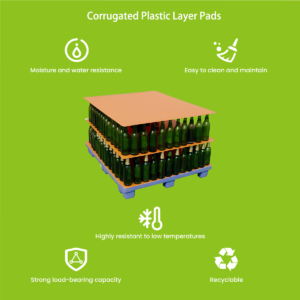
Corrugated Plastic Layer Pads — Temperature-Resistant Pallet Separation
Most pallet layer pads fail at temperature extremes. Cardboard absorbs moisture and collapses in cold storage. Cheap plastic sheets become brittle in freezers and warp in heat. PPBOXY’s وسائد من البلاستيك المموج are engineered to perform from -30°C to +80°C — from deep-freeze food logistics to hot manufacturing environments — without losing dimensional stability, compression strength, or surface integrity.
Manufactured from high-strength, food-grade polypropylene, these layer pads combine the structural rigidity of corrugated design with the extreme-temperature tolerance that only PP can deliver. Reusable up to 50 times, they eliminate the recurring cost and waste of single-use cardboard separators.
Why operations choose PPBOXY corrugated layer pads:
- -30°C to +80°C operating range — freezer to factory floor, one pad works everywhere
- 50x reuse — amortised cost per trip is a fraction of disposable alternatives
- Sealed edges — prevent dust, moisture, and contamination ingress between layers
- Weight distribution — disperses load across pallet surface, reducing product damage
- Fully recyclable — 100% PP at end of life
المواصفات الفنية
| المعلمة |
Spec |
| المواد |
Food-grade polypropylene corrugated board |
| نطاق درجات الحرارة |
-30°C to +80°C |
| دورات إعادة الاستخدام |
Up to 50 times |
| Edge Finish |
Sealed edges (hygiene) / Standard |
| السطح |
Smooth / Anti-slip |
| مقاومة الرطوبة |
100% مقاوم للماء |
| المقاومة الكيميائية |
Resists oils, mild acids, alkalis |
| سلامة الأغذية |
FDA 21 CFR / EU 10/2011 |
| التخصيص |
Size, color, thickness |
| قابلية إعادة التدوير |
100% PP — resin code 5 |
التطبيقات الصناعية
Glass Bottle Industries: Breweries, wineries, and beverage manufacturers. Layer pads stabilize bottle pallets through cold storage and distribution. PP material unaffected by condensation and bottle sweat.
Electronics Manufacturing: Protect sensitive components from static, impact, and dust during intra-facility transport. Sealed edges prevent particulate contamination.
Food & Pharmaceutical: Food-grade PP with sealed edges meets hygiene requirements. Compatible with cold chain and ambient distribution.
For complementary layer pad options, see our وسادات ذات طبقة بلاستيكية من مادة البولي بروبيلين (PP) for bottle palletizing and وسادات بلاستيكية واقية for heavy-duty applications.
Corrugated Plastic Layer Pads vs Cardboard Layer Pads
| ميزة |
وسائد بلاستيكية مموجة |
Cardboard Layer Pads |
| مقاوم للماء |
✓ |
✗ |
| قابل لإعادة الاستخدام |
✓ |
✗ |
| Washable |
✓ |
✗ |
| Food-Grade Available |
✓ |
محدود |
| Sealed Edge Option |
✓ |
✗ |
| المقاومة الكيميائية |
✓ |
✗ |
| العمر التشغيلي |
Long-Term |
للاستخدام مرة واحدة |
| Hygiene Performance |
ممتاز |
معتدل |
Why PPBOXY
Extreme temperature performance. -30°C to +80°C under one SKU — no need to stock different pads for cold storage and ambient warehouse.
50x reusability. Design life that pays for itself within the first few rotation cycles.
مباشرة من المصنع. Custom sizes, colors, and edge finishes without distributor delays.
Need layer pads that handle your temperature range? اطلب عرض أسعار — tell us your pallet size and operating conditions.
الأسئلة الشائعة
Q1: What temperature range do corrugated plastic layer pads support?
-30°C to +80°C. This covers deep-freeze cold storage, refrigerated transport, ambient warehouses, and hot manufacturing environments — all with a single pad specification.
Q2: How many times can they be reused?
Up to 50 times under normal handling. The corrugated PP structure resists impact, moisture, and chemical exposure that would degrade cardboard after a single use.
Q3: What are sealed edges and why do they matter?
Sealed edges close the open flutes (channels) at the pad perimeter, preventing dust, moisture, and contaminants from entering. Critical for food, pharmaceutical, and electronics applications.
Q4: Can I get custom sizes?
Yes. We manufacture to your exact pallet footprint — standard EUR/ISO pallets or custom dimensions.
Q5: Are they food-safe?
Yes. FDA 21 CFR and EU 10/2011 compliant for indirect food contact. Documentation available.
Q6: How do they compare to cardboard layer pads in cost?
Upfront cost is higher, but 50x reuse delivers per-trip costs well below single-use cardboard — while eliminating cardboard disposal costs and product damage from pad failure.