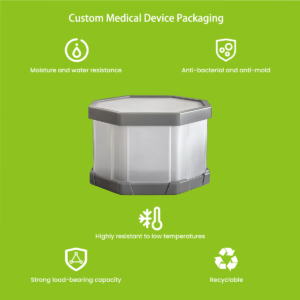
Emballages sur mesure pour dispositifs médicaux — Pas une simple boîte, mais un système d'emballage validé
L'emballage des dispositifs médicaux n'est pas un produit de base. Une prothèse de hanche emballée dans une boîte qui se déforme sous l'effet de la chaleur de stérilisation peut arriver au bloc opératoire avec une barrière stérile compromise — et cette compromission peut entraîner l'annulation d'une intervention chirurgicale, coûter des milliers à l'hôpital en temps de bloc perdu et déclencher un rapport à la FDA sur les dispositifs médicaux. C’est pourquoi l’emballage des dispositifs médicaux est considéré comme faisant partie intégrante du dossier de contrôle de la conception du dispositif, conformément à la norme FDA 21 CFR Partie 820 et à la norme ISO 13485, et non comme un élément secondaire relevant du service expédition.
Le service d'emballage sur mesure pour dispositifs médicaux de PPBOXY conçoit, prototypise et fabrique des systèmes d'emballage en polypropylène ondulé adaptés à la géométrie spécifique de votre dispositif, à sa méthode de stérilisation et à son parcours réglementaire. À partir du fichier CAO de votre dispositif ou d'un échantillon physique, nous concevons un emballage qui :
- Préserve l'intégrité de la barrière stérile lors des cycles de stérilisation à l'oxyde d'éthylène, aux rayons gamma, par faisceau d'électrons ou à la vapeur
- Protège l'appareil contre les dommages physiques pendant le transport (conforme aux normes ISTA 3A ou ASTM D4169)
- S'adapte parfaitement à l'appareil, ce qui évite les espaces vides susceptibles de générer des particules dans les salles blanches
- Livré avec une traçabilité complète de la documentation : certificats des matériaux, déclarations de compatibilité à la stérilisation, certificat de conformité (CoC) selon la norme ISO 13485
Cette page concerne le service sur mesure : un emballage conçu spécialement pour votre appareil, et non un produit standard. Pour les formats d'emballage médicaux standard, consultez le tableau comparatif ci-dessous.
| Produit |
Sur mesure ou standard ? |
Une barrière stérile ? |
Idéal pour |
Aller à |
| Emballages sur mesure pour dispositifs médicaux |
✅ Sur mesure — conçu selon les plans CAO de votre appareil |
✅ Conception avec système de barrière stérile disponible |
Implants, kits chirurgicaux, instruments de diagnostic |
Cette page |
| Emballage des dispositifs médicaux |
Formats standard |
Facultatif |
Transport de dispositifs médicaux en général |
Emballage des dispositifs médicaux → |
| Emballage de matériel médical |
Formats standard |
Facultatif |
Protection des équipements médicaux de grande taille |
Emballage de matériel médical → |
| Emballages pharmaceutiques en PP |
Standard + sur mesure |
Facultatif |
Conditionnement des produits pharmaceutiques, des médicaments et des remèdes |
Emballages pharmaceutiques en PP → |
| Séparateurs pour Cryobox |
Standard |
N/A |
Stockage dans des flacons cryogéniques (−80 °C/−196 °C) |
Séparateurs pour Cryobox → |
Le processus de développement des emballages pour dispositifs médicaux — De la conception au système validé
PPBOXY suit un processus de développement par étapes conforme aux exigences en matière de contrôle de la conception des dispositifs médicaux :
Phase 1 : Analyse des appareils et définition des besoins
Vous nous fournissez le fichier CAO du dispositif, un échantillon physique ou un plan coté. Nous documentons : la géométrie et la masse du dispositif, les points de fragilité, la méthode de stérilisation (EtO / rayons gamma / faisceau d'électrons / vapeur), la classification de la salle blanche (ISO 5–8), le niveau d’emballage (barrière stérile primaire, protection secondaire, emballage tertiaire d’expédition), le cadre réglementaire (FDA 510(k)/PMA, RDM de l’UE, MDSAP) et l’environnement de distribution cible.
Phase 2 : Choix des matériaux et conception préliminaire
En fonction des exigences, nous précisons : le type de PP (vierge de qualité médicale, antistatique ou ESD), l'épaisseur de la feuille et la géométrie des cannelures, le traitement de surface (traitement corona pour l'impression, revêtement antistatique), la configuration de la barrière stérile (insert de sachet scellé, plateau à couvercle compatible avec les couvercles en Tyvek, système stérile à double emballage) et les éléments de fixation internes (inserts en PP découpés à l'emporte-pièce, coussins en mousse, clips de retenue).
Phase 3 : Prototypage et validation de l'ajustement
Un prototype de système d'emballage est fabriqué et vous est expédié afin que vous puissiez effectuer des tests d'ajustement et de fonctionnement. Vous vérifiez : que le dispositif s'adapte correctement, que la barrière stérile est bien scellée, que le cycle de stérilisation se déroule sans altération de l'emballage et que celui-ci résiste aux tests de distribution simulés.
Phase 4 : Validation et documentation
Nous fournissons l'ensemble complet de la documentation : certifications des matériaux (FDA 21 CFR 177.1520, classe VI de l’USP, biocompatibilité selon la norme ISO 10993, le cas échéant), une déclaration de compatibilité à la stérilisation, un certificat de conformité à la norme ISO 13485, un certificat de fabrication en salle blanche (le cas échéant) et un certificat d’analyse pour chaque lot de production.
Phase 5 : Production et approvisionnement continu
Les séries de production bénéficient d'une traçabilité au niveau des lots. PPBOXY conserve les fichiers de conception des emballages et peut reproduire votre système d'emballage validé à la demande — sans délai lié au réoutillage ni quantité minimale de commande après la validation initiale.
Compatibilité avec la stérilisation — Quelle méthode votre dispositif nécessite-t-il ?
| Méthode de stérilisation |
Compatibilité avec le PP |
Points clés à prendre en compte |
Appareils courants |
| EtO (oxyde d'éthylène) |
✅ Entièrement compatible |
Le PP est perméable au gaz d'EtO — permet la stérilisation du dispositif à l'intérieur d'un sachet scellé ; nécessite un cycle d'aération après la stérilisation |
Implants, cathéters, trousses chirurgicales, dispositifs médicaux électroniques |
| Irradiation gamma |
✅ Compatible (PP standard) |
Le PP subit une réticulation mineure du polymère — aucune modification significative des propriétés n'est observée aux doses standard (25 à 50 kGy) ; il convient d'utiliser du PP de qualité radiologique pour les applications à forte dose. |
Instruments chirurgicaux à usage unique, fils de suture, champs opératoires, blouses |
| Faisceau d'électrons (E-Beam) |
✅ Compatible |
Similaire au rayonnement gamma mais avec un débit de dose plus élevé — le PP offre des performances équivalentes ; traitement plus rapide |
Dispositifs jetables à grand volume |
| Autoclave à vapeur |
⚠️ Attention — Le PP se ramollit au-delà de 100 °C |
Le PP standard (HDT ~100 °C) n'est pas adapté à l'autoclave à 121 °C/134 °C ; il convient de spécifier un PP résistant aux hautes températures (coût du matériau : +15–25%) pour la stérilisation à la vapeur. |
Instruments chirurgicaux réutilisables (en PP résistant aux hautes températures) |
| Plasma de peroxyde d'hydrogène |
✅ Entièrement compatible |
Procédé à basse température (45–55 °C) — bien dans la plage de fonctionnement du PP |
Dispositifs thermosensibles, endoscopes, instruments chirurgicaux électroniques |
PPBOXY déterminera la qualité de PP adaptée à votre méthode de stérilisation et vous fournira une déclaration de compatibilité à la stérilisation à intégrer à votre dossier historique de conception.
Cadre réglementaire — Documentation à l'appui de votre demande auprès de la FDA ou au titre du RDM de l'UE
| Exigence |
Documentation PPBOXY fournie |
| Biocompatibilité des matériaux |
FDA 21 CFR 177.1520 (contact indirect avec les denrées alimentaires) ; essais conformes à la norme USP Classe VI et à la norme ISO 10993 disponibles sur demande auprès de laboratoires partenaires |
| Système qualité |
Fabrication certifiée ISO 9001 ; documentation attestant la conformité à la norme ISO 13485 disponible |
| Fiche technique du dispositif / Dossier d'historique de conception |
Fiche technique d'emballage, certificats de conformité des matériaux, déclaration de compatibilité à la stérilisation, certificat de conformité par lot |
| FDA 21 CFR, partie 820 (Règlement sur les systèmes qualité) |
Traçabilité au niveau des lots, notification des modifications, documentation relative à la qualification des fournisseurs |
| Règlement européen MDR 2017/745 |
Déclarations relatives aux matériaux, conformité aux réglementations REACH/RoHS, documentation d'accompagnement pour la validation de la stérilisation |
| Essai de distribution ISTA 3A / ASTM D4169 |
Emballage conçu pour répondre aux exigences de conformité ; essais réalisés par le client ou par un laboratoire partenaire de PPBOXY |
Foire aux questions
Q : Quelle est la quantité minimale de commande pour les emballages sur mesure destinés aux dispositifs médicaux ?
Il n'y a pas de quantité minimale stricte pour le développement sur mesure. Nous pouvons réaliser un prototype et produire une seule unité à des fins de validation de l'ajustement et du fonctionnement. La quantité minimale de commande (MOQ) dépend de la complexité : généralement 50 unités pour un emballage simple en PP découpé à l'emporte-pièce, et 200 unités pour des systèmes complexes à plusieurs composants intégrant une barrière stérile. Contactez notre équipe spécialisée dans les emballages médicaux en lui communiquant les spécifications de votre dispositif afin d'obtenir un devis sur mesure pour votre projet.
Q : Combien de temps dure le processus de développement d'un emballage sur mesure ?
Délai habituel entre l'analyse du dispositif et la mise en production validée : 4 à 8 semaines pour un système d'emballage sur mesure standard, 8 à 16 semaines pour les systèmes d'emballage nécessitant une validation de stérilisation, des tests de biocompatibilité ou la coordination complète des essais de distribution ISTA/ASTM. Des délais accélérés sont disponibles pour les projets urgents — contactez-nous pour discuter de vos dates cibles.
Q : Les emballages en PP peuvent-ils servir de système de barrière stérile ?
Oui, à condition que la configuration soit adéquate. Les emballages en polypropylène (PP) ondulé peuvent servir de couche de protection secondaire ou tertiaire dans un système de barrière stérile, la barrière stérile primaire étant assurée par un sachet scellé (Tyvek/PE, feuille d’aluminium ou film PP) ou un plateau muni d’un couvercle à l’intérieur de la boîte en PP. Pour les configurations dans lesquelles la boîte en PP doit elle-même faire partie de la barrière stérile (par exemple, un plateau en PP muni d’un couvercle et d’un joint en Tyvek), PPBOXY spécifiera la nuance de PP et la finition de surface appropriées afin de garantir l’intégrité du joint. Le système d’emballage est validé pour votre méthode de stérilisation spécifique ; il ne s’agit pas d’une allégation générique.
Q : La fabrication en salle blanche est-elle possible pour le conditionnement des dispositifs médicaux ?
Oui. PPBOXY propose des services de fabrication en salle blanche conformes aux normes ISO 7 (classe 10 000) et ISO 8 (classe 100 000) pour le conditionnement de dispositifs médicaux. Veuillez préciser vos exigences en matière de classification de salle blanche dès le lancement du projet. La fabrication en salle blanche entraîne une majoration du coût unitaire d'environ 15 à 251 TP3T et nécessite un délai supplémentaire de 4 semaines pour la planification et la validation des installations.
Q : Est-il possible d'imprimer des codes UDI (identification unique des dispositifs médicaux) sur l'emballage ?
Oui. PPBOXY imprime des marquages conformes à la norme UDI directement sur la surface de l’emballage en PP, notamment l’identifiant du dispositif (DI) et l’identifiant de production (PI) — numéro de lot, numéro de série, date de péremption et date de fabrication — conformément aux exigences de la FDA en matière d’UDI (21 CFR, parties 801 et 830) et de l’annexe VI du Règlement sur les dispositifs médicaux (MDR) de l’UE. Les codes-barres (GS1-128, Data Matrix, QR) sont imprimés avec une qualité lisible par machine, vérifiée par un équipement d’évaluation des codes-barres.
Q : Quelle est la différence entre cette page et la page standard consacrée à l'emballage des dispositifs médicaux ?
La page consacrée aux emballages standard pour dispositifs médicaux présente les formats d'emballage en PP disponibles dans le commerce, adaptés au transport et à la protection des dispositifs médicaux en général. Cette page est consacrée au service d'ingénierie sur mesure : des emballages conçus à partir du fichier CAO de votre dispositif, avec une compatibilité de stérilisation spécifiée, une fabrication en salle blanche, la documentation réglementaire et l'intégration d'un système de barrière stérile. Si vous avez besoin d’un emballage s’adaptant parfaitement à un dispositif existant et accompagné d’une documentation de validation complète, vous êtes sur la bonne page.