PP Corrugated Celery Box — Upright Support, Breathable & Hydrocool-Resistant for Stem Vegetables
The Celery Box, crafted from Polypropylene (PP) Hollow Board, combines lightweight handling, superior strength, and excellent insulation. Designed to meet the needs of the agricultural industry, this box ensures celery stays fresh during storage and transportation. With features like waterproofing, chemical resistance, and breathability, the Celery Box provides a reliable, reusable, and cost-effective solution for farmers, distributors, and retailers.
Key Features That Protect Stem Vegetables in Transit
Celery is not a fruit, a grain, or a root — it is a hollow stem with 95 % water content. That single fact determines every design choice in this box. Bend a stalk and it snaps; let it lose just 2 % of its moisture and it wilts irreversibly; trap ethylene gas around it and the core goes hollow within 48 hours. The PP Corrugated Celery Box is engineered to address all three threats simultaneously.
Vertical cradle design
Internal ribbing and a tall sidewall profile keep stalks upright throughout handling and transport. In a flat-bottom crate, celery naturally leans under vibration, creating pressure points that turn into bruise lines. The vertical support structure prevents that lean, distributing pressure evenly along the full length of each stalk — the same principle used in commercial celery hydrocoolers.
Breathable corrugated walls
The fluted PP structure allows continuous air exchange: oxygen in, ethylene and CO₂ out. Unlike solid-walled plastic crates that trap respiration gases, the Celery Box’s corrugated channels create a passive ventilation system that works even when boxes are tightly stacked on a pallet. This is critical because celery is one of the highest ethylene-sensitive vegetables — even low concentrations accelerate pith formation and yellowing.
Hydrocool-ready construction
After harvest, most commercial celery goes through a hydrocooler — a cold-water spray system that pulls field heat out fast. Conventional cardboard boxes disintegrate under that water load. The PP Celery Box absorbs zero moisture; it enters the hydrocooler and comes out structurally identical, ready for cold storage or direct dispatch. The waterproof surface also prevents water pooling inside the box, which would otherwise accelerate bacterial soft rot at the stalk bases.
Impact dispersion through hollow-core structure
The internal honeycomb geometry of PP hollow board absorbs and distributes impact energy across the panel surface rather than concentrating it at the point of contact. A forklift bump or a box dropped from waist height transmits far less force to the celery inside compared with a rigid plastic or wooden crate — both of which pass shock directly through to the produce.
Industry Applications — Where the Celery Box Performs Best
Commercial farms and packing houses
Large-scale celery operations harvest 40–60 kg bins that are immediately hydrocooled. The PP Celery Box transitions seamlessly from field bin → hydrocooler → cold room → truck without repacking. Its 95 %+ water resistance means no structural degradation through multiple wet cycles per day.
Cold chain distribution and wholesale markets
From refrigerated truck to wholesale floor, the box maintains upright stalk orientation and consistent airflow. Distributors report that upright celery sells faster and at higher price points than horizontally packed stalks, because buyers associate vertical presentation with freshness.
Retail and farm-to-store programs
The Celery Box doubles as a display container at farmers’ markets and grocery backrooms. Its clean, waterproof interior can be presented directly to the customer, eliminating the need to transfer stalks into display trays. Custom-printed branding on the exterior reinforces the grower’s identity at point of sale.
Export and long-distance shipping
For celery crossing borders — whether by sea container or refrigerated air freight — the box’s insulation properties buffer temperature fluctuations during loading, transit, and customs holds. The 8–12 mm air gap within the PP hollow board acts as a thermal break, slowing heat transfer by approximately 40 % compared with single-wall plastic crates.
PP Corrugated Celery Box vs Cardboard & Wooden Crates
| Criteria |
PP Corrugated Celery Box |
Wax-Coated Cardboard Box |
Wooden Crate |
| Water / Hydrocool Resistance |
✅ Fully waterproof — no degradation through repeated wet cycles |
❌ Wax delays but does not prevent breakdown; softens after 2–3 hydrocool passes |
⚠️ Absorbs moisture → warps → splinters → contaminates stalks |
| Upright Stalk Support |
✅ Internal ribbing + tall sidewalls keep celery vertical |
❌ Flat bottom only; sidewalls soften when wet → stalks lean and bruise |
⚠️ Rigid but no internal support; celery still leans |
| Ethylene Ventilation |
✅ Corrugated flutes create passive airflow even when stacked |
❌ Solid walls trap ethylene → pith formation accelerates |
⚠️ Gaps between slats allow some airflow, but inconsistent |
| Weight per Unit (empty) |
✅ 0.8–1.5 kg — easy one-hand carry |
⚠️ 1.0–1.8 kg (dry); heavier when wet |
❌ 3.0–5.0 kg — two-hand lift required |
| Reuse Cycles |
✅ 50–100+ cycles with normal handling |
❌ 1–3 cycles before structural failure |
⚠️ 10–30 cycles; requires sanitization between uses |
| Sanitation / Food Safety |
✅ Non-porous surface; pressure-washable; no microbial absorption |
❌ Porous cardboard absorbs bacteria; cannot be fully sanitized |
❌ Wood grain harbors pathogens; cannot be pressure-washed |
| Stackability When Wet |
✅ No change in compression strength |
❌ Stacking strength drops 60 %+ when saturated |
⚠️ Wet wood swells → stack becomes unstable |
| Custom Ventilation Hole Pattern |
✅ Die-cut to spec at no extra tooling cost for volume orders |
❌ Vent holes weaken already-limited wet strength |
⚠️ Not applicable — gaps between slats are fixed |
| Cost per Use (50 cycles) |
✅ ~$0.10–0.20/cycle |
❌ ~$0.80–1.50/cycle (replaced every 1–3 uses) |
⚠️ ~$0.40–0.80/cycle + sanitization labor |
Key takeaway: Cardboard and wood fail at the exact moment celery needs them most — during and after hydrocooling. The PP Celery Box’s waterproof structure and passive ventilation are not incremental improvements; they are the difference between a crate that protects and a crate that collapses.
Soalan Lazim
Q1: Can the Celery Box go through a hydrocooler? Yes. The PP hollow board is 100 % waterproof and retains full structural integrity through unlimited hydrocool cycles. Unlike wax-coated cardboard, which softens after 2–3 passes, the Celery Box exits the hydrocooler in the same condition it entered.
Q2: How does this box keep celery upright during transport? The box features internal ribbing and a tall sidewall profile that cradles stalks in a vertical position. This prevents the leaning and pressure-point bruising that occurs in flat-bottom crates when vibration causes stalks to shift during transit.
Q3: What is the difference between the Celery Box and the Eggplant Box? Both are made from PP corrugated board, but they solve different problems. The Celery Box is engineered for upright stem support and moisture retention — celery is a hollow stem that wilts at 2 % moisture loss and snaps when bent. The Eggplant Box prioritizes bruise prevention and ethylene ventilation — eggplant skin blackens on contact and the fruit is highly ethylene-sensitive. The Celery Box has taller sidewalls and internal ribbing; the Eggplant Box has wider ventilation channels and a flatter profile.
Q4: Do you offer a Celery Box size that fits standard pallets? Yes. Common configurations include 600 × 400 mm and 800 × 600 mm footprints that fit EUR and US standard pallets. Custom sizes are available with minimum order quantities. Contact us for specifications tailored to your operation.
Q5: Is this box suitable for other stem vegetables like asparagus or rhubarb? Yes. The vertical support and breathable wall design make this box well-suited for any long-stem vegetable that requires upright orientation. For asparagus, which has a longer stalk profile, we offer an extended-height version. See our Asparagus Box for a dedicated solution.
Q6: How many reuse cycles can I expect? With normal commercial handling, 50–100+ cycles. The PP hollow board resists cracking, UV degradation, and chemical exposure. After the box reaches end of life, it is 100 % recyclable into new PP products.
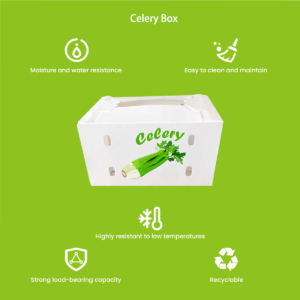 Celery Box