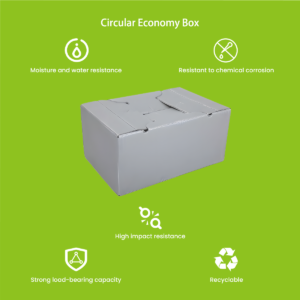
What Does “Circular Economy” Mean for PP Packaging?
The circular economy model replaces the traditional linear “take → make → dispose” supply chain with a closed loop: materials are kept in use at their highest value for as long as possible, then recovered and regenerated at end of life. For polypropylene (PP) corrugated packaging, this means three things in practice:
- Design for multiple use cycles — A PP box designed for 200+ trips replaces 200 cardboard boxes that would each be manufactured, shipped, used once, and landfilled.
- Material recovery at end of life — PP is recycling code #5, one of the most widely recycled plastics globally. PPBOXY’s corrugated PP boxes can be ground, melted, and re-extruded into new PP sheet — without downcycling into lower-grade products.
- Closed-loop take-back — PPBOXY accepts used PP boxes from customers in volume for regrinding and reprocessing back into new PP sheet, completing the material loop within our own manufacturing facility.
This page is not about a single box product. It is about the compliance frameworks, lifecycle data, and recycling infrastructure that make PP corrugated packaging one of the few packaging materials capable of supporting a genuinely circular supply chain. For specific box types — Velcro-closure, foldable, pallet-sized, coaming-rim — the relevant product pages are linked throughout.
| PPBOXY Box Category |
Key Circular Economy Feature |
Pergi ke |
| PP Corrugated Box (Velcro) |
200+ cycles without tape consumables |
PP Corrugated Box → |
| Petak Palet Lipat |
82% collapse ratio — 5.5:1 return logistics efficiency |
Foldable Pallet Boxes → |
| Petak pelindung lipat |
PP honeycomb + dual pallets — 4:1 return ratio, 200–500+ cycles |
Collapsible Coaming Box → |
| PP Corrugated Plastic Box (Overview) |
6 box types — choose the format that maximizes reuse cycles for your operation |
PP Kotak Plastik Bergelombang → |
| Petak Penyimpanan Plastik Bergelombang |
Reusable warehouse storage — replace cardboard bins |
Corrugated Plastic Storage Boxes → |
| Kontena Penghantaran Plastik Tersuai |
OEM design for maximum cycle life in your specific supply chain |
Kontena Penghantaran Plastik Tersuai → |
PP vs Cardboard vs Single-Use Plastic — Lifecycle Comparison
The circular economy argument for PP packaging is quantitative, not aspirational. The table below compares three packaging materials across the full lifecycle — manufacturing, use phase, and end of life:
| Lifecycle Dimension |
PP Kotak Bergelombang |
Petak Kadbod Beralun |
Single-Use Plastic (LDPE/HDPE) Bag or Wrap |
| Raw Material |
Polypropylene resin — fossil-derived but indefinitely recyclable |
Virgin or recycled paper pulp — tree-derived |
Fossil-derived — typically not recycled |
| Manufacturing Energy (MJ per kg) |
~75 MJ/kg (extrusion) |
~25–50 MJ/kg (pulping + forming) |
~80 MJ/kg (film blowing) |
| Use Cycles per Unit |
50–500+ (varies by box type) |
1–3 (structure fails) |
1 (disposed after use) |
| Material Consumed per 100 Uses |
0.2–2 units (one box used 50–500×) |
33–100 units (replaced every 1–3 uses) |
100 units (single use) |
| Pengambilan Air |
< 0.01% absorption — no degradation from moisture |
Absorbs water — collapses when wet, requiring replacement |
Water-resistant but tears easily |
| Ketahanan kimia |
Resistant to oils, acids, alkalis, solvents |
Absorbs oils and solvents — degrades |
Moderate — depends on polymer |
| End-of-Life Recycling |
✅ PP #5 — widely recyclable, can be reground into new PP sheet |
✅ Paper — recyclable 5–7× before fibre degradation |
❌ Typically landfill/incineration (~9% US recycling rate for plastic film) |
| Recycling Infrastructure |
Established — PP #5 accepted in most municipal and industrial streams |
Established — cardboard recycling is globally mature |
Very limited — few facilities accept film |
| Landfill Degradation |
> 500 years (not biodegradable — but designed to be recycled, not landfilled) |
2–6 months (biodegradable but generates methane in anaerobic landfill) |
> 500 years |
| Carbon Footprint (kg CO₂e per box, 1 use) |
~1.5–2.0 kg (amortize over 200 uses → ~0.01 kg/use) |
~0.5–1.0 kg/use |
~0.2–0.5 kg/use |
| Carbon Footprint (kg CO₂e per 200 uses) |
~2.0 kg (one box, 200 cycles) |
~100–200 kg (100–200 boxes) |
~40–100 kg (200 units) |
The PP advantage is not in per-unit manufacturing footprint — it is in per-cycle footprint. A PP box has a higher upfront carbon cost than a cardboard box, but after 3–5 uses, the per-cycle carbon cost drops below cardboard. After 200 uses, the PP box has generated approximately 50–100× less lifecycle carbon than the equivalent number of cardboard boxes.
Recycling Infrastructure — What Happens to a PP Box at End of Life
PP (polypropylene, recycling code #5) has a well-established recycling infrastructure that continues to expand globally:
Collection & Sorting
PP boxes are collected through municipal recycling programs (curbside in most developed markets), commercial/industrial waste streams, and PPBOXY’s own customer take-back program. At material recovery facilities (MRFs), PP is separated from other plastics via near-infrared (NIR) optical sorting — PP has a distinct NIR spectral signature that automated sorting equipment identifies with > 95% accuracy.
Processing: Grinding → Washing → Pelletizing
Sorted PP boxes are ground into flake (typically 8–12 mm particle size), washed to remove labels, adhesives, and contaminants, dried, and pelletized into recycled PP resin. PPBOXY’s manufacturing facility in Shandong uses both virgin and recycled PP resin — boxes returned through our take-back program are ground and re-extruded into new PP corrugated sheet, completing a true closed loop within a single manufacturing site.
Recycled Content Integration
PPBOXY offers PP corrugated sheet with up to 50% post-consumer recycled (PCR) content, certified to the Global Recycling Standard (GRS). Recycled-content sheet maintains the same mechanical properties (≥ 18 MPa tensile strength, ≥ 10 kJ/m² impact resistance) as virgin sheet when produced under ISO 9001 quality controls. See High-Strength PP Board for GRS-certified recycled-content specifications.
What Cannot Be Recycled
PP boxes with mixed-material components — metal rivets, non-PP foam inserts, vinyl labels — require separation before the PP body can enter the recycling stream. PPBOXY’s standard box designs are mono-material (100% PP body) to maximize end-of-life recyclability. Velcro fasteners should be peeled off before recycling; sewn-on Velcro can be cut away. Internal PP dividers and PP pallets are recyclable together with the box body.
| Recycling Stream |
PP Box Compatibility |
Notes |
| PPBOXY Take-Back Program |
✅ 100% — any PPBOXY box in any condition |
Ground and re-extruded in-house; contact us for collection logistics |
| Commercial MRF |
✅ Yes — sorted as PP #5 |
Remove non-PP components before disposal |
| Municipal Curbside |
✅ Yes in most developed markets |
Check local guidelines — some municipalities limit rigid plastic size |
| Industrial Waste Hauler |
✅ Yes — typically accepted as “rigid PP” |
Specify PP #5 on waste profile sheet |
Regulatory Compliance — UK Plastic Packaging Tax, EU Directive, and GRS Certification
European and UK regulations are rapidly reshaping packaging material choices — and PP corrugated packaging is positioned to meet or exceed these requirements for buyers in regulated markets.
UK Plastic Packaging Tax (effective April 2022)
| Keperluan |
PP Corrugated Box Status |
| Tax Rate (2025/26) |
£210.82 per tonne of plastic packaging |
| Tax Trigger |
Packaging with < 30% recycled content |
| Standard PP (Virgin) |
❌ Taxable — £210.82/tonne |
| PP with ≥ 30% Recycled Content |
✅ Tax-exempt |
| PPBOXY Recycled-Content Option |
✅ Available — up to 50% PCR, GRS-certified, exempt from UK PPT |
| Dokumentasi |
GRS certificate + batch-specific recycled-content statement provided |
EU Packaging and Packaging Waste Directive (94/62/EC, amended)
| Keperluan |
PP Corrugated Box Status |
| Essential Requirements |
Source reduction, reuse, recovery, recyclability |
| Heavy Metals Limit |
Sum of Pb, Cd, Hg, Cr(VI) ≤ 100 ppm |
| PP Compliance |
✅ Virgin PP inherently meets heavy metal limits; recycled-content PP verified per batch |
| Kebolehkitar semula |
✅ PP #5 — meets Annex II recyclability criteria |
| Reuse Systems |
✅ PPBOXY boxes designed for multi-cycle reuse — supports Directive’s reuse targets |
Global Recycling Standard (GRS)
PPBOXY’s recycled-content PP sheet is certified to the Global Recycling Standard (GRS), which verifies:
- Recycled content percentage (chain of custody from post-consumer source to finished sheet)
- Social and environmental practices in recycling and manufacturing
- Chemical restrictions in recycled materials
- Accurate labeling and claims
A Certificate of Conformance (CoC) is available for each production batch upon request. The GRS certification is increasingly required by European automotive OEMs, global consumer brands, and retailers with corporate sustainability mandates.
EU Corporate Sustainability Reporting Directive (CSRD) — Packaging Metrics For EU-based buyers subject to CSRD reporting, PPBOXY can provide:
- Material composition declaration (virgin vs recycled %)
- Recyclability certification (PP #5 compatibility statement)
- Take-back program documentation for Scope 3 emissions reporting
- Batch-level recycled-content verification for GRS claims
Closed-Loop in Practice — PPBOXY’s Customer Take-Back Program
The difference between “recyclable” and “recycled” is infrastructure. PPBOXY operates a customer take-back program that turns this difference into a managed service:
How It Works
- Collection: When your PPBOXY boxes reach end of service life — after 200–500+ cycles — palletize them and contact our logistics team. We coordinate return freight from your facility to our Shandong manufacturing plant.
- Inspection & Sorting: Returned boxes are inspected. Boxes still serviceable are cleaned and redeployed. Boxes at end of life enter the recycling stream.
- Grinding & Reprocessing: Boxes are ground into PP flake, washed, dried, pelletized, and re-extruded into new PP corrugated sheet — in the same facility that manufactured the original boxes.
- New Box Production: The recycled PP sheet is fabricated into new boxes, which can be shipped back to the same customer — creating a literal closed loop from your dock to our plant and back.
Documentation for Your Sustainability Reporting
- Tonnage of PP returned and recycled per period
- Recycled-content percentage in replacement boxes
- Avoided carbon emissions (calculated per lifecycle assessment methodology)
- Chain of custody documentation for GRS and CSRD compliance
Eligibility & Scale The take-back program is available for customers with regular return volumes (typically 500+ kg per collection). Smaller-volume customers can return boxes via consolidated shipments or local recycling. Contact our sustainability team for a take-back program assessment.
Which PPBOXY Product Maximizes Circular Economy Impact for Your Operation?
The box format you choose determines how many use cycles you achieve — and cycle count is the single largest lever in lifecycle environmental performance. More cycles = less packaging manufactured per unit of goods shipped.
| Operation Type |
Recommended Box |
Expected Cycles |
Circular Economy Benefit |
| E-commerce fulfillment with daily access |
PP Corrugated Box (Velcro Fasteners) → |
200+ |
Eliminates tape consumables + 200 cardboard boxes per PP box |
| Inter-facility part transfer (automotive, electronics) |
Collapsible Coaming Box → |
200–500+ |
4:1 return ratio + honeycomb long-life walls |
| Bulk food & beverage pallet loads |
Foldable Pallet Boxes → |
200–500+ |
5.5:1 return ratio + food-safe grade |
| Warehouse storage & picking bins |
Corrugated Plastic Storage Boxes → |
100–300+ |
Replace cardboard bins in warehouse racking |
| Custom closed-loop system (any industry) |
Kontena Penghantaran Plastik Tersuai → |
Kustom |
OEM design optimized for your specific cycle count and return logistics |
| Light-duty occasional-use packaging |
Petak Pembungkusan Lipat → |
20–30 |
Short-cycle format — fold-flat for efficient returns |
Soalan Lazim
Q: Are PP corrugated boxes really recyclable, or is this greenwashing?
PP corrugated boxes are PP #5 — one of the most widely and demonstrably recycled plastics globally. The recycling process (grind → wash → pelletize → re-extrude) is well-established industrial practice, not a theoretical future technology. PPBOXY operates a customer take-back program that physically recycles used boxes back into new PP sheet in our own facility. The recycling infrastructure exists; the question is whether your local waste management system routes PP #5 to recycling or to landfill. We provide documentation to support your sustainability claims with verifiable data.
Q: What is the difference between “recyclable” and “contains recycled content”?
“Recyclable” means the material can be recycled at end of life — all PPBOXY PP boxes are PP #5 recyclable. “Contains recycled content” means the material was made from post-consumer or post-industrial recycled PP — PPBOXY offers sheet with up to 50% PCR content, GRS-certified. These are independent attributes: a box can be made from virgin PP and still be fully recyclable. For UK Plastic Packaging Tax exemption, you need ≥ 30% recycled content — specify this at time of order.
Q: How does the UK Plastic Packaging Tax affect PP packaging?
Standard virgin PP packaging is subject to the UK Plastic Packaging Tax at £210.82 per tonne (2025/26 rate) because it contains less than 30% recycled content. PPBOXY offers PP sheet with ≥ 30% post-consumer recycled content that is GRS-certified and exempt from the tax. If you import PP packaging into the UK or manufacture it in the UK, this exemption can represent significant cost savings — particularly for high-volume, heavy-duty packaging where the tax per unit is material.
Q: How many times can a PP box be reused before recycling?
This depends on the box type, load weight, handling environment, and closure mechanism. General guidance: Velcro-closure standard boxes — 200+ cycles (Velcro wear is the limiting factor). Collapsible coaming boxes with honeycomb walls — 200–500+ cycles. Foldable pallet boxes — 200–500+ cycles. Light-duty foldable packaging boxes — 20–30 cycles (crease fatigue). Standard taped PP boxes — 5–10 cycles (flap damage). The PP material itself has no meaningful wear limit — cycle life is determined by the closure and hinge/crease design, not by the PP sheet.
Q: What happens to the Velcro or other non-PP components during recycling?
Non-PP components (Velcro strips, metal fasteners, foam inserts) must be removed before the PP box body enters the recycling stream. Adhesive-backed Velcro can be peeled off in seconds. Sewn-on Velcro can be cut away. PPBOXY’s standard box designs use mono-material PP construction wherever possible to simplify end-of-life processing. In our take-back program, we handle separation during the grinding and washing stages.
Q: Does PPBOXY offer boxes made from ocean-bound or post-consumer recycled PP?
Yes — PPBOXY offers PP corrugated sheet with up to 50% post-consumer recycled (PCR) content, certified to the Global Recycling Standard (GRS). The recycled content is sourced from verified post-consumer PP waste streams, processed to maintain mechanical properties equivalent to virgin PP. Ocean-bound plastic content is available on a project basis — contact our sustainability team with your specific recycled-content requirements.
Q: Can PP boxes replace cardboard in our sustainability reporting?
Yes, with the right documentation. The lifecycle carbon advantage of PP over cardboard emerges after 3–5 uses (per-cycle carbon drops below cardboard’s single-use footprint). For sustainability reporting, PPBOXY provides: material composition declarations, recycled-content percentages, GRS certificates, take-back program tonnage reports, and lifecycle carbon estimates per box type and cycle count. This data supports Scope 3 emissions reporting, packaging sustainability metrics, and corporate ESG disclosures.