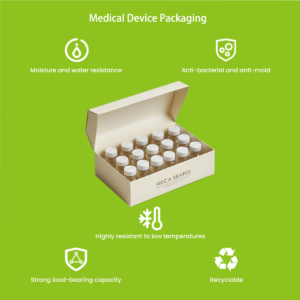
Medical Device Packaging — Protect Instruments from Manufacturing Floor to Operating Room
A surgical instrument tray travels from the manufacturing clean room to the hospital central sterile supply department, passing through sterilization, warehouse storage, distributor handling, and final delivery. At each handoff, the packaging is the only barrier between the device and contamination, impact, or environmental damage. When the packaging fails, the device does not reach the patient.
PPBOXY’s medical device packaging is fabricated from twin-wall corrugated polypropylene — a material that is waterproof, particle-free, and compatible with the full range of medical sterilization methods. Standard sizes and configurations are available for immediate quotation and fast-turn production; for devices requiring custom-engineered packaging with full validation documentation, see Custom Medical Device Packaging →.
Use this page to understand which PPBOXY medical packaging product fits your device type, then follow the link to the most relevant detail page.
| Device Type |
Best Packaging |
Key Requirement |
Pergi ke |
| Surgical instruments, diagnostic kits, implants |
Standard medical PP boxes |
Sterile barrier, impact protection |
Halaman ini |
| Custom-engineered device-specific packaging |
Custom design service |
Built to device CAD, sterilization-validated, ISO 13485 |
Pembungkusan Peranti Perubatan Tersuai → |
| Cryogenic vial storage (−80°C/−196°C) |
PP honeycomb dividers |
Ultra-low temperature, USP Class VI |
Cryobox Dividers → |
| Large medical equipment (scanners, monitors) |
Heavy-duty PP containers |
Vibration protection, ISTA-tested |
Medical Equipment Packaging → |
| Pharmaceutical, drug, medicine packaging |
Bekas PP gred farmaseutikal |
FDA 21 CFR 211, tamper-evident |
PP Pembungkusan Farmaseutikal → |
Specifications — Standard Medical Device Packaging Formats
| Parameter |
Spesifikasi |
| Produk |
Medical Device Packaging — standard PP corrugated protective and sterile barrier packaging |
| Bahan |
3–5 mm twin-wall corrugated polypropylene (PP), virgin medical-grade |
| Saiz Standard |
400×300 mm, 500×350 mm, 600×400 mm, 800×600 mm (footprint); height: 100–300 mm |
| Format Kotak |
Die-cut scored PP sheet, folded box; optional lidded tray format |
| Penyerapan air |
< 0.01% — waterproof, particle-free surface |
| Sterilization Compatibility |
EtO, gamma, e-beam, H₂O₂ plasma (standard PP); steam autoclave (high-heat PP grade on request) |
| Penghasilan zarah |
Zero fiber shedding — suitable for ISO 5–8 clean room use |
| Pilihan ESD |
Anti-static grade available (10⁹–10¹¹ Ω/sq) for electronic medical devices |
| Food Contact / Medical Grade |
FDA 21 CFR 177.1520; USP Class VI and ISO 10993 testing available through partner labs |
| Kebolehcetakan |
UV digital or screen print — device name, sterilization indicator, UDI (GS1-128/Data Matrix), lot number |
| Boleh ditindih |
Stackable 6–8 high; maintains dimensional stability through sterilization cycles |
| Kebolehkitar semula |
100% PP #5 |
| Kitaran Penggunaan Semula |
50+ cycles (protective packaging); single-use for sterile barrier applications |
| Pengubahsuaian |
Size, thickness, lid/tray format, internal dividers, foam inserts, Tyvek lid compatibility |
| Kuantiti minimum |
50 units (standard); 200 (custom size/printed) |
| Masa Pimpinan |
7–14 business days (standard); 15–25 days (custom) |
Medical Device Packaging vs Cardboard — Why PP for the Regulated Environment
Cardboard is incompatible with medical device packaging for three fundamental reasons that PP addresses:
Particulate Contamination
Cardboard sheds fibers continuously — in a clean room, in a sterilization chamber, in a hospital storage area. These fibers are a contamination vector for sterile devices. PP is a non-fibrous, non-shedding surface. When cut or handled, it generates zero particulate — essential for ISO 5–8 clean room environments where particle counts are monitored and controlled.
Sterilization Compatibility
Cardboard cannot survive most sterilization methods. EtO penetrates but cardboard absorbs the gas and requires extended aeration. Gamma and e-beam degrade cellulose fibers, embrittling the material. Steam autoclave destroys cardboard instantly. PP is compatible with all major sterilization methods without degradation.
Ketahanan Kelembapan dan Kimia
Medical environments involve frequent cleaning with disinfectants and sterilants — hydrogen peroxide, quaternary ammonium, peracetic acid, and alcohol-based solutions. Cardboard absorbs these liquids and degrades. PP is chemically resistant to all standard medical disinfectants and can be wiped down or fogged without material degradation.
| Keperluan |
Kadbod |
PP Kotak Bergelombang |
| Particulate generation |
Continuous fiber shedding |
Zero — non-fibrous surface |
| EtO sterilization |
Absorbs gas — extended aeration |
Fully compatible |
| Gamma / E-beam |
Cellulose degrades — embrittlement |
Fully compatible |
| Disinfectant wipe-down |
Absorbs liquid — degrades |
Chemically resistant |
| Clean room (ISO 5–8) |
Not permitted |
Compatible |
Applications by Medical Device Category
Surgical Instruments & Sterile Kits
Stainless steel surgical instruments are heavy, sharp-edged, and must arrive sterile. PPBOXY’s standard medical boxes combine impact-resistant walls (protecting instruments from each other and from external handling) with optional internal die-cut PP dividers that separate instruments and prevent edge-to-edge contact. The boxes can be configured with a Tyvek-lidded inner tray for sterile presentation in the operating room — the outer PP box provides structural protection, the inner sealed tray maintains sterility until point of use.
Diagnostic Kits & Laboratory Consumables
Diagnostic kits — PCR test assemblies, ELISA plate kits, sample collection sets — contain multiple small components that must stay organized and contamination-free. PPBOXY’s standard boxes with compartment dividers organize kit components, protect reagent vials from breakage, and present a professional appearance to the laboratory end user. Custom printing can include kit instructions, component checklists, and lot-specific QR codes for traceability.
Orthopedic Implants & Prosthetic Devices
Orthopedic implants — hip stems, knee tibial trays, spinal cages — are machined to micron-level tolerances. Surface damage from implant-to-implant contact during transport is a leading cause of intraoperative rejection. PPBOXY’s packaging secures each implant in a custom-cut PP or foam nest within the box, preventing component contact and absorbing distribution shock. The packaging can be validated per ISTA 3A for the specific implant geometry and weight.
Soalan Lazim
Q: What is the difference between this page and Custom Medical Device Packaging?
This page covers standard PP medical device packaging formats — off-the-shelf sizes, thicknesses, and configurations suitable for general medical device protection and sterile barrier use. The Custom Medical Device Packaging page covers the custom engineering service: packaging designed from your device CAD file, validated for your specific sterilization method, manufactured in an ISO 7/8 clean room if required, and delivered with full ISO 13485 and FDA/EU MDR documentation. If you need a standard box for surgical instruments, you are on the right page. If you need a packaging system designed around your implant geometry, visit Pembungkusan Peranti Perubatan Tersuai →.
Q: Can PP packaging be used as a sterile barrier?
PP corrugated boxes serve as the protective outer layer in a sterile barrier system. The primary sterile barrier is typically a sealed pouch (Tyvek/PE, foil) or lidded tray inside the PP box. For configurations where the PP box must form part of the barrier (e.g., a lidded PP tray with a Tyvek seal), specify this during quotation and PPBOXY will recommend the appropriate PP grade and surface finish for seal integrity.
Q: Are these boxes compatible with EtO and gamma sterilization?
Yes. Standard medical-grade PP is compatible with EtO (gas-permeable, no material degradation), gamma irradiation (25–50 kGy standard dose, no significant polymer degradation), and e-beam sterilization. For steam autoclave (121°C/134°C), a high-heat PP grade is required — specify this at time of quotation.
Q: Can UDI barcodes be printed directly on the packaging?
Yes. PPBOXY prints UDI-compliant markings — Device Identifier (DI), Production Identifier (PI), lot number, serial number, expiration date — directly onto the PP surface. Supported barcode formats include GS1-128, Data Matrix, and QR code. Barcode grading verification ensures machine-readable quality per FDA and EU MDR requirements.
Q: What is the minimum order quantity for standard medical device packaging?
We operate without a predetermined MOQ. Our production capabilities accommodate a wide spectrum of order volumes — from initial prototype samples to full-scale manufacturing — allowing us to align precisely with your project requirements.