Why One-Size-Fits-All Fails for Fresh Produce Packaging
Fruits and vegetables are not uniform cargo. A box that protects ginger will suffocate berries. A box that ventilates grapes will let celery wilt. A box built for ambient transport will crack in cold chain. Yet most packaging suppliers offer a single “fruit and vegetable box” with generic ventilation holes and call it universal.
The problem is biological: every produce category has a different respiration rate, ethylene sensitivity, moisture tolerance, and cold chain requirement. Packaging that ignores these differences causes measurable losses:
- Berries (strawberries, cherries, passion fruit) respire at 3–8× the rate of root vegetables — inadequate ventilation causes CO₂ buildup, off-flavors, and mold within 24 hours.
- Root vegetables (ginger, potatoes, onions) are susceptible to impact bruising and sprouting — solid-walled boxes without cushioning cause surface damage that accelerates decay.
- Stem vegetables (celery, asparagus) require upright support to prevent bending — short, wide boxes cause stem curvature that renders produce unsellable.
- Citrus (oranges, lemons) release ethylene that accelerates ripening in adjacent produce — ventilation must balance airflow with stack stability.
- Sweet corn loses sugar content rapidly at ambient temperature — cold chain compatibility is not optional.
Respiration rate comparison (at 20°C):
| Produce Category |
Respiration Rate (mg CO₂/kg·h) |
Ethylene Sensitivity |
Cold Chain Required |
| Berries (strawberry, cherry) |
50–100 |
High |
Yes (0–2°C) |
| Tropical fruits (passion fruit, mango) |
40–80 |
Very High |
Yes (7–13°C) |
| Citrus (orange, lemon) |
15–25 |
Low |
Optional (4–10°C) |
| Stem vegetables (celery, asparagus) |
20–35 |
Low |
Yes (0–2°C) |
| Root vegetables (ginger, potato) |
8–15 |
Very Low |
Optional (7–13°C) |
| Sweet corn |
30–50 |
Low |
Yes (0–2°C) |
Implication: A box designed for oranges will kill strawberries. A box designed for ginger will wilt celery. Crop-specific packaging is not a luxury — it is a loss-prevention necessity.
Crop Category Guide — 5 Produce Types, 5 Box Requirements
PPBOXY designs crop-specific fruit and vegetable packaging boxes based on each produce category’s biological requirements. Below are five crop categories, their packaging demands, and the PPBOXY boxes engineered for each.
Berries & Small Fruits — Ventilation & Ethylene Management
Berries are the most demanding produce category to package: high respiration rates, extreme ethylene sensitivity, soft skins, and short shelf lives (3–7 days). Box design must prioritize continuous airflow across every fruit surface while maintaining stack stability during cold chain distribution.
Key box design requirements:
- Ventilation area ≥ 15% of sidewall surface to prevent CO₂ buildup
- Shallow depth (single-layer or double-layer) to prevent crushing under weight of upper layers
- Smooth interior walls to prevent skin abrasion on soft berries
- Cold chain compatibility (0–2°C) with condensation drainage
PPBOXY berry boxes:
Root Vegetables & Tubers — Impact Protection & Moisture Control
Root vegetables (ginger, potatoes, onions, garlic) are dense, irregularly shaped, and susceptible to impact bruising and moisture-triggered sprouting. Box design must prioritize structural rigidity under heavy loads and moisture control in the root zone.
Key box design requirements:
- Thick walls (4–5 mm board) to resist impact from irregular root shapes
- Reinforced corners for stacking loads up to 25 kg per box
- Controlled ventilation — enough to prevent condensation, not enough to cause desiccation
- Narrow temperature window (7–13°C for ginger) — boxes must perform in refrigerated transport without cracking
PPBOXY root vegetable boxes:
- Ginger Box — Rhizome-specific design with sprouting prevention
Stem Vegetables — Upright Support & Hydrocool Resistance
Stem vegetables (celery, asparagus, leeks) must remain vertical from harvest to display. Bending causes irreversible quality loss. Box design must provide tall sidewalls, internal support structures, and compatibility with hydrocooling (water spray immersion at 0–2°C).
Key box design requirements:
- Tall sidewalls (300–350 mm) to support full stem length
- Hydrocool-compatible material — box must not soften or warp during water immersion
- Drainage holes in base to prevent waterlogging after hydrocooling
- Open-top or flap-top design for field packing speed
PPBOXY stem vegetable boxes:
- Celery Box — Upright support, breathable, hydrocool-resistant
Citrus & Tree Fruits — Stack Strength & Ventilation Balance
Citrus fruits (oranges, lemons, grapefruit) are relatively robust individually but heavy in bulk — a standard orange box may carry 15–20 kg. The primary packaging challenge is maintaining stack stability at height while providing enough ventilation to manage ethylene off-gassing without weakening the box structure.
Key box design requirements:
- High stack strength — boxes must support 5–6 high stacking in cold rooms
- Ventilation area 10–12% of sidewall surface — enough for ethylene dissipation without compromising wall rigidity
- Medium walls (3–4 mm board) balancing weight and strength
- Moisture resistance — citrus cold rooms operate at 85–90% relative humidity
PPBOXY citrus boxes:
- Orange Box — Citrus-specific ventilation and stack design
Sweet Corn & Pods — Bulk Capacity & Field-to-Market Speed
Sweet corn is a high-volume, time-sensitive crop. Sugar-to-starch conversion begins immediately after harvest — each hour at ambient temperature reduces sweetness measurably. Box design must prioritize fast field packing, bulk capacity, and cold chain compatibility.
Key box design requirements:
- Large capacity — sweet corn is typically packed 48–60 ears per crate
- Wide opening for rapid field packing (harvest crews pack directly into boxes)
- Cold chain ready — must withstand 0–2°C refrigeration and hydrocooling
- Stackable with airflow channels — cold air must penetrate to center of stack
PPBOXY corn & pod boxes:
Specifications
| Parameter |
Value |
| Material |
Polypropylene (PP) Corrugated Hollow Sheet |
| Food-Grade |
Yes (FDA 21 CFR §177.1520 / EU 10/2011) |
| Board Thickness |
3 mm / 4 mm / 5 mm (crop-dependent) |
| Standard Sizes |
600×400×300 mm / 500×350×280 mm / Custom |
| Ventilation |
Crop-specific patterns (8–15% sidewall area) |
| Stack Height |
Up to 6 high (loaded) |
| Operating Temperature |
-20°C to +80°C |
| Moisture Absorption |
< 0.02% |
| Reuse Cycles |
200+ |
| Color Options |
Blue, Black, White, Green, Custom |
| Custom Printing |
Full-color UV printing available |
| OEM/ODM |
Available |
| MOQ |
None |
Key Features of PP Corrugated Fruit and Vegetable Boxes
Ventilation Engineering — Per-Crop Airflow Design
PPBOXY does not use a single ventilation pattern for all produce. Each box design specifies ventilation hole placement, size, and percentage of sidewall area based on the target crop’s respiration rate and ethylene sensitivity:
- Berry boxes: Ventilation area ≥ 15%, holes on all four sidewalls plus base channels for 360° airflow
- Citrus boxes: Ventilation area 10–12%, balanced between airflow and wall strength for 5–6 high stacking
- Root vegetable boxes: Controlled ventilation (8–10%), positioned to prevent condensation without causing desiccation
- Stem vegetable boxes: Sidewall vents + base drainage holes for hydrocool water egress
This crop-specific ventilation engineering is the single most important design difference between a PPBOXY produce box and a generic “fruit and vegetable box.”
Waterproof & Condensation-Resistant
PP corrugated board absorbs < 0.02% moisture by weight — compared to 6–9% for cardboard. In cold chain environments where condensation is constant, this is the difference between a box that maintains structural integrity and one that collapses under its own stack weight.
- Cold room environments (0–4°C, 85–95% RH): Cardboard absorbs moisture continuously, losing 40–60% stack strength within 72 hours. PP maintains 100%.
- Hydrocooling (water spray immersion): Cardboard disintegrates. PP is fully waterproof and hydrocool-compatible.
- Tropical transit (25–35°C, 70–90% RH): Cardboard softens and deforms. PP is dimensionally stable across the full temperature range.
Stackable Without Weight Transfer
PPBOXY produce boxes feature interlocking rim designs that allow stable stacking up to 6 high (depending on box size and contents) without transferring the weight of upper boxes onto the produce below. This is critical for:
- Cold room storage: Maximizing vertical space in refrigerated facilities
- Transport: Stable loads reduce shift damage during braking and cornering
- Retail display: Stackable boxes can be displayed directly on the floor, reducing handling
200+ Reuse Cycles — 85% Lower Cost Per Trip
PP corrugated produce boxes withstand 200+ handling cycles before replacement — compared to 1–3 uses for cardboard. When amortized across their full lifespan:
- PP box: 0.03–0.08pertrip(basedon0.03–0.08pertrip(basedon6–16 unit cost ÷ 200+ cycles)
- Cardboard box: 0.17–0.50pertrip(basedon0.17–0.50pertrip(basedon0.50–1.50 unit cost ÷ 1–3 uses)
- Net savings: 85%+ lower packaging cost per shipment over the box lifecycle
For operations running 50+ shipments per week, this translates to $15,000–40,000 annual packaging cost savings.
PP Fruit Boxes vs Cardboard, Foam & Wooden Crates
| Property |
PP Corrugated Box |
Cardboard Box |
EPS Foam Crate |
Wooden Crate |
| Moisture Absorption |
< 0.02% |
6–9% |
< 0.5% |
8–15% |
| Reuse Cycles |
200+ |
1–3 |
5–10 |
20–50 |
| Cost Per Trip |
$0.03–0.08 |
$0.17–0.50 |
$0.10–0.30 |
$0.20–0.75 |
| Cold Chain Compatible |
✅ |
❌ (softens) |
✅ |
⚠️ (absorbs) |
| Hydrocool Compatible |
✅ |
❌ |
✅ |
❌ |
| Crop-Specific Ventilation |
✅ |
⚠️ Limited |
❌ |
❌ |
| Stack Height (loaded) |
6 high |
3–4 high |
3–4 high |
4–5 high |
| Custom Printing |
✅ Full color |
✅ |
❌ |
⚠️ Stencil only |
| Food-Safe (direct contact) |
✅ |
⚠️ Adhesives |
✅ |
⚠️ Treatment |
| Ethylene Management |
✅ Engineered |
⚠️ Passive |
❌ |
❌ |
| Recyclable |
✅ (#5 PP) |
✅ |
⚠️ Limited |
✅ |
| Typical Unit Cost |
$6–16 |
$0.50–1.50 |
$2–5 |
$8–20 |
Decision rule: If you ship produce once in cardboard and discard it, cardboard is cheaper per unit. If you ship produce repeatedly — weekly harvests, cold chain distribution, or export logistics — PP corrugated boxes are 85% cheaper per trip over their lifespan.
Need crop-specific packaging? For ginger, celery, cherries, grapes, passion fruit, sweet corn, oranges, or eggplant, see our dedicated crop-specific box pages linked in the crop guide above.
Frequently Asked Questions
Q1: What types of fruit and vegetable packaging boxes does PPBOXY offer?
PPBOXY offers crop-specific PP corrugated packaging boxes for five produce categories: berries and small fruits (cherry, grape, shine muscat, passion fruit), root vegetables (ginger), stem vegetables (celery), citrus and tree fruits (orange), and sweet corn. Each box is designed with crop-specific ventilation patterns, wall thicknesses, and structural features based on the target produce’s respiration rate, ethylene sensitivity, and cold chain requirements. Visit the crop category guide above to find the right box for your produce.
Q2: How do ventilation patterns differ between fruit and vegetable boxes?
Ventilation design is driven by respiration rate. Berry boxes require ≥ 15% sidewall ventilation area because berries respire at 50–100 mg CO₂/kg·h — three to eight times the rate of root vegetables. Citrus boxes use 10–12% ventilation, balancing ethylene dissipation with wall strength for 5–6 high stacking. Root vegetable boxes use controlled 8–10% ventilation to prevent condensation without causing desiccation. Stem vegetable boxes combine sidewall vents with base drainage holes for hydrocool water egress. Generic “one ventilation pattern fits all” designs cause measurable produce loss.
Q3: Can PP fruit boxes be used in cold chain logistics?
Yes. PP corrugated board maintains full structural integrity at temperatures down to -20°C — unlike cardboard, which absorbs condensation moisture and loses 40–60% stack strength within 72 hours in cold room environments. PPBOXY berry, cherry, celery, and sweet corn boxes are specifically designed for cold chain distribution (0–2°C). Ginger boxes are designed for the 7–13°C narrow temperature window required by tropical root vegetables.
Q4: Are PP corrugated fruit boxes food-safe?
Yes. PPBOXY fruit and vegetable boxes are manufactured from food-grade polypropylene (PP) — the same polymer used in food containers, baby bottles, and medical packaging. PP is approved for direct food contact under FDA 21 CFR §177.1520 and EU Regulation 10/2011. Unlike cardboard, which contains adhesives (often formaldehyde-based) and sizing agents between flutes, PP has no secondary chemicals that could migrate into produce.
Q5: What is the lifespan of a PP fruit and vegetable box?
PPBOXY produce boxes withstand 200+ handling cycles before replacement under normal operating conditions. This compares to 1–3 uses for cardboard, 5–10 for EPS foam, and 20–50 for wooden crates. Over the box lifespan, this translates to 85%+ lower packaging cost per trip compared to cardboard. Boxes should be inspected periodically for cracking at stress points (corners, hinges) and replaced when structural integrity is compromised.
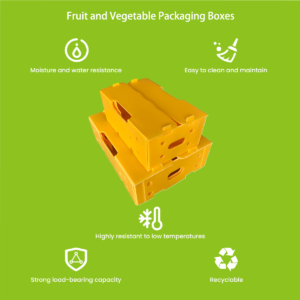 Fruit and Vegetable Packaging Boxes