Why Passion Fruit Demands a Dedicated Box
Passion fruit (Passiflora edulis) is a tropical climbing berry — not a citrus, not a stone fruit, and not a temperate berry. Its biology creates a set of post-harvest challenges that make it one of the most difficult commercial fruits to ship: extreme respiratory heat, a 5-7 day shelf-life cliff, and a hard-but-shrinkable shell that punishes both impact and moisture loss. Standard produce boxes, designed for apples or oranges, cannot solve these problems simultaneously.
Respiratory Heat — 3-4× Higher Than Oranges
Passion fruit is a climacteric fruit — it experiences a sharp respiratory peak after harvest, producing 3-4 times more heat and ethylene than oranges at the same temperature. In a sealed or poorly ventilated box, this trapped heat accelerates ripening, which in turn generates more ethylene — a self-reinforcing cycle that can push fruit from “ripe” to “overripe and fermenting” within 24-48 hours. Our PP corrugated boxes feature calibrated ventilation that removes respiratory heat while retaining enough humidity to prevent shell shrinkage.
| Fruit Type |
Respiration Rate (mL CO₂/kg·h at 20°C) |
Climacteric? |
Ethylene Production |
| Passion fruit |
150-280 |
Yes — strong |
High (50-100 µL/kg·h) |
| Orange |
40-65 |
No — non-climacteric |
Very low |
| Cherry |
25-40 |
No — non-climacteric |
Very low |
| Grape |
15-30 |
No — non-climacteric |
Very low |
| Banana |
120-200 |
Yes — strong |
Very high |
The 5-7 Day Shelf-Life Countdown
From harvest to overripe, passion fruit has a shelf-life of only 5-7 days at ambient temperature — one of the shortest among all commercially shipped fruits. This creates extreme time pressure across the supply chain: Day 1-2 for harvest and pre-cooling, Day 2-4 for transport and distribution, Day 4-6 for retail display, and Day 6-7 is the sell-by cliff. Every hour saved in cooling and every degree of temperature control gained directly extends this window. Our PP corrugated boxes contribute by maintaining the 7-10°C optimal storage zone through twin-wall insulation and calibrated airflow.
| Day |
Fruit Condition |
Action Window |
| Day 1-2 |
Harvest, pre-cool, pack |
Critical: cool to 7-10°C within 4 hours |
| Day 2-4 |
Transport, distribute |
Critical: maintain 7-10°C, vent respiratory heat |
| Day 4-6 |
Retail display, consumer purchase |
Critical: prevent shrivel, manage ethylene |
| Day 6-7 |
Sell-by cliff — overripe, fermentation |
Beyond this: 40-60% price discount or reject |
Hard Shell, Easy Shrink — The Moisture Paradox
Passion fruit has a hard, woody outer shell that resists puncture and impact — but this same shell is remarkably susceptible to moisture loss. A loss of just 2-3% of water weight causes visible shriveling and wrinkling, which consumers interpret as “old” or “bad,” even when the pulp inside is perfectly fine. The paradox: ventilate to remove heat and ethylene (which accelerates moisture loss), or seal to retain moisture (which traps heat and ethylene). Our PP corrugated boxes solve this through calibrated ventilation geometry — vent holes sized and positioned to achieve the optimal balance between airflow (for heat/ethylene removal) and humidity retention (for shell plumpness).

Specifications
| Parameter |
Value |
| Material |
Polypropylene (PP) corrugated sheet |
| Sheet Structure |
Twin-wall (fluted/hollow) |
| Thickness Options |
3mm, 4mm, 5mm (4mm recommended for passion fruit) |
| Standard Box Dimensions (Small) |
400×300×200mm (purple variety) |
| Standard Box Dimensions (Medium) |
500×350×250mm (golden variety) |
| Standard Box Dimensions (Large) |
600×400×300mm (export pallet) |
| Empty Weight (500×350×250mm) |
0.8-1.5 kg |
| Load Capacity |
5-15 kg per box (size-dependent) |
| Stacking Height |
6-8 boxes (without crushing) |
| Optimal Storage Temperature |
7-10°C (44.6-50°F) |
| Chilling Injury Threshold |
<5°C (tropical varieties) |
| Ventilation Pattern |
Standard 4-vent / High-flow 10-vent / Low-flow 2-vent |
| Moisture Resistance |
<0.05% absorption (waterproof) |
| Food Compliance |
FDA 21 CFR 177.1520, EU 10/2011, GB 4806.7-2023 |
| ISPM-15 |
Exempt (no wood content) |
| Reuse Cycles |
50-200+ (depending on handling) |
| Printing Options |
Silk screen (standard) / Corona + digital (optional) |
| Colors Available |
White, yellow, purple, green, custom |
| Surface Treatment |
Standard smooth / Corona-treated (print-ready) |
| Nesting Ratio (empty) |
70% volume reduction for return freight |
| Pallet Compatibility |
1200×1000mm / 1200×800mm EUR |
| Divider Options |
Individual cell dividers (optional) |
PP Corrugated Passion Fruit Box vs Cardboard vs EPS Foam vs Wooden Crates
| Feature |
PP Corrugated Box |
Cardboard Box |
EPS Foam Box |
Wooden Crate |
| Respiratory heat management |
Calibrated vents + twin-wall airflow |
No ventilation design — heat traps |
Sealed — heat and ethylene trap completely |
Open — no insulation, no airflow control |
| Moisture retention |
85-90% RH balance — no shrivel |
Absorbs moisture → softens + shrivel |
Sealed → condensation → mold |
Absorbs moisture → warps → splinters |
| Impact protection |
Twin-wall cushion absorbs drops |
Crushes on impact → fruit bruise |
Good cushion but cracks → EPS fragments on food |
Hard surface → impact transfers to fruit |
| Ethylene management |
Vents allow ethylene escape |
Traps ethylene → rapid overripe |
Traps ethylene → rapid overripe |
Open but no controlled venting |
| Reuse cycles |
50-200+ |
1-3 (single-use) |
5-15 (fragile, cracks) |
10-30 (requires treatment) |
| Weight (empty, 500×350×250mm) |
0.8-1.5 kg |
0.6-1.0 kg |
0.3-0.6 kg |
3.0-5.0 kg |
| Stack height |
6-8 boxes |
3-4 boxes (wet conditions) |
4-6 boxes (risk of cracking) |
6-8 boxes |
| Food safety |
FDA & EU 10/2011 compliant |
Glue/ink migration risk |
EPS microplastic contamination risk |
ISPM-15 treatment required |
| Cost per trip (100+ trips) |
$0.12-0.35 |
$1.20-2.00 (single-use) |
$0.40-1.20 (short life) |
$0.50-1.50 (with treatment) |
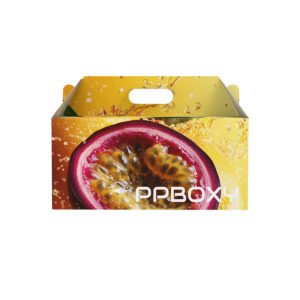
Key Features of the PPBOXY Passion Fruit Box
Calibrated Ventilation — Cooling Rate vs. Moisture Retention
The single most important engineering feature of a passion fruit box is ventilation calibration. Too many vents → fast cooling but rapid shrivel. Too few vents → retained moisture but trapped heat and ethylene → fermentation. Our boxes feature precision-punched ventilation holes sized and positioned based on:
- Cooling rate: 0.5-0.8°C/hour through forced-air pre-cooling (target: 7-10°C within 4 hours of harvest)
- Ethylene removal: Continuous passive venting prevents ethylene concentration above 1 ppm (fermentation threshold)
- Moisture retention: 85-90% RH within the box micro-climate (below 2-3% weight loss threshold for shrivel)
Ventilation options by market:
| Vent Pattern |
Vent Area (% of wall) |
Best For |
Shelve-Life Impact |
| Standard (4 side vents) |
3-5% |
Short-haul domestic (1-3 days) |
5-7 days |
| High-flow (8 side + 2 base vents) |
6-8% |
Long-haul export (4-6 days) |
7-10 days at 7-10°C |
| Low-flow (2 side vents only) |
1-2% |
Humid tropical storage |
5-7 days (high humidity env.) |
Cushion-Rate Interior for Impact & Fermentation Protection
Passion fruit’s high sugar content (14-18°Brix) creates a unique failure mode: when one fruit cracks from impact, its sugary juice coats neighboring fruit, and fermentation begins within hours — spreading to adjacent fruit through contact. Our PP corrugated boxes address this with:
- Twin-wall cushion structure that absorbs 40-60% more impact energy than single-wall cardboard
- Individual cell dividers (optional) that isolate each fruit, preventing juice-on-fruit contact
- Waterproof walls that contain leaked juice without softening — unlike cardboard, which absorbs juice and creates a fermentation medium inside the box wall
Stack-to-8 Without Crush — 50-200+ Reuse Cycles
Under standard cold-chain handling, our PP corrugated passion fruit boxes achieve:
- Stack height: 6-8 boxes without crushing lower layers (twin-wall load distribution)
- Reuse cycles: 50-200+ trips under normal handling
- Nesting for return: Empty boxes nest inside each other — 70% volume reduction for return freight
- Break-even vs cardboard: 8-12 trips
| Cost Factor |
PP Corrugated (per trip) |
Cardboard (per trip) |
| Box unit cost |
$6-12 |
$1.20-2.00 |
| Reuse cycles |
50-200+ |
1 |
| Cost per trip |
$0.12-0.35 |
$1.20-2.00 |
| Break-even |
8-12 trips |
— |
| Annual savings (100 trips/yr, 500 boxes) |
— |
$42,500-82,500 |
FDA & EU 10/2011 Food-Contact Compliant
All PPBOXY passion fruit boxes are manufactured from food-grade polypropylene:
- FDA 21 CFR 177.1520 — Olefin polymers for food contact (US market)
- EU Regulation 10/2011 — Plastic materials in contact with food (European market)
- GB 4806.7-2023 — Food contact plastic materials (China domestic)
- Non-toxic, odorless — no chemical migration, no flavor transfer to fruit pulp
Custom Sizes for Purple/Gold Varieties + Export Dimensions
Passion fruit comes in two major commercial varieties with different sizing requirements:
| Variety |
Typical Weight |
Typical Diameter |
Common Origin |
Key Characteristic |
| Purple (P. edulis f. edulis) |
35-60g |
4-6 cm |
Australia, South Africa, Kenya |
Smaller, more aromatic, thicker shell |
| Golden/Yellow (P. edulis f. flavicarpa) |
60-120g |
5-8 cm |
Brazil, Colombia, Southeast Asia |
Larger, more acidic, thinner shell |
Standard box sizes:
| Size |
Dimensions (L×W×H) |
Capacity |
Best For |
| Small |
400×300×200mm |
5-6 kg purple variety |
Domestic retail |
| Medium |
500×350×250mm |
8-10 kg golden variety |
Wholesale distribution |
| Large |
600×400×300mm |
12-15 kg mixed |
Export pallet optimization |
| Custom |
Per specification |
Per specification |
Brand-specific requirements |
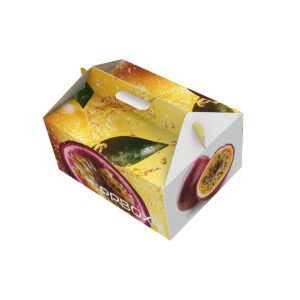
Passion Fruit Supply Chain Applications
H3-9: Farm Harvest & Pre-Cooling
After harvest, passion fruit must be cooled to 7-10°C within 4 hours to arrest the climacteric respiratory surge. Our PP corrugated boxes are designed for forced-air pre-cooling: the calibrated ventilation pattern allows cold air to flow through the box stack, pulling field heat out of the fruit rapidly. Unlike cardboard, which softens under the condensation that forms during rapid cooling, PP corrugated boxes maintain structural integrity through repeated cooling cycles.
Cold Chain Distribution (7-10°C)
The 7-10°C cold chain corridor is the optimal transport temperature for passion fruit — cold enough to slow respiration and ethylene production, but warm enough to avoid chilling injury (which occurs below 5°C for tropical varieties). Our twin-wall boxes provide passive insulation that buffers against temperature spikes during dock transfers, while the calibrated vents ensure continuous ethylene removal throughout transit.
Wholesale & Retail Display
PP corrugated passion fruit boxes are cleanable, stackable, and presentable for wholesale and retail environments:
- Corona-printed surfaces — grade, origin, lot number, and barcode printed directly on box walls
- Open-display configuration — removable or fold-down lid for retail counter display
- Easy-clean surface — wipe down between reuse cycles without damage
- Stack height 6-8 boxes — maximize floor space in wholesale markets
Export & Long-Distance Shipping
For international passion fruit shipments (South America → EU/US, Southeast Asia → Japan/Korea, Africa → Middle East), our boxes provide:
- ISPM-15 exemption — no wood = no heat treatment certification
- Pallet-optimized dimensions — designed for 1200×1000mm and 1200×800mm EUR pallets
- Nesting return logistics — 70% volume reduction for empty box return
- Corona-printed phytosanitary info — grade, origin, treatment codes printed directly
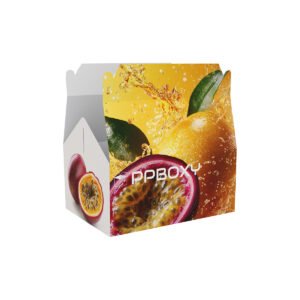
Frequently Asked Questions
Q1: What makes a passion fruit box different from other fruit packaging?
Passion fruit is a climacteric tropical berry with a respiratory rate 3-4× higher than oranges and a shelf-life of only 5-7 days. It produces large amounts of ethylene and heat that must be continuously vented, while simultaneously retaining enough moisture to prevent shell shriveling (2-3% water loss = visible wrinkle). Our PP corrugated passion fruit boxes feature calibrated ventilation that balances these opposing demands — something standard produce boxes, designed for low-respiration fruits, cannot do. See our agricultural packaging board for general-purpose solutions.
Q2: Why does passion fruit need ventilation if it has a hard shell?
The hard shell protects against impact but does not block moisture loss or internal heat buildup. Inside a sealed box, passion fruit’s high respiration generates heat and ethylene that accelerate ripening into fermentation within 24-48 hours. The shell, meanwhile, loses water through microscopic pores — just 2-3% loss causes visible shriveling that consumers reject. Our calibrated ventilation removes heat and ethylene while maintaining 85-90% relative humidity inside the box.
Q3: How does this box differ from your cherry box or grape box?
Our cherry shipping box is designed for small, soft, non-climacteric berries that need pre-cooling and moisture retention without ethylene concerns. Our grape box focuses on cluster integrity and mold prevention. This passion fruit box addresses climacteric tropical biology: extreme respiratory heat, high ethylene output, hard-shell shrinkage, and the fermentation cascade when high-sugar juice contacts other fruit.
Q4: What is the optimal storage temperature for passion fruit?
7-10°C (44.6-50°F) — this is the sweet spot where respiration is slowed enough to extend shelf life to 7-10 days, but warm enough to avoid chilling injury (which damages tropical varieties below 5°C). Our PP corrugated boxes maintain this zone through twin-wall passive insulation and calibrated ventilation that prevents both overheating and overcooling during transit.
Q5: Do you offer different box sizes for purple and golden passion fruit?
Yes. Purple passion fruit (P. edulis f. edulis) is smaller (35-60g, 4-6cm diameter), typically packed in our 400×300×200mm box for 5-6 kg. Golden/yellow passion fruit (P. edulis f. flavicarpa) is larger (60-120g, 5-8cm diameter), best in our 500×350×250mm box for 8-10 kg. Custom dimensions are available for specific grading requirements and export pallet optimization.
Q6: Can PP corrugated boxes handle the juice from cracked passion fruit?
Yes — and this is a critical advantage over cardboard. When a passion fruit cracks, its high-sugar juice (14-18°Brix) spills onto the box interior. In cardboard, this juice is absorbed into the wall, creating a fermentation medium that accelerates spoilage of adjacent fruit. In PP corrugated boxes, the waterproof surface contains the juice without absorbing it — you can wipe it clean between trips, and the box structure remains intact.
Q7: How many times can a PP corrugated passion fruit box be reused?
Under normal cold-chain handling, our PP corrugated passion fruit boxes achieve 50-200+ reuse cycles — compared to 1 trip for cardboard. At a unit cost of 6−12,theper−tripcostdropsto∗∗6−12,theper−tripcostdropsto∗∗0.12-0.35**, with break-even versus cardboard achieved in just 8-12 trips. A fleet of 500 boxes making 100 trips annually can save $42,500-82,500/year versus single-use cardboard.
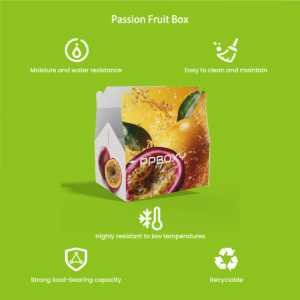 Passion Fruit Box