What Is a PP Corrugated Plastic Box?
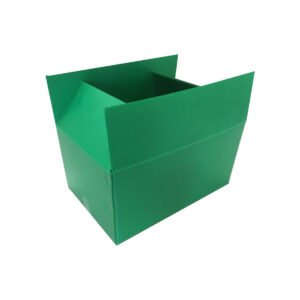
A PP corrugated plastic box is a reusable shipping and storage container made from polypropylene (PP) corrugated sheet — a twin-wall panel with parallel flutes running between two flat faces. This structure gives the box a high strength-to-weight ratio: a typical 600 × 400 × 300 mm box weighs 0.8–1.2 kg yet supports 15–25 kg of contents stacked 4–6 units high.
The “corrugated” in the name refers to the fluted core — identical in principle to corrugated cardboard, but in PP rather than paper. This distinction matters because PP corrugated board does not absorb moisture, does not delaminate when wet, and does not lose rigidity in humid environments — the three failure modes that make cardboard unsuitable for industrial reuse.
Common names for the same product: PP corrugated boxes are also marketed as correx boxes, coroplast boxes, fluted plastic boxes, PP hollow board boxes, and twin-wall polypropylene boxes. These are all the same material (polypropylene corrugated sheet) converted into box form — the different names reflect regional or trade terminology rather than product differences.
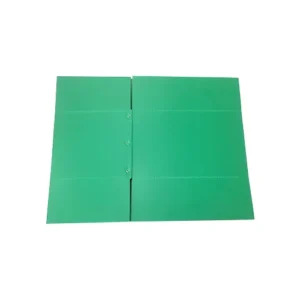
Structure and manufacturing: Each box starts as a flat PP corrugated sheet, precision die-cut and creased, then folded and joined into a 3D container. The conversion method determines the box type:
Key distinction: A PP corrugated plastic box is defined by its material (PP corrugated sheet) and structure (twin-wall fluted core), not by its closure type, lid style, or application. The 6 box types below all share the same material — they differ in form factor and use case.
Specifications
| Specification |
Details |
| Material |
100% Virgin Polypropylene (PP) Corrugated Sheet |
| Flute Types |
B-flute (3 mm), C-flute (4 mm), BB-flute (5 mm), custom |
| Size Range |
200 × 150 mm to 1200 × 800 × 600 mm (custom available) |
| Standard Sizes |
400 × 300, 500 × 350, 600 × 400, 800 × 600 mm |
| Load Capacity |
5–30 kg (varies by box type — see comparison table) |
| Temperature Range |
−20°C to +80°C |
| Colors |
White, Blue, Black, Red, Green, Yellow, Custom Pantone |
| Reuse Cycles |
150–500+ (varies by box type) |
| Food-Grade |
Yes (virgin PP, FDA/EU compliant) |
| ESD-Safe Option |
Yes (surface resistivity 10⁶–10⁹ Ω/sq) |
| OEM/ODM |
Available |
| MOQ |
None |
PP Corrugated Plastic Box Types Compared
Not all PP corrugated plastic boxes serve the same purpose. The table below compares the six primary types by structure, capacity, and best-fit application — so you can identify the right box before browsing individual product pages.
6-Type Comparison Table
| Box Type |
Structure |
Size Range (mm) |
Load Capacity |
Foldable? |
Reuses |
Best For |
Link |
| Correx Box |
Die-cut fold-up with tab/Velcro closure |
200–1200+ |
5–20 kg |
✅ Flat |
200+ |
General-purpose packaging, retail, light industrial |
Correx Boxes |
| Hollow Sheet Box |
Die-cut with ventilation holes, open-top |
300–1200+ |
5–15 kg |
✅ Flat |
150+ |
Fresh produce, agricultural produce, ventilated storage |
PP Hollow Sheet Box |
| Foldable Box |
Die-cut fold-up with Velcro/handle options |
300–1200+ |
10–25 kg |
✅ Flat |
200+ |
E-commerce, promotional packaging, space-constrained shipping |
Foldable Packaging Box |
| Turnover Box |
Hinged lid, rigid base, stackable |
400–600+ |
15–30 kg |
❌ Rigid |
300+ |
Cold chain, factory turnover, heavy parts, repetitive open-close |
PP Corrugated Turnover Box |
| Courier Box |
Rigid shell, interlocking lid, impact-resistant |
300–600+ |
10–20 kg |
❌ Rigid |
200+ |
Last-mile delivery, reverse logistics, courier fleets |
Courier Box |
| Pallet Box |
PP walls on HDPE pallet base |
600–1200+ |
500–1000 kg |
✅ Collapsible walls |
500+ |
Heavy-load warehouse storage, bulk shipping, automotive |
Foldable Pallet Boxes |
Selection Guide: Which Box Type Fits Your Needs?
| Your Priority |
Recommended Type |
Why |
| Minimum storage space when empty |
Foldable Box or Correx Box |
Both fold flat — 75–80% volume reduction |
| Repeated open-close cycles per day |
Turnover Box |
Hinged lid designed for 300+ cycles without wear |
| Parcel delivery with rough handling |
Courier Box |
Rigid shell + impact resistance + interlocking lid |
| Fresh produce needing airflow |
Hollow Sheet Box |
Ventilation holes maintain cold chain airflow |
| Loads over 100 kg on a pallet |
Pallet Box |
HDPE base rated for 500–1000 kg static load |
| General-purpose, best value |
Correx Box |
200+ reuses, foldable, widest size range, lowest cost per use |
Still unsure? For storage-focused applications (warehouse shelving, inventory management), see our Corrugated Plastic Storage Boxes guide — it covers storage-specific features in more depth.

Key Features Across All PP Corrugated Plastic Boxes
Regardless of box type, every PP corrugated plastic box shares these material-level advantages over cardboard and solid plastic alternatives.
Waterproof & Chemical-Resistant
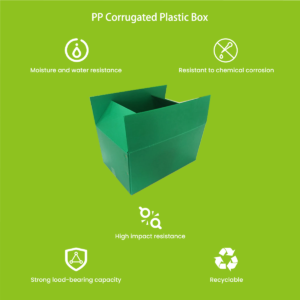
PP corrugated sheet absorbs less than 0.03% moisture by weight — compared to 6–9% for cardboard. The material is inert to water, most acids, alkalis, and organic solvents, making it suitable for wet environments, cold storage, and chemical plants where cardboard delaminates within hours.
Foldable & Space-Saving (Where Applicable)
Die-cut fold-up box types (Correx, Hollow Sheet, Foldable) collapse flat when empty, reducing return-shipping volume by 75–80%. A standard 600 × 400 × 300 mm foldable box packs down to roughly 600 × 400 × 40 mm — enabling 15–20 empty boxes to stack in the space of one assembled box. Rigid types (Turnover, Courier) do not fold but are designed to nest inside each other when empty.
Customizable & Stackable
PP corrugated boxes accept screen printing, digital printing, and hot-stamping for branding, barcodes, and handling instructions. All types are designed to stack when full (4–6 units high for standard boxes; 3–4 units for pallet boxes) and nest when empty. Custom sizes, colors, and internal dividers are available on all models with no minimum order quantity.
PP Corrugated Box vs Cardboard Box vs Solid Plastic Tote
| Property |
PP Corrugated Box |
Cardboard Box |
Solid Plastic Tote (PP/HDPE) |
| Weight (600×400×300 mm) |
0.8–1.2 kg |
0.5–0.8 kg |
2.0–3.5 kg |
| Load Capacity |
15–25 kg |
10–15 kg |
25–40 kg |
| Reuses |
150–500+ |
1–3 |
500–1000+ |
| Waterproof |
✅ |
❌ |
✅ |
| Foldable When Empty |
✅ (foldable types) |
✅ (always) |
❌ |
| Temperature Range |
−20°C to +80°C |
−5°C to +50°C (dry) |
−20°C to +80°C |
| Chemical Resistance |
✅ |
❌ |
✅ |
| Printable |
✅ |
✅ |
⚠️ Limited (in-mold or pad print) |
| Recyclable |
✅ (#5 PP) |
✅ |
✅ (#5 PP or #2 HDPE) |
| Typical Cost/Unit |
$2–8 |
$0.50–2 |
$8–25 |
| Cost Per Use (50 reuses) |
$0.04–0.16 |
$0.17–0.67 |
$0.16–0.50 |
Takeaway: PP corrugated boxes occupy the sweet spot between cardboard (cheap but disposable) and solid plastic totes (durable but expensive and non-foldable). For most industrial and logistics applications, PP corrugated delivers the lowest cost-per-use while maintaining waterproof performance and foldability.
Industry Applications
PP corrugated plastic boxes are used across industries where cardboard fails too quickly and solid plastic totes are too expensive or inflexible. Here are the five sectors with the highest adoption.
Manufacturing & Automotive
Factory floors use PP corrugated boxes for work-in-progress (WIP) transport between stations, parts kits for assembly lines, and returnable packaging for supplier deliveries. The key advantage over cardboard: boxes survive oil, coolant, and metal shavings without degradation. Turnover boxes with hinged lids are the standard here — workers open and close them dozens of times per shift.
Recommended type: PP Corrugated Turnover Box or Correx Boxes
Food & Beverage
Fresh produce, bottled beverages, and processed foods require packaging that is waterproof, food-grade, and easy to clean. PP corrugated boxes with ventilation holes (Hollow Sheet Box type) allow cold-chain airflow through produce; solid-wall types protect packaged goods from condensation. All PPBOXY food-contact boxes use virgin PP resin compliant with FDA 21 CFR and EU Regulation 10/2011.
Recommended type: PP Hollow Sheet Box (ventilated) or Correx Boxes (solid wall)
Electronics & Semicon
ESD-safe PP corrugated boxes protect circuit boards, connectors, and semiconductors from both physical shock and electrostatic discharge. Surface resistivity can be specified at 10⁶–10⁹ Ω/sq for ESD-safe grades. The lightweight structure reduces shipping costs compared to solid plastic containers, while the non-outgassing PP material avoids contamination of sensitive components.
Recommended type: Correx Boxes (ESD-safe grade) or Courier Box
Pharmaceutical & Medical
Pharmaceutical packaging must meet traceability and contamination standards that cardboard cannot satisfy. PP corrugated boxes are USP Class VI compliant, zero-leachable, and compatible with all three primary sterilization methods (autoclave, gamma, EtO). They are used for tablet boxes, vial trays, diagnostic kit packaging, and cold-chain pharmaceutical shipping.
Recommended type: PP Corrugated Turnover Box (cold chain) or Correx Boxes (general pharma)
Logistics & E-Commerce
Courier and logistics operations need boxes that survive hundreds of delivery cycles, resist rain and impact, and fold flat for return trips. The Courier Box type is specifically designed for this use case — rigid shell for protection, interlocking lid for security, and 200+ reuse lifecycle. For e-commerce returns, foldable boxes minimize reverse-shipping volume.
Recommended type: Courier Box (delivery) or Foldable Packaging Box (e-commerce returns)
Frequently Asked Questions
Q1: What is the difference between a PP corrugated plastic box and a cardboard box?
A PP corrugated plastic box is made from twin-wall polypropylene sheet — waterproof, chemical-resistant, and reusable 150–500+ times. A cardboard box is made from fluted paper — absorbs moisture, degrades with reuse, and typically survives 1–3 cycles. PP corrugated boxes cost more upfront (2–8vs2–8vs0.50–2) but deliver a lower cost-per-use over time.
Q2: How many times can a PP corrugated plastic box be reused?
It depends on the box type and handling conditions. Die-cut foldable types (Correx, Foldable) typically achieve 200+ reuse cycles. Rigid hinged types (Turnover) achieve 300+ cycles. Pallet boxes with HDPE bases achieve 500+ cycles. All figures assume proper handling and no structural damage.
Q3: Are PP corrugated plastic boxes food-safe?
Yes. PPBOXY food-contact boxes are manufactured from virgin PP resin that meets FDA 21 CFR 177.1520 (US) and EU Regulation 10/2011 (Europe) requirements for food-contact materials. For fresh produce applications, the PP Hollow Sheet Box includes ventilation holes that maintain cold-chain airflow.
Q4: Can PP corrugated boxes be customized with printing?
Yes. All PPBOXY box types accept screen printing, UV digital printing, and hot-stamp labeling. Common print applications include company logos, barcodes, QR codes, handling icons, and color-coded identifiers for warehouse sorting. Custom sizes and colors (including Pantone matching) are also available with no minimum order quantity.
Q5: What is the difference between a “correx box” and a “PP corrugated plastic box”?
Nothing in material terms — “correx” is a trade name that has become generic in the UK and parts of Europe for corrugated polypropylene sheet. A “correx box” and a “PP corrugated plastic box” are the same product made from the same material. PPBOXY uses both terms: this page covers the full category, while our Correx Boxes page provides detail on the most popular foldable type.
 PP Corrugated Plastic Box