Why Ginger Needs a Rhizome-Specific Box
Ginger is not a fruit, not a leaf, and not a stem — it is a rhizome: an irregular, knobby underground stem with a surface covered in delicate bud eyes. This unique biology creates a set of storage and transport challenges that no standard produce box can solve.
The 7-13°C Narrow Temperature Window
Ginger is chilling-sensitive: temperatures below 7°C (44.6°F) trigger irreversible internal browning (chilling injury), while temperatures above 13°C (55.4°F) accelerate sprouting and dehydration. This 6-degree window is one of the narrowest among all commercial root crops. PP corrugated boxes maintain thermal stability within this zone through their twin-wall air-channel insulation — passively buffering temperature spikes during loading, transit, and cold-room staging.
| Condition |
Temperature |
Effect on Ginger |
Time to Visible Damage |
| Chilling injury |
<7°C |
Internal browning, water-soaked lesions |
7-10 days |
| Optimal storage |
7-13°C |
Firm, plump, no sprouting |
4-6 months |
| Sprouting onset |
>13°C |
Bud eyes activate, weight loss 3-5%/week |
5-7 days |
| Rapid dehydration |
>20°C |
Shriveling, wrinkled skin, 10%+ weight loss |
3-5 days |
Irregular Shape = 30-40% Space Waste in Standard Boxes
Unlike spherical oranges or cylindrical corn cobs, ginger rhizomes are asymmetric and unpredictable — each piece has a unique combination of fingers, lobes, and curves. Packed into standard rectangular boxes, up to 30-40% of the volume becomes void space, meaning fewer kilograms per box and higher per-kg shipping costs. Our PP corrugated ginger boxes offer custom-molded dividers that conform to typical rhizome clusters, maximizing load density while cushioning each piece individually.
Bud Eye Protection — The Weakest Point on Every Rhizome
Every ginger rhizome carries bud eyes (growth nodes) on its surface — small, raised points where new shoots emerge. These are the softest, most vulnerable areas on the entire root. When standard boxes shift during transit, adjacent rhizomes press against each other, and bud eyes are the first to crush. A crushed bud eye becomes an entry point for mold and bacteria, often ruining not just one piece but spreading to neighboring rhizomes through contact. Our divider system creates individual cells that isolate each rhizome, preventing surface-to-surface contact at the bud eye zone.
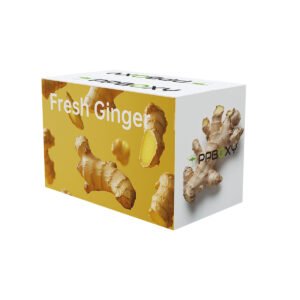
技术规格
| 材料 |
Polypropylene (PP) corrugated sheet |
| Sheet Structure |
Twin-wall (fluted/hollow) |
| 厚度选项 |
3mm, 4mm, 5mm (4mm recommended for ginger) |
| Standard Box Dimensions |
600×400×300mm / 500×350×280mm / Custom |
| Empty Weight (600×400×300mm) |
1.2-1.8 kg |
| 承载能力 |
15-25 kg per box |
| Stacking Height |
6-8 boxes (without crushing) |
| 温度范围 |
-20°C to +80°C (ginger optimal: 7-13°C) |
| Moisture Absorption |
<0.05% (virtually waterproof) |
| Divider Options |
Straight-cut / Custom-molded / Adjustable slot |
| Food Compliance |
FDA 21 CFR 177.1520, EU 10/2011, GB 4806.7-2023 |
| ISPM-15 |
Exempt (no wood content) |
| Reuse Cycles |
50-200+ (depending on handling) |
| Printing Options |
Silk screen (standard) / Corona + digital (optional) |
| Colors Available |
White, blue, green, black, custom |
| Surface Treatment |
Standard smooth / Corona-treated (print-ready) |
| Nesting Ratio (empty) |
70% volume reduction when nested for return |
| Pallet Compatibility |
1200×1000mm / 1200×800mm EUR |
| Chemical Resistance |
Resistant to acids, alkalis, and most solvents |
| UV Resistance |
UV-stabilized for outdoor staging (optional) |
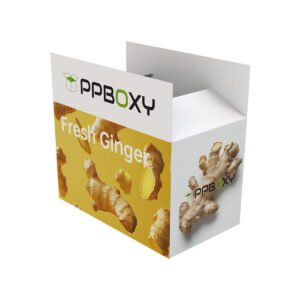
PP Corrugated Ginger Box vs Cardboard vs Wooden Crates
| 功能 |
PP瓦楞姜盒 |
Cardboard Box |
Wooden Crate |
| Moisture resistance |
Waterproof — no absorption even after wash |
Absorbs water → softens → collapses |
Absorbs moisture → warps → mold growth |
| Reuse cycles |
50-200+ trips |
1-3 trips (single-use) |
10-30 trips (requires treatment) |
| Temperature stability |
Twin-wall air channels buffer 7-13°C zone |
No insulation — rapid temp transfer |
Minimal — thermal mass but no seal |
| Bud eye protection |
Custom-molded dividers isolate each rhizome |
No dividers — rhizomes press together |
Rough interior splinters can gouge rhizomes |
| Post-wash handling |
Washable surface — stack immediately |
Cannot stack wet — cardboard softens |
Must air-dry to prevent rot |
| Weight (empty, 600×400×300mm) |
1.2-1.8 kg |
0.8-1.2 kg |
3.5-6.0 kg |
| Food safety |
FDA & EU 10/2011 compliant |
Glue/ink migration risk |
ISPM-15 heat treatment required |
| Space efficiency |
Custom dividers → 85-90% fill rate |
No dividers → 60-70% fill rate |
No dividers → 55-65% fill rate |
| Cost per trip (over 100 trips) |
$0.15-0.40/trip |
$0.80-1.20/trip (single-use) |
$0.50-1.00/trip (with treatment) |
| Break-even vs cardboard |
10-15 trips |
— |
— |
Key Features of the PPBOXY Ginger Box
Breathable Twin-Wall Structure for 7-13°C Zone
The corrugated twin-wall design creates thousands of micro air channels that serve a dual purpose for ginger: passive temperature buffering within the 7-13°C critical zone, and controlled ventilation that removes ethylene and excess humidity without drying out the rhizomes. Unlike solid-wall plastic containers that trap moisture and accelerate mold, our twin-wall structure lets ginger “breathe” — maintaining the 85-90% relative humidity that keeps rhizomes firm without condensation.
Custom Molded Dividers for Irregular Rhizomes
Standard produce boxes assume uniform shapes. Ginger defies uniformity. Our custom-molded dividers are designed around typical rhizome cluster geometries, creating individual cells that:
- Prevent rhizome-to-rhizome contact at bud eyes
- Reduce void space from 30-40% to 10-15%
- Allow each piece to be individually inspected without unpacking the whole box
- Can be configured for different grading sizes (small/medium/large/jumbo)
Divider options:
| Divider Type |
Tooling Cost |
Lead Time |
Best For |
| Straight-cut board (no mold) |
$0 |
3-5 days |
Mixed-size ginger, cost-sensitive orders |
| Custom-molded cell dividers |
$200-600 |
10-15 days |
Export-grade, single-size grading |
| Adjustable slot dividers |
$0 |
3-5 days |
Multi-product lines, flexible configurations |
Moisture-Vapor Balance (87% Hydration Without Condensation)
Fresh ginger contains approximately 87% water by weight. The packaging challenge is paradoxical: too much moisture → mold and rot; too little → shriveling and weight loss. Our PP corrugated ginger boxes achieve this balance through the twin-wall vapor diffusion effect — the air channels create a micro-climate that maintains 85-90% RH around the rhizomes while allowing excess condensation to escape through the breathable walls. The result: ginger stays firm and plump without surface water film that breeds Fusarium and Pythium species.
FDA & EU 10/2011 Food-Contact Compliant
All PPBOXY ginger boxes are manufactured from food-grade polypropylene that meets:
- FDA 21 CFR 177.1520 — Olefin polymers for food contact (US market)
- EU Regulation 10/2011 — Plastic materials in contact with food (European market)
- GB 4806.7-2023 — Food contact plastic materials and articles (China domestic)
- Non-toxic, odorless — no chemical migration, no flavor transfer to ginger
This compliance documentation is available for your import clearance and buyer audits.
50-200+ Reuse Cycles — Cost Break-Even in 10-15 Trips
| Cost Factor |
PP Corrugated (per trip) |
Cardboard (per trip) |
| Box unit cost |
$8-15 |
$1.50-2.50 |
| Reuse cycles |
50-200+ |
1 |
| Cost per trip |
$0.15-0.40 |
$1.50-2.50 |
| Break-even point |
10-15 trips |
— |
| Annual savings (100 trips/yr, 500 boxes) |
— |
$55,000-105,000 |
Ginger Supply Chain Applications
Farm Harvest & Post-Wash Drying
After harvest, ginger is typically washed to remove soil — leaving a surface water film that cardboard cannot handle. PP corrugated boxes can receive wet rhizomes immediately after washing, as the waterproof surface does not absorb moisture or soften. The breathable twin-wall design then allows the surface water to evaporate naturally during the initial drying period, preventing the damp-onset mold that ruins ginger within 24-48 hours in sealed containers.
Cold Chain Distribution (7-13°C)
Our ginger boxes are designed for the 7-13°C cold chain corridor — the narrow thermal window where ginger remains dormant without chilling injury or sprouting. The twin-wall structure provides passive insulation that buffers against temperature spikes during dock transfers, while the breathable walls prevent condensation when boxes move between temperature zones (e.g., cold room → refrigerated truck → wholesale floor).
Wholesale & Retail Display
PP corrugated ginger boxes are cleanable, stackable, and presentable — suitable for direct display on wholesale market floors. The smooth surface can be Corona-treated for direct printing (grade, origin, lot number) or fitted with label sleeves, eliminating the need for secondary display packaging. Stack height up to 6-8 boxes without crushing lower layers.
Export & Long-Distance Shipping
For international ginger shipments (China → Japan/Korea/EU/US), our boxes provide:
- ISPM-15 exemption — no wood = no heat treatment certification required
- Nesting for return logistics — empty boxes nest inside each other, reducing return-freight volume by 70%
- Custom dimensions — designed to maximize pallet utilization (1200×1000mm or 1200×800mm EUR pallets)
- Corona-printed labels — grade, origin, phytosanitary info printed directly on box walls
常见问题解答
What makes a ginger box different from other agricultural packaging boxes?
Ginger is a rhizome — irregular in shape, covered in delicate bud eyes, and chilling-sensitive below 7°C. Unlike spherical fruits (oranges, apples) or cylindrical vegetables (celery, corn), ginger requires boxes with custom-molded dividers that isolate each piece at the bud-eye zone, plus breathable twin-wall construction that maintains the 7-13°C temperature window. Standard produce boxes lack both the divider system and the thermal buffering ginger demands. See our agricultural packaging board for general-purpose solutions.
Can PP corrugated boxes handle freshly washed ginger?
Yes — and this is a critical advantage over cardboard. After harvest, ginger is washed to remove soil, leaving surface moisture that softens cardboard within hours. PP corrugated boxes are fully waterproof: you can stack wet rhizomes immediately after washing without any risk of the box absorbing moisture, softening, or collapsing. The breathable twin-wall design then allows surface water to evaporate naturally, preventing the damp-onset mold that develops in sealed containers.
How does this ginger box differ from your celery box or eggplant box?
Each is designed for a different crop biology. Our celery box provides vertical support for long stems and hydrocool compatibility. Our eggplant box prioritizes bruise-free cushioning for smooth-skinned fruit vegetables. This ginger box focuses on rhizome-specific challenges: custom dividers for irregular shapes, bud-eye isolation, and the 7-13°C temperature window that prevents both chilling injury and sprouting.
What is the 7-13°C temperature window, and why does it matter for ginger?
Ginger is chilling-sensitive: below 7°C, internal tissues suffer irreversible browning (chilling injury) within 7-10 days. Above 13°C, bud eyes activate and ginger begins sprouting, losing 3-5% weight per week and dropping in market value by 50%+. The twin-wall air channels in our PP corrugated boxes provide passive insulation that buffers temperature within this narrow 6-degree window during dock transfers, truck loading, and cold-room staging.
Are these boxes food-safe and compliant for export
Yes. All PPBOXY ginger boxes are manufactured from FDA 21 CFR 177.1520 and EU 10/2011 compliant food-grade polypropylene. They are also ISPM-15 exempt (no wood content), eliminating the heat-treatment certification required for wooden crates in international shipping. Compliance documentation is available for import clearance and buyer audits.
How many times can a PP corrugated ginger box be reused?
Under normal agricultural handling conditions, our PP corrugated ginger boxes achieve 50-200+ reuse cycles — compared to 1-3 trips for cardboard. At an average unit cost of 8−15, the per-trip cost drops to 0.15- 0.40, with break-even versus cardboard achieved in just 10-15 trips. A fleet of 500 boxes making 100 trips annually can save $55,000-105,000/year versus single-use cardboard.
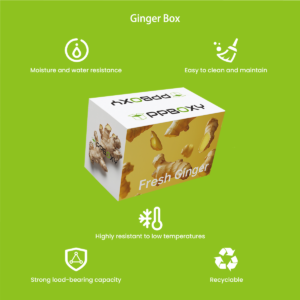 Ginger Box