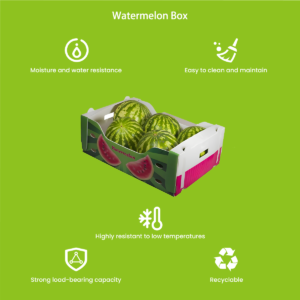
Watermelon Box — Built for the Heaviest Fruit in the Produce Aisle
A single watermelon weighs more than a case of beer. Stack 30 of them on a pallet and the box at the bottom supports over 200 kg of static load — plus the dynamic shock of a forklift drop and the vibration of a refrigerated truck on a rural highway. Cardboard, wet from the 92% moisture content of the fruit it contains, collapses under this load within 24 hours. PPBOXY’s watermelon box, fabricated from 5 mm twin-wall corrugated polypropylene, does not.
This is the only box format PPBOXY manufactures specifically for the 5–15 kg individual fruit weight class. Standard crop boxes for citrus, eggplant, and grapes are engineered for sub-1 kg fruit — a fundamentally different load profile. A watermelon box must resist not just vertical compression, but also the lateral outward pressure of spherical fruit pressing against the walls during transport, and the point-load of a single melon shifting inside a half-empty box during cornering.
PPBOXY offers the watermelon box in standard pallet-compatible footprints (600×400 mm and 800×600 mm) with reinforced side walls and optional internal dividers for seedless/mini watermelon varieties shipped in multi-fruit configurations.
| 裁剪 |
Typical Fruit Weight |
Box Wall Thickness (Standard) |
堆叠高度 |
转到 |
| 西瓜 |
5–15 公斤 |
5–6 mm |
4–5 高 |
本页面 |
| 橙子 / 柑橘类 |
0.15–0.25 kg |
3–4 毫米 |
6–8 high |
《橙盒》→ |
| 茄子 |
0.2–0.4 kg |
3 毫米 |
6–8 high |
茄子盒 → |
| Grapes (Shine Muscat) |
0.5–1.5 kg (per bunch) |
3–4 毫米 |
5–6 high |
Shine Muscat 礼盒 → |
| All Fruit & Vegetable Types |
0.1–15 kg |
2–12 毫米 |
因情况而异 |
水果和蔬菜包装盒 → |
技术规格
| 参数 |
规格 |
| 产品 |
Watermelon Box — PP corrugated heavy-duty transport & display box |
| 材料 |
5–6 mm twin-wall corrugated polypropylene (PP), virgin grade |
| 结构 |
Die-cut scored PP sheet, folded box with reinforced side-wall double-layer corners |
| 标准尺寸 |
600×400 mm, 800×600 mm (footprint); height: 200–350 mm (custom) |
| Box Weight (empty, 600×400×250 mm) |
~1.2–1.8 kg |
| Load Capacity (static, per box) |
50–100 kg (contents); up to 250 kg (bottom box in 5-high stack) |
| Single Melon Capacity |
1 melon per box (standard jumbo); 2–4 melons (mini/seedless in divided configuration) |
| 通风 |
Optional side-wall ventilation slots (laser-cut, 6–8 mm diameter) |
| 排水 |
Optional bottom drainage holes for condensation and washdown |
| 吸水率 |
< 0.01% — will not soften, swell, or collapse from watermelon moisture |
| 工作温度 |
−20 °C to +80 °C (cold storage compatible) |
| 抗紫外线性能 |
2–3 years outdoor (standard); extended UV available |
| 耐化学性 |
Resists field wash sanitizers (peroxyacetic acid, chlorine ≤ 200 ppm) |
| 可回收性 |
100% PP #5 |
| 再利用循环 |
50+ harvest cycles (standard); 100+ with reinforced corners |
| 自定义 |
Size, wall thickness, ventilation pattern, drainage, printing, internal divider configuration, corner reinforcement |
| 打印 |
UV digital or screen print — logo, farm name, variety, PLU code, barcode |
| 最小起订量 |
不 |
| 交货期 |
10–15 business days (new order); 5–7 days (repeat) |
Why Cardboard Fails for Watermelon — and How PP Solves It
Watermelon packaging is a worst-case scenario for cardboard:
Moisture Collapse
Watermelon is 92% water. In a closed refrigerated truck or cold storage room, the fruit respires and releases moisture into the air. Cardboard absorbs this humidity — its compression strength drops 40–60% within 24 hours of exposure to 90%+ relative humidity. The box that was strong enough when dry in the packing shed is no longer strong enough when wet in the truck. PP absorbs less than 0.01% water and maintains 100% of its compression strength regardless of humidity. A 5 mm PP box at 95% RH is exactly as strong as the same box at 0% RH.
Spherical Point Loading
A round watermelon presses against the box wall at a single tangent point — concentrating its full weight onto an area roughly the size of a coin. Cardboard dents and creases at this point, creating a stress concentrator that initiates wall buckling. PP’s twin-wall fluted structure distributes point loads across the internal ribs, preventing localized deformation.
Bottom-Box Stacking Pressure
In a standard 4-high pallet stack of watermelon boxes (each box ~60–90 kg loaded), the bottom box supports the combined weight of three boxes above it — roughly 180–270 kg of static load. Add transport vibration (equivalent to 1.5–2× static load in dynamic conditions) and the bottom box experiences momentary loads exceeding 400 kg. 5–6 mm corrugated PP is rated for this load range; standard 3–4 mm cardboard is not.
| 条件 |
Cardboard Box (5 mm) |
PP Corrugated Box (5 mm) |
| Dry compression strength |
~1,500 N |
~3,500 N |
| Compression after 24 hr at 90% RH |
~600–900 N (−40–60%) |
~3,500 N (unchanged) |
| Side-wall puncture resistance |
~50 N |
~180 N |
| 吸水率 |
50–150% (structure collapses) |
< 0.01% |
| Stack integrity after 4 hr wet transport |
Failed — bottom boxes collapse |
Maintained — no deformation |
Watermelon Box vs Other PPBOXY Agricultural Boxes — Which Crop Needs Which Box?
| 裁剪 |
Typical Box |
壁厚 |
堆叠高度 |
主要特点 |
转到 |
| 西瓜 |
600×400 or 800×600 mm, 5–6 mm walls |
5–6 mm |
4–5 高 |
Reinforced corners for 5–15 kg spherical load |
本页面 |
| 橙子 / 柑橘类 |
600×400 mm, 3–4 mm walls |
3–4 毫米 |
6–8 high |
Perforated walls for ethylene ventilation |
《橙盒》→ |
| Shine Muscat Grape |
Custom gift-box format, 3–4 mm |
3–4 毫米 |
5–6 high |
Oval handles, premium print for retail display |
Shine Muscat 礼盒 → |
| 茄子 |
600×400 mm, 3 mm walls |
3 毫米 |
6–8 high |
Long-format box for elongated vegetable shape |
茄子盒 → |
| 樱桃 |
400×300 mm, 3 mm walls |
3 毫米 |
6–8 high |
Small-format, bruise-resistant for delicate fruit |
樱桃运输箱 → |
| All crops — need help deciding |
Compare formats |
2–12 毫米 |
因情况而异 |
全景图 × 框图对比 |
水果和蔬菜包装盒 → |
Watermelon Supply Chain — From Field to Market in a PP Box
The watermelon supply chain is one of the shortest and most physically demanding in fresh produce. Understanding the journey informs the box design:
Stage 1: Field Harvest → Packing Shed (Day 0)
Watermelons are harvested by hand, loaded into field bins, and transported to the packing shed — typically within 2–4 hours of cutting. At the shed, melons are washed, graded by size and ripeness, and packed into boxes. PP boxes tolerate the washdown environment — water spray, field sanitizer residue, and wet melon surfaces — without absorbing moisture or losing structural integrity.
Stage 2: Cold Storage (Days 0–1)
Packed boxes enter cold storage at 10–15 °C (watermelons are chilling-sensitive — storage below 7 °C causes pitting and flavor loss). The high humidity of cold storage (85–95% RH) accelerates cardboard degradation; PP boxes are unaffected. Stacked 4–5 high on pallets, the boxes at the bottom of each stack bear the full weight of the fruit above.
Stage 3: Refrigerated Transport (Days 1–3)
Boxes travel by refrigerated truck from the packing shed to distribution centers or directly to retail. Road vibration produces dynamic loads 1.5–2× the static weight. Cardboard boxes that survived cold storage frequently fail during the first hour of highway transport. PP boxes absorb vibration through the twin-wall fluted structure, protecting the fruit from bruising and the box from structural fatigue.
Stage 4: Distribution Center & Retail (Days 2–5)
At the distribution center, pallets are broken down and individual boxes are shipped to retail locations. At retail, watermelon boxes often serve double duty — as both transport container and display fixture. The clean white PP surface presents watermelons attractively on the sales floor without the rumpled, water-stained appearance of cardboard that has traveled 500 km in a refrigerated truck.
Stage 5: Box Return & Reuse (Days 5–7)
Empty boxes are collapsed, stacked, and returned to the packing shed. PP boxes withstand 50+ full cycles through stages 1–5. Cardboard boxes are disposed after a single cycle — generating waste disposal cost and requiring new box purchasing for the next harvest.
常见问题解答
Q: How many watermelons fit in one box?
Standard configuration: 1 jumbo watermelon (10–15 kg) per 600×400 mm box. Multi-fruit configuration: 2–4 mini or seedless watermelons (3–6 kg each) in a divided 800×600 mm box. Custom configurations are available — specify your average melon weight and preferred fruit-per-box count for a size recommendation.
Q: What thickness of PP sheet is used for watermelon boxes?
5–6 mm corrugated PP is standard for watermelon boxes. This is thicker than the 3–4 mm used for lighter crops (citrus, eggplant, grapes) because of the extreme stacking loads experienced by the bottom boxes in a 4–5 high pallet configuration. If you ship watermelons in 6+ high stacks or use automated pallet handling equipment, 6 mm with reinforced corners is recommended.
Q: Do the boxes need ventilation holes?
Optional. Watermelons have a thick rind and do not require forced-air ventilation for cooling — unlike berries or leafy greens that need continuous airflow. However, condensation can form inside a sealed PP box during cold chain temperature transitions. Laser-cut side-wall ventilation slots (6–8 mm diameter) allow passive moisture escape without compromising box strength. If your supply chain includes ice-packing or high-humidity cold storage, specify ventilation slots at time of order.
Q: Can the boxes be used for field harvest directly?
Yes. PPBOXY’s watermelon boxes can be deployed at the point of harvest — eliminating the field bin → packing shed box transfer step. Pickers place melons directly into the PP box in the field; the same box travels through washing, grading, cold storage, transport, and retail display without repacking. This single-box workflow reduces labor (no transfer step), reduces bruising (fewer handling events), and eliminates the field bin cleaning and storage overhead.
Q: How do PP watermelon boxes compare to reusable plastic crates (RPCs)?
Both are reusable alternatives to cardboard. The key differences: PPBOXY’s corrugated PP boxes weigh approximately 1.2–1.8 kg empty — about 30–40% lighter than an equivalent RPC (typically 2.5–3.5 kg). PP boxes fold flat when empty for return logistics; RPCs nest but do not typically fold. RPCs are standardized to pool dimensions (600×400 or 400×300 mm); PP boxes can be manufactured to any custom dimension. PP boxes have a lower upfront cost per unit; RPCs may offer longer service life in high-volume pooled systems. The right choice depends on whether you operate a dedicated closed loop (PP box) or participate in a third-party pool (RPC).
Q: Can I print my farm branding on the boxes?
Yes. UV digital or screen printing directly onto the PP surface — logo, farm name, watermelon variety, PLU code, barcode, or QR code to your farm’s website. The white PP box surface provides excellent print contrast. Printing is applied to the exterior walls; interior remains unprinted for food contact. Pre-production digital proofs are provided at no charge. MOQ for printed boxes: 200 units.
问:最低订购量是多少?
Forget about MOQ restrictions. Order one piece or a thousand — we’re equipped to handle orders of any size, from initial testing to bulk manufacturing.