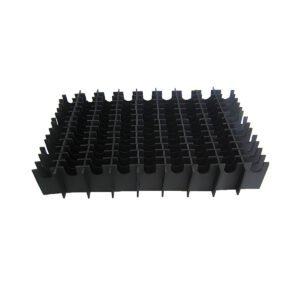
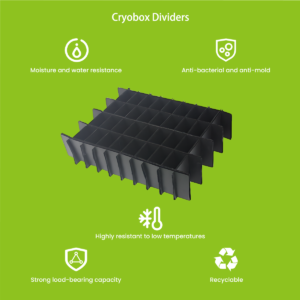
Cryobox Dividers — Cell Grid Inserts for Cryogenic Vial Organization
PPBOXY cryobox dividers are die-cut polypropylene cell grid inserts designed to organize and separate vials (2–50 mL) inside cryoboxes stored at -80°C ultra-low temperature (ULT) freezers and -196°C liquid nitrogen (LN2) dewars. Unlike flat board dividers that simply partition space, cryobox dividers create individual cells — each vial sits in its own pocket, preventing contact damage, label abrasion, and sample mix-ups during storage and retrieval.
Where cryobox dividers fit in the PP separator lineup:
| Separator Type |
How It Divides |
Best For |
Learn More |
| Cryobox Dividers (this page) |
Vertical cell grid for vials at cryogenic temps |
Biobanking, clinical trials, genomics |
— |
| PP 瓦楞隔板 |
Vertical cell grid for bottles at ambient temps |
Chemical bottles, industrial shipping |
PP 瓦楞隔板 |
| Board Dividers |
Flat vertical wall, no tooling |
General separation, display |
Polypropylene Corrugated Board Dividers |
| Layer Pads Dividers |
Horizontal flat sheet between stacked layers |
Beverage bottles, jar palletizing |
Layer Pads Dividers |
If your vials are stored at -80°C or below, this is your page. For bottles and containers at ambient temperatures, see our PP Corrugated Dividers.

技术规格
| Parameter |
Detail |
| 材料 |
Polypropylene (PP) corrugated board |
| Resin Grade |
Homopolymer PP, FDA 21 CFR 177.1520 |
| USP Classification |
USP Class VI (USP <87>, <88>) |
| Standard Cryobox Sizes |
133×133 mm (2″×2″), 270×270 mm, custom |
| Vial Compatibility |
2 mL, 5 mL, 10 mL, 15 mL, 20 mL, 50 mL |
| Cell Configurations |
9-cell (3×3), 25-cell (5×5), 81-cell (9×9), 100-cell (10×10), custom |
| 厚度 |
3 mm / 4 mm / 5 mm |
| 温度范围 |
-196°C to +80°C |
| Liquid Nitrogen Compatible |
✅ |
| ULT Freezer Compatible |
✅ (-80°C) |
| Cold-Crack Resistance |
No embrittlement at -196°C |
| Moisture Absorption |
<0.02% (ASTM D570) |
| Chemical Resistance |
Ethanol, isopropanol, formaldehyde, DMSO |
| Autoclave Tolerance |
121°C, 15 psi, 30 min |
| Surface Treatment |
Standard / Anti-static (10⁹–10¹¹ Ω/sq) / Corona-treated |
| 颜色 |
White (standard), Blue, Custom |
| Printability |
Screen printing / UV digital (Corona-treated) |
| 可重用性 |
50–200 freeze-thaw cycles |
| 可回收性 |
100% 可回收(PP #5) |
| Regulatory Compliance |
USP Class VI, ISO 20387, IATA 650, FDA 21 CFR 177.1520 |
| Certificate of Compliance |
Included with every batch |
| 最小起订量 |
无 |
| OEM/ODM |
已支持 |
Why PP for Cryogenic Vial Storage?
Three material properties make polypropylene the standard for cryobox dividers — and disqualify every alternative:
Cold-Crack Resistance at -196°C
PP corrugated board maintains full structural flexibility at liquid nitrogen temperature (-196°C). It does not embrittle, shatter, or develop micro-cracks during thermal cycling between room temperature and cryogenic storage. This is verified through ASTM D746 brittle point testing — PP’s brittle point is below -200°C, far below the operating range of any cryogenic storage system.
Cardboard and foam dividers become brittle below -20°C. At -80°C (ULT freezer), cardboard cracks on contact. At -196°C (LN2), cardboard disintegrates. PP endures both environments through thousands of freeze-thaw cycles without structural degradation.
Zero Leachables — USP Class VI at Cryogenic Temperatures
USP Class VI certification (USP <87> and <88>) guarantees zero extractables and zero leachables from the divider material — even at cryogenic temperatures where some plastics release residual monomers. This is critical because stored vials may have direct contact with divider cell walls over months or years of storage. Any leachable migrating into a biological sample compromises its research validity or clinical diagnostic accuracy.
Cardboard cannot achieve USP Class VI due to adhesives, sizing agents, and lignin-based compounds that off-gas and migrate. Foam inserts generate particulate contamination. PP is the only common divider material that meets USP Class VI biological reactivity standards.
Non-Porous Surface Prevents Cross-Contamination
PP’s non-porous surface does not absorb biological fluids, condensation, or decontamination agents. If a vial leaks, the spill is contained within the individual cell and can be wiped clean — it does not wick through the divider wall to adjacent vials as it would with cardboard or foam.
This non-porous property also enables effective decontamination. PP cryobox dividers can be wiped with 70% ethanol, 10% bleach, or autoclaved at 121°C — standard biosafety protocols — without material degradation. Cardboard and foam cannot be decontaminated; they must be discarded after any contamination event.
Cryobox Dividers vs Cardboard vs Foam vs Solid Plastic Inserts
| Criteria |
PP Cryobox Dividers |
Cardboard Dividers |
Foam Inserts |
Solid Plastic Totes |
| Cryogenic temp (-196°C) |
✅ No embrittlement |
❌ Cracks/shatters |
❌ Becomes brittle |
⚠️ Some grades ok |
| ULT freezer (-80°C) |
✅ Full flexibility |
❌ Cracks on contact |
⚠️ Partial |
✅ |
| USP Class VI |
✅ Certified |
❌ Cannot qualify |
❌ Particulate risk |
✅ (if PP/PE) |
| Cross-contamination |
Non-porous, spill-contained |
Wicks liquid between cells |
Absorbs fluid |
Non-porous |
| Decontamination |
Ethanol, bleach, autoclave |
Must discard |
Must discard |
Ethanol, bleach |
| Freeze-thaw cycles |
50–200+ |
1–3 |
3–5 |
50–200+ |
| Cell configuration |
Custom die-cut any grid |
Limited to standard grids |
Mold-limited |
Mold-limited |
| 重量 |
Light |
Light |
Light |
Heavy |
| Cost per cycle |
$0.02–0.10 |
$0.50–2.00 |
$0.30–1.00 |
$0.05–0.20 |
| 可回收 |
✅ PP #5 |
⚠️ Contaminated |
❌ |
✅ |
The decision is clear: For any facility storing vials at -80°C or below, PP cryobox dividers are the only option that maintains structural integrity, biological safety, and decontamination capability simultaneously. Cardboard and foam fail at cryogenic temperatures; solid plastic totes are heavy and inflexible in cell configuration.

Applications — Who Uses Cryobox Dividers?
Biobanking & Genomic Research
Biobanks store millions of biological specimens (blood, tissue, DNA, RNA) in vials at -80°C or -196°C. Each specimen must be individually identifiable and retrievable without disturbing adjacent samples. PP cryobox dividers create organized grids that map directly to inventory management systems — every cell position corresponds to a database entry, enabling rapid sample location and retrieval.
Compliance: ISO 20387 (Biobanking), ISBER Best Practices, NCI Best Practices for Biospecimen Resources.
Clinical Trials & Pharmaceutical R&D
Clinical trial specimens (blood draws, urine samples, tissue biopsies) are collected at study sites, aliquoted into vials, and shipped on dry ice to central laboratories. Cryobox dividers keep each patient’s samples separated and identifiable during frozen transit and storage. Tamper-evident packaging options ensure chain-of-custody integrity.
Compliance: ICH GCP E6(R2), 21 CFR Part 11 (electronic records), IATA 650 (Category 6/6.2 biological substances).
IVF & Reproductive Medicine
Cryopreserved embryos, oocytes, and sperm straws are stored in LN2 dewars at -196°C. Each reproductive sample is irreplaceable — cross-contamination or misidentification is unacceptable. PP cryobox dividers provide individual cell isolation and survive repeated thermal cycling between LN2 and room temperature during retrieval procedures.
Compliance: ESHRE Guidelines, ASRM Guidelines, HFEA Code of Practice.
Veterinary & Agricultural Biobanking
Animal genetics repositories, seed banks, and veterinary diagnostic labs store cryopreserved samples under similar conditions to human biobanks. PP dividers are chemically resistant to DMSO (common cryoprotectant) and formaldehyde (tissue fixation), ensuring compatibility with diverse preservation protocols.
Cryobox Divider vs Other PP Separators — Which Do You Need?
| Need |
Right Product |
Why |
| Vials at -80°C or -196°C |
Cryobox Dividers (this page) |
Only product rated for cryogenic temps with USP Class VI |
| Bottles/cans at ambient temp |
PP 瓦楞隔板 |
Chemical/industrial bottle cells at -20°C to +80°C |
| Flat vertical wall, no tooling |
Polypropylene Corrugated Board Dividers |
Straight-cut flat sheets, zero die cost |
| Horizontal layer separation |
Layer Pads Dividers |
Flat sheets between stacked bottle layers |
| Base cradle for bottles on pallet |
中空板瓶托盘 |
Recessed cell tray at bottom of each row |
| Complete pharma packaging solutions |
PP 医药包装 |
Full category hub: boxes, trays, dividers, vial trays |
Combination strategy: Many biobanks use cryobox dividers inside our pharmaceutical packaging boxes for complete protection — divider for internal vial separation, box for external containment during dry-ice shipping.
常见问题解答
Q: What is a cryobox divider?
A cryobox divider is a die-cut polypropylene cell grid insert that organizes vials (2–50 mL) inside a cryobox. Each vial sits in its own individual cell, preventing contact damage, label abrasion, and sample mix-ups. Cryobox dividers are specifically engineered for use at cryogenic temperatures (-80°C ULT freezers and -196°C liquid nitrogen) where standard cardboard or foam dividers fail. They are USP Class VI certified for zero leachables and are the standard divider type used in biobanking, clinical trials, and genomic research facilities.
Q: What temperature range can cryobox dividers withstand?
PPBOXY cryobox dividers maintain full structural flexibility from -196°C (liquid nitrogen) to +80°C. They do not embrittle, shatter, or develop micro-cracks during thermal cycling. This has been verified through ASTM D746 brittle point testing — PP’s brittle point is below -200°C. Whether your vials are stored in ULT freezers at -80°C or submerged in LN2 dewars at -196°C, PP cryobox dividers perform identically on day 1 and day 200.
Q: What is the difference between cryobox dividers and PP corrugated dividers?
Cryobox dividers and PP corrugated dividers are both die-cut cell grid inserts, but they serve different applications. Cryobox dividers are designed for vials at cryogenic temperatures (-80°C to -196°C) in biobanking and clinical research — they require USP Class VI certification and zero-leachable compliance. PP corrugated dividers are designed for bottles and containers at ambient temperatures (-20°C to +80°C) in chemical and industrial shipping — they emphasize chemical resistance and leak containment. If you store vials below -20°C, you need cryobox dividers. If you ship bottles at or above -20°C, you need PP corrugated dividers.
Q: Are cryobox dividers compatible with liquid nitrogen storage?
Yes. PPBOXY cryobox dividers are fully compatible with liquid nitrogen (LN2) storage at -196°C. PP corrugated board does not embrittle, crack, or degrade when submerged in LN2 or when cycled between LN2 and room temperature during sample retrieval. This is the primary advantage over cardboard dividers (which shatter at -196°C) and foam inserts (which become brittle and generate particulate contamination).
Q: Can cryobox dividers be autoclaved for sterilization?
Yes. PP cryobox dividers can be autoclaved at 121°C, 15 psi for 30 minutes without dimensional change or structural degradation. They are also compatible with gamma irradiation (25 kGy) and EtO gas sterilization. This three-method sterilization compatibility allows cryobox dividers to be decontaminated between uses in biosafety level (BSL) environments, unlike cardboard or foam, which must be discarded after contamination events.
Q: What vial sizes and cell configurations are available?
PPBOXY offers cryobox dividers for vials from 2 mL to 50 mL. Standard cell configurations include 9-cell (3×3), 25-cell (5×5), 81-cell (9×9), and 100-cell (10×10) grids. Custom cell sizes, grid patterns, and mixed-cell configurations (different cell sizes in one divider) are available for non-standard vial types. Standard cryobox sizes include 133×133 mm (2″×2″) and 270×270 mm. All dividers are custom die-cut to your exact vial dimensions and cryobox interior — simply provide your vial diameter, height, and box internal dimensions.
Q: How do cryobox dividers prevent cross-contamination?
PP corrugated board has a non-porous surface that does not absorb biological fluids, condensation, or decontamination agents. If a vial leaks, the spill is contained within the individual cell pocket and can be wiped clean — it does not wick through the divider wall to adjacent vials. Cardboard dividers wick liquid between cells; foam inserts absorb and pool fluid. PP dividers can also be decontaminated with 70% ethanol, 10% bleach, or autoclaved — standard biosafety protocols — without material degradation.
冷冻盒隔板