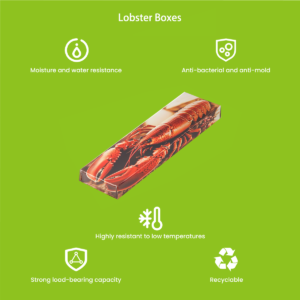
Boîtes à homards — La boîte qui permet d'expédier un animal vivant, et pas seulement un produit
Toutes les autres caisses de la gamme de produits de la mer de PPBOXY contiennent des produits morts : des filets de poisson frais sur de la glace, des crevettes surgelées à −18 °C, des coquilles Saint-Jacques réfrigérées dans des barquettes scellées. Les caisses destinées aux homards, quant à elles, contiennent un animal vivant qui doit arriver au restaurant ou au marché vivant, intact et plein de vigueur. Un homard mort représente une perte de type 100%.
Cela modifie toutes les exigences en matière d'emballage. La caisse doit retenir l’humidité : les homards sont expédiés emballés dans du papier journal humide ou des algues, et leurs branchies doivent rester humides pour que l’animal puisse respirer. La caisse doit résister à l’empilement humide : le papier journal humide transfère l’humidité aux parois de la caisse, et la palette entière est transportée à une température comprise entre 0 et 4 °C avec un taux d’humidité proche de la saturation. La caisse doit protéger les homards les uns des autres : les pinces peuvent écraser les homards voisins pendant le transport si les animaux ne sont pas séparés ; un seul homard blessé dans une caisse peut déclencher un comportement agressif qui se propage à l’ensemble du chargement.
La caisse à homard de PPBOXY est fabriquée en polypropylène ondulé à double paroi, ce qui lui permet de répondre simultanément à ces trois exigences. Ses parois imperméables ne se ramollissent pas au contact du papier journal humide utilisé comme rembourrage. Sa structure rigide préserve l’intégrité des cloisons, même lorsque les parois de la caisse sont mouillées par la condensation. De plus, le polypropylène résiste à la chaîne du froid (0–4 °C) sans se fragiliser : les caisses peuvent être déplacées entre le camion frigorifique, la chambre froide et le quai de réception du restaurant sans fissurer ni subir de défaillance structurelle.
Il s'agit de la seule fiche produit du catalogue PPBOXY spécialement conçue pour le transport d'animaux vivants. Pour les produits de la mer morts, réfrigérés ou surgelés, veuillez vous reporter au tableau comparatif ci-dessous.
| Produit |
Un animal vivant ? |
Température |
Matériau de rembourrage |
Aller à |
| Boîtes à homard |
✅ Oui — homards vivants |
0 à 4 °C |
Journal humide, algues, sachets réfrigérants |
Cette page |
| Boîte d'emballage pour crabes |
✅ Oui — des crabes vivants |
0 à 4 °C |
Journal humide, algues |
Boîte d'emballage pour crabes → |
| Coffret de fruits de mer |
❌ Abattu — frais réfrigéré |
0 à 4 °C |
Glace, poches de glace |
Coffret de fruits de mer → |
| Boîte d'emballage pour fruits de mer frais |
❌ Abattu — frais réfrigéré |
0 à 4 °C |
Glace, pochettes réfrigérantes |
Boîte d'emballage pour produits de la mer frais → |
| Boîte d'emballage pour crevettes |
❌ Animaux morts — frais ou congelés |
0–4 °C / −18 °C |
Poches de glace, sèches |
Boîte d'emballage pour crevettes → |
Caractéristiques techniques
| Paramètre |
Caractéristiques techniques |
| Produit |
Lobster Box — Conteneur de transport en polypropylène ondulé pour homards vivants |
| Matériau |
Polypropylène (PP) ondulé à double paroi de 4 à 6 mm, vierge, de qualité alimentaire |
| Dimensions standard |
600 × 400 mm, 800 × 600 mm (encombrement au sol) ; hauteur : 150 à 300 mm (peut accueillir des homards de 1 à 5 lb) |
| Poids du carton (vide) |
~0,8–2,0 kg |
| Capacité de charge |
10 à 25 kg par caisse (généralement 8 à 20 homards, selon leur taille) |
| Plage de températures |
De −20 °C à +80 °C en fonctionnement continu (température optimale pour le transport des homards : 0 à 4 °C) |
| Absorption d'eau |
< 0,01% — ni le papier journal humide ni la condensation ne ramolliront la boîte |
| Rétention d'humidité |
Les parois en PP non poreux retiennent l'humidité autour des branchies ; fentes d'aération en option pour le renouvellement de l'air |
| Séparateurs internes |
Séparateurs fixes en PP ondulé (en option) — permettent de séparer les homards les uns des autres ou de les classer par taille |
| Fixation par griffe |
Points d'ancrage optionnels pour bandes élastiques moulés dans les cloisons de séparation |
| Drainage |
Petits trous de drainage facultatifs au fond pour évacuer l'excès d'eau de fonte (sachets de gel) |
| Empilable |
Empilables par 6 à 8 sur des palettes — les caisses du bas garantissent l'intégrité structurelle sous une charge humide |
| Conformité en matière de contact alimentaire |
FDA 21 CFR 177.1520 ; règlement (CE) n° 1935/2004 |
| Imprimabilité |
Impression numérique UV ou sérigraphie — espèce de homard, origine, date de pêche, marque du fournisseur |
| Recyclabilité |
100% PP #5 |
| Cycles de réutilisation |
30 à 50+ utilisations (durée de vie inférieure à celle des sacs « dry-pack » en raison d'un lavage intensif entre chaque utilisation) |
| Personnalisation |
Dimensions, épaisseur des parois, configuration des cloisons, schéma de ventilation, points d'ancrage des bandes à griffes |
| Quantité minimale de commande |
50 unités (standard) ; 200 (personnalisées/imprimées) |
| Délai de livraison |
10 à 15 jours ouvrables |
Les trois défis liés au transport du homard vivant — et comment PP les relève
Défi n° 1 : L'humidité sans défaillance structurelle
Les homards vivants sont emballés dans du papier journal humide ou des algues afin de maintenir leurs branchies humides pendant le transport. Ce matériau d’emballage transfère l’humidité en continu vers les parois de la caisse pendant toute la durée du trajet — généralement entre 12 et 36 heures, de la Nouvelle-Écosse à un restaurant de Manhattan, ou d’un quai du Maine à un distributeur de Los Angeles. Le carton ciré absorbe l’humidité progressivement par les imperfections de la couche de cire et perd 40 à 60% de sa résistance à la compression dans les 12 heures suivant le contact avec l’humidité. Le PP absorbe moins de 0,01% d’eau : l’intérieur des parois de la boîte reste parfaitement sec, quel que soit le degré d’humidité atteint par le papier journal d’emballage.
Défi n° 2 : Prévention des dommages causés par les griffes
Les homards se montrent agressifs dans les espaces confinés. Un homard non immobilisé attaquera les homards voisins, leur brisant les pinces et les antennes. Les homards blessés libèrent des hormones de stress qui déclenchent l’agressivité chez les homards voisins — un effet en cascade susceptible de ruiner tout un chargement. La solution réside dans la séparation physique : des séparateurs en PP à l'intérieur de la caisse créent des compartiments individuels, tandis que des points d'ancrage à élastiques maintiennent les pinces en position fermée. Contrairement aux séparateurs en carton qui se ramollissent sous l'effet de l'humidité et s'affaissent, les séparateurs en PP conservent leur forme et leur position pendant toute la durée du transport.
Défi n° 3 : Compression « wet-stack »
Les caisses de homards sont transportées empilées par 6 à 8 sur des palettes, dans des camions frigorifiques à une température comprise entre 0 et 4 °C et à un taux d’humidité relative supérieur à 90%. La caisse située tout en bas de la pile supporte une charge statique de 100 à 175 kg, alors que ses parois sont mouillées par la condensation et que son contenu est constitué d’animaux vivants qui bougent. Dans ces conditions, le carton ciré cède progressivement : les caisses du bas ramollissent, se compriment et finissent par s'effondrer, écrasant les homards à l'intérieur. Les caisses en PP conservent toute leur résistance à la compression dans cet environnement : la caisse située au bas de la palette est mécaniquement identique à celle située au sommet.
| Conditions de transport |
Carton ciré |
Boîte en PP ondulé |
| 12 heures au contact de papier journal humide |
Les parois s'assouplissent — perte de compression 40–60% |
Perte de compression 0% — parois inchangées |
| 24 h à 0–4 °C / > 90% RH |
Les caisses du bas risquent de s'effondrer |
Intégrité structurelle totale |
| Impact de la griffe sur la cloison de séparation |
Le carton est perforé, la cloison ne tient pas |
Le PP absorbe les chocs sans se perforer |
| État après le voyage |
Taches d'eau, cabossé — à usage unique |
Propre — prêt à être lavé, désinfecté et réutilisé |
La chaîne d'approvisionnement du homard — Du casier ou du quai à la cuisine du restaurant
Étape 1 : Récolte et conditionnement primaire (heures 0 à 4)
Les homards sont débarqués au quai ou à l'usine de transformation, classés par poids (calibre « chicken » : 1 lb, « quarter » : 1,25 lb, « half » : 1,5 lb, « select » : 1,75–2,5 lb, « jumbo » : 3+ lb), puis emballés dans des caisses en polypropylène avec du papier journal humide ou des algues. Les pinces sont cerclées. Des séparateurs internes permettent de trier les homards par taille ou de les isoler individuellement. Les caisses sont empilées sur des palettes.
Étape 2 : Transport réfrigéré (de la 4e à la 36e heure)
Les palettes sont chargées dans des camions frigorifiques à une température comprise entre 0 et 4 °C. Les parois rigides en PP des caisses à homards empêchent toute déformation due aux vibrations pendant le transport. L'humidité provenant du matériel d'emballage est confinée à l'intérieur de la caisse ; la condensation ne ramollit donc pas les parois. Les chauffeurs peuvent empiler 6 à 8 caisses les unes sur les autres sans risque que la caisse du bas ne s'affaisse.
Étape 3 : Centre de distribution / Vente en gros (12e à 48e heure)
Au centre de distribution, les palettes sont déchargées et les cartons peuvent être triés à nouveau en fonction de leur destination. Le carton en PP est propre, sec à l'extérieur (quelle que soit l'humidité à l'intérieur) et présente un aspect soigné — ce qui est important pour les acheteurs en gros qui inspectent les produits à leur arrivée.
Étape 4 : Réception dans les restaurants et les commerces (24e à 72e heure)
La caisse arrive au restaurant ou chez le poissonnier. Le chef ou le poissonnier ouvre une caisse propre et intacte — et non pas un tas de carton détrempé et en piteux état. Les homards en sont retirés vivants et pleins de vigueur. La caisse est lavée, désinfectée, puis renvoyée au fournisseur en vue de la prochaine livraison.
Boîtes à homard vs autres conteneurs PPBOXY pour fruits de mer frais ou réfrigérés
Foire aux questions
Q : Peut-on vraiment expédier des homards dans une boîte en PP plutôt que dans une boîte en carton ciré ?
Oui — et de nombreux distributeurs de homards adoptent cette solution. La caisse en PP surpasse le carton ciré sur tous les aspects importants pour le transport des homards vivants : sa structure étanche préserve l’intégrité du contenu dans des conditions humides, ses séparateurs rigides empêchent les pinces de s’abîmer, et sa conception empilable élimine le risque d’effondrement de la caisse du bas. Le coût initial est plus élevé, mais avec 30 à 50 cycles de réutilisation, le coût par trajet tombe à une fraction de celui du carton ciré à usage unique.
Q : Comment fait-on pour que les homards restent en vie pendant le transport dans une boîte en PP ?
Les homards vivants sont emballés dans du papier journal humide ou des algues afin de maintenir leurs branchies humides, et les caisses sont transportées dans un camion frigorifique à une température comprise entre 0 et 4 °C. Les parois des caisses en PP sont non poreuses et retiennent l’humidité autour des homards, ce qui permet de maintenir l’environnement humide dont leurs branchies ont besoin. La caisse n’est pas hermétique (les homards peuvent survivre pendant de longues périodes sans eau tant que leurs branchies restent humides), mais de petites fentes d’aération optionnelles peuvent être ajoutées pour permettre le renouvellement de l’air lors des transports sur de longues distances.
Q : Comment évitez-vous que les homards ne s'abîment mutuellement dans la caisse ?
Trois méthodes, toutes compatibles avec les caisses à homards PPBOXY : (1) Bandes élastiques sur les pinces — des bandes élastiques placées sur chaque pince avant l’emballage, la norme du secteur pour le transport en gros des homards. (2) Séparateurs internes — des cloisons fixes en PP créent des compartiments individuels afin que les homards ne puissent pas entrer en contact les uns avec les autres. (3) Combinaison — élastiques et séparateurs pour les envois de grande valeur (homards géants, exportation de homards vivants). PPBOXY peut intégrer des points d'ancrage pour les élastiques dans les parois des séparateurs afin de garantir une fixation solide des élastiques pendant le transport.
Q : Peut-on laver les boîtes et les réutiliser ?
Oui. Le PP est un matériau non poreux et compatible avec les désinfectants destinés aux produits de la mer. Après chaque expédition, lavez la caisse et les séparateurs avec un désinfectant standard destiné à la transformation des produits de la mer (acide peroxyacétique, ammonium quaternaire), rincez-les, puis laissez-les sécher à l'air libre. La caisse est alors prête pour sa prochaine expédition. Le carton ciré, en revanche, est à usage unique : il ne peut pas être lavé car le matériau absorbe l'eau et les produits chimiques de nettoyage.
Q : Quelles sont les tailles disponibles pour les différentes catégories de homards ?
Les caisses standard s'adaptent à toute la gamme des tailles de homards commercialisés, des « chickens » d'une livre aux « jumbos » de plus de 5 livres. La hauteur des caisses et l'espacement des séparateurs sont adaptés à votre gamme de produits habituelle. Configurations courantes : boîte de 600 × 400 mm avec 8 à 12 compartiments pour les homards « half » ou « select » (1,5 à 2,5 lb), caisse de 800 × 600 mm avec 12 à 20 compartiments pour les homards « chicken » et « quarter » (1 à 1,5 lb), ou caisses grand format en vrac pour les homards « jumbo » (3+ lb, 4 à 6 par caisse). Contactez-nous en nous indiquant la répartition habituelle de vos calibres afin que nous puissions vous recommander une configuration adaptée.
Q : Quelle est la quantité minimale de commande ?
Nous n'imposons aucune quantité minimale de commande. Nos capacités de production nous permettent de prendre en charge un large éventail de volumes de commande — allant de l'échantillonnage de prototypes et des tests en petites séries jusqu'à la production en série à grande échelle —, ce qui nous permet de nous adapter aux besoins spécifiques de votre projet à chaque étape.