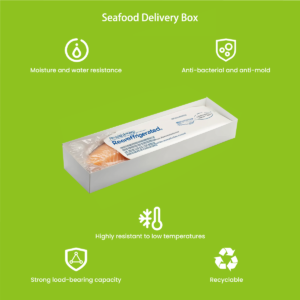
Seafood Delivery Box — The Box That Reaches the Customer’s Door
Seafood logistics have two distinct packaging challenges. The first — the wholesale pallet box that moves tuna from dock to auction, or shrimp from processing plant to distribution center — is about brute strength: survive the forklift, the cold storage stack, the cross-country reefer truck. The second — the delivery box that travels from the distribution center to a restaurant kitchen, a retail seafood counter, or a consumer’s doorstep — is about precision: maintain temperature with just an ice pack, arrive without leaks, and look professional when opened.
PPBOXY’s seafood delivery box is engineered for the second challenge. Fabricated from twin-wall corrugated polypropylene, it delivers the same waterproof durability as our wholesale seafood containers in a format optimized for route delivery: compact footprint, ice-pack compatible, leak-proof bottom, stackable on a delivery van shelf, and clean enough to open in front of a paying customer.
This is the box that replaces single-use styrofoam coolers and waxed cardboard in the growing direct-to-consumer seafood market — meal kit services, online fish markets, community-supported fishery (CSF) subscriptions — where packaging is part of the product experience and a damaged, leaking, or water-stained box means a lost customer.
| Produit |
Idéal pour |
Température |
Delivery Format |
Aller à |
| Coffret de livraison de fruits de mer |
Last-mile delivery — restaurant, retail, D2C |
0 à 4 °C au rayon frais + −18 °C au rayon surgelés |
Route delivery, customer-facing |
Cette page |
| Coffret de fruits de mer |
General wholesale seafood |
0 à 4 °C |
Pallet-level, distribution center |
Coffret de fruits de mer → |
| Boîte d'expédition pour poisson congelé |
Frozen fish export & shipping |
−18°C |
Pallet-level, container shipping |
Frozen Fish Shipping Box → |
| Boîte d'emballage pour fruits de mer frais |
Fresh seafood overview |
0 à 4 °C |
Wholesale & retail |
Boîte d'emballage pour produits de la mer frais → |
| Coffret de fruits de mer bien frais |
Iced fresh seafood transport |
0–4 °C, en glace |
Pallet-level transport |
Coffret de fruits de mer bien frais → |
Caractéristiques techniques
| Paramètre |
Caractéristiques techniques |
| Produit |
Seafood Delivery Box — PP corrugated last-mile delivery container |
| Matériau |
Polypropylène (PP) ondulé à double paroi de 3 à 5 mm, vierge, de qualité alimentaire |
| Dimensions standard |
300×200 mm, 400×300 mm, 500×350 mm (delivery-route-optimized footprints) |
| Poids du carton (vide) |
~0.3–0.8 kg |
| Capacité de charge |
3–12 kg per box |
| Plage de températures |
−20°C to +80°C (fresh and frozen compatible) |
| Absorption d'eau |
< 0.01% — ice-melt water will not soften box |
| Leak-Proof |
Yes — seamless folded base with optional sealed corners prevents liquid seepage |
| Ice-Pack Compatibility |
Gel packs, ice packs, dry ice — direct contact safe |
| Isolation |
Twin-wall flutes provide passive thermal barrier; pair with insulated liner for extended cold chain |
| Empilable |
Stackable 4–6 high on delivery van shelves; interlocking lid option |
| Conformité en matière de contact alimentaire |
FDA 21 CFR 177.1520 ; règlement (CE) n° 1935/2004 |
| Imprimabilité |
UV digital or screen print — seafood brand, species, catch date, QR code to recipe page |
| Recyclabilité |
100% PP #5 — no wax, no styrofoam |
| Cycles de réutilisation |
50+ delivery cycles |
| Personnalisation |
Size, thickness, lid type, ice-pack pocket integration, branding, QR code |
| Quantité minimale de commande |
50 unités (standard) ; 200 (personnalisées/imprimées) |
| Délai de livraison |
10 à 15 jours ouvrables |
Why Styrofoam and Waxed Cardboard Are Losing to PP in Seafood Delivery
The seafood delivery industry has relied on two packaging materials for decades — both with fundamental problems that PP solves:
| État |
Styrofoam Cooler |
Waxed Cardboard Box |
PP Corrugated Delivery Box |
| Isolation |
✅ Excellent (expanded polystyrene) |
❌ Minimal |
⚠️ Passive only — pair with insulated liner for equivalent performance |
| Imperméable |
✅ Yes (but seams leak) |
⚠️ Delays but doesn’t prevent water ingress |
✅ Fully waterproof — no seam leakage |
| Leak-Proof Base |
❌ Seams leak melt water onto customer’s floor |
❌ Box bottom softens and leaks |
✅ Seamless folded base |
| Empilabilité |
❌ Crushes under weight — max 2–3 high |
⚠️ Softens when wet — stack collapse |
✅ Stack 4–6 high, wet or dry |
| Customer Experience |
❌ Styrofoam debris, squeaking, landfill guilt |
❌ Water-stained, dented, tape-encrusted |
✅ Clean white surface, professional unboxing |
| Recyclabilité |
❌ EPS — technically recyclable but functionally landfilled (> 90% landfill rate) |
❌ Wax coating contaminates paper recycling → landfill |
✅ PP #5 standard recycling |
| Cost per Trip (50 uses) |
$1.50–3.00 (single use) |
$1.00–2.00 (single use) |
$0.04–0.08 |
| Single-Use Waste per 50 Deliveries |
50 styrofoam coolers → landfill |
50 waxed boxes → landfill |
1 box → recyclable |
The Customer Experience Factor Styrofoam has become a consumer-facing liability — customers associate it with environmental guilt, packaging waste, and an antiquated industry. Direct-to-consumer seafood brands increasingly market their switch away from styrofoam as a brand differentiator. PPBOXY’s PP delivery box provides the functional performance of a styrofoam cooler (when paired with an insulated liner) with none of the consumer backlash.
Seafood Delivery Supply Chain — From Distribution Center to Customer Door
Restaurant & Food Service Delivery
- DC Pick: Seafood order is picked at the distribution center — fresh fish fillets, shellfish, crustaceans — and packed in the PP delivery box with ice packs.
- Route Loading: Boxes are stacked 4–6 high on delivery van shelves. The rigid PP walls prevent crushing — the box at the bottom of a 4-box stack is identical in shape to the box at the top.
- Multi-Stop Delivery: The driver makes 15–30 stops. Boxes are opened at each stop for check-in. The clean PP surface and professional appearance reinforce the supplier’s quality image at every kitchen door.
- Return & Reuse: Empty boxes are collapsed flat, stacked, and returned to the DC on the same vehicle. 50+ cycles per box.
Direct-to-Consumer (D2C) Seafood Delivery
- Order Fulfillment: Fresh or frozen seafood is packed with gel ice packs in the PP delivery box. An optional insulated liner extends temperature hold time for overnight shipping.
- Last-Mile Courier: The box travels via overnight courier or local delivery service. PP’s impact resistance protects contents from courier handling; the leak-proof base means no “wet box” complaint calls.
- Customer Unboxing: The customer opens a clean, white, professional box — not a water-stained cardboard carton or styrofoam debris field. A QR code printed on the inside lid links to recipe suggestions, the fishery’s sustainability story, or reorder page.
- Box Return (Optional): For subscription services, the PP box can be returned, sanitized, and reused — or the customer keeps it for home storage. Either way, no single-use packaging enters the waste stream.
Seafood Delivery Box vs Other PPBOXY Seafood Containers
Foire aux questions
Q: Can this box replace styrofoam coolers for seafood delivery?
Yes, with an insulated liner. PP corrugated on its own provides passive thermal insulation through the twin-wall air channels, but for extended cold chain (4+ hours), pair the PP box with a foil-backed PE foam liner or gel-pack configuration. The combination delivers equivalent temperature hold time to a styrofoam cooler while eliminating the single-use waste, customer dissatisfaction, and recycling impossibility of styrofoam. Several direct-to-consumer seafood brands have made this switch as a marketed sustainability initiative.
Q: Is the box leak-proof for wet seafood?
Yes. The box base is folded from a single scored PP sheet — there are no glued seams or taped joints where melt water can seep through. For added security with high-moisture product (fresh fish packed on gel ice), PPBOXY offers optional sealed internal corners. The box can hold liquid melt water without dripping onto a customer’s floor, delivery van floor, or restaurant kitchen surface.
Q: What is the difference between this delivery box and a standard seafood box?
The seafood delivery box is optimized for last-mile route delivery: smaller footprints that fit delivery van shelving, lighter weight for driver handling, leak-proof base for customer-facing handoff, and a clean white surface suitable for unboxing in a restaurant kitchen or on a consumer’s doorstep. Standard seafood boxes are optimized for pallet-level wholesale distribution: larger formats, heavier construction, and designed for warehouse handling rather than driver-route delivery.
Q: Can I print my seafood brand on the box for D2C delivery?
Yes. PPBOXY prints logos, brand names, QR codes, and custom messaging directly onto the PP surface using UV digital or screen printing. For direct-to-consumer seafood brands, the unboxing experience is a brand touchpoint — a customized box with your logo and a QR code linking to recipe ideas or reorder page adds measurable value to the customer relationship. Pre-production digital proofs are provided at no charge. MOQ for printed boxes: 200 units.
Q: How do PP boxes perform compared to styrofoam on cost?
An insulated PP box configuration (PP box + foam liner + gel pack) costs more upfront than a single styrofoam cooler, but the per-delivery cost drops below styrofoam after approximately 8–12 uses. At 50 delivery cycles, the insulated PP system costs roughly 0.40–0.80pertripversus0.40–0.80pertripversus1.50–3.00 for a new styrofoam cooler each trip — savings of 70–85% per delivery. Additionally, eliminating styrofoam waste disposal fees and the negative customer perception of styrofoam contribute unquantified but real value.
Q: Can the boxes be sanitized between uses?
Yes. PP is non-porous and compatible with standard food-grade sanitizers used in seafood processing — peroxyacetic acid, quaternary ammonium compounds, and chlorine solutions at standard concentrations. The smooth PP surface does not harbor bacteria in pores or fibers (unlike cardboard). Wash, sanitize, air-dry, and the box is ready for its next delivery cycle.
Q : Quelle est la quantité minimale de commande ?
50 units for standard sizes. 200 units for custom sizes, printed boxes, or boxes with insulated liner integration. Contact us with your typical seafood product mix, delivery route structure, and volume for a configuration recommendation and quotation.