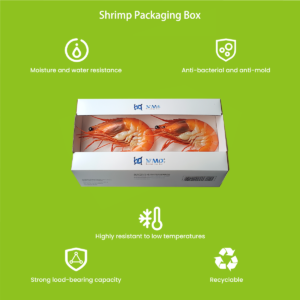
Shrimp Packaging Box — One Box, Two Temperature Zones
Shrimp distribution operates across two temperature regimes that most packaging materials handle poorly: fresh shrimp packed on ice at 0–4°C in retail-ready displays, and frozen shrimp block-frozen or IQF (individually quick frozen) at −18°C for wholesale and export. A wax-coated cardboard box can handle one or the other — but not both, and not for long.
PPBOXY’s shrimp packaging box is fabricated from twin-wall corrugated polypropylene that functions identically at both temperatures. At 0–4°C, sitting on a bed of crushed ice in a seafood display case, the waterproof PP walls prevent ice-melt water from softening the box structure. At −18°C, in a blast freezer or frozen storage facility, PP maintains full impact resistance — unlike waxed cardboard, which becomes brittle and cracks at freezer temperatures.
This dual-temperature capability means a single box format serves the entire shrimp supply chain: packing shed → cold storage → distribution center → retail display. No box change between fresh and frozen lines. No wet cardboard disposal fees. No wax contamination in the recycling stream.
| Produk |
Julat Suhu |
Ice Compatible? |
Retail Display? |
Pergi ke |
| Petak Pembungkusan Udang |
0–4°C fresh + −18°C frozen |
✅ Ice-pack & crushed ice direct contact |
✅ Seafood counter-ready |
Halaman ini |
| Seafood Box (General) |
0–4°C |
✅ |
Pilihan |
Seafood Box → |
| Petak Makanan Laut Beku Ais |
0–4°C iced |
✅ — ice-pack optimized |
❌ Transport-focused |
Ice Cold Seafood Box → |
| Petak-petak Udang Karang |
0–4°C live/lobster |
✅ |
❌ |
Lobster Boxes → |
| Pembungkusan Makanan Laut Segar |
0–4°C fresh |
✅ |
Pilihan |
Fresh Seafood Packaging Box → |
Spesifikasi
| Parameter |
Spesifikasi |
| Produk |
Shrimp Packaging Box — PP corrugated dual-temperature seafood container |
| Bahan |
3–5 mm twin-wall corrugated polypropylene (PP), virgin food-grade |
| Saiz Standard |
400×300 mm, 500×350 mm, 600×400 mm (footprint); height: 100–200 mm |
| Berat kotak (kosong) |
~0.4–1.0 kg |
| Kapasiti muatan |
5–15 kg per box |
| Julat Suhu |
−20°C to +80°C continuous (spanning frozen to ambient) |
| Penyerapan air |
< 0.01% — ice-melt water has zero effect on structure |
| Ice Compatibility |
Direct contact with crushed ice, ice packs, gel packs — no degradation |
| Freezer Performance |
Maintains full impact resistance at −18°C (unlike waxed cardboard which embrittles) |
| Saliran |
Optional bottom drainage holes for ice-melt water runoff |
| Pengudaraan |
Optional side-wall slots for cold air circulation |
| Menimbun |
Stackable 6–8 high on pallets; interlocking lid option available |
| Pematuhan Perhubungan Makanan |
FDA 21 CFR 177.1520; EU EC 1935/2004 |
| Kebolehcetakan |
UV digital or screen print — species name, count/size, origin, PLU, barcode |
| Kebolehkitar semula |
100% PP #5 — no wax coating to contaminate recycling stream |
| Kitaran Penggunaan Semula |
50+ kitaran |
| Pengubahsuaian |
Size, thickness, drainage, ventilation, internal dividers (head-on vs headless vs peeled separation), printing |
| Kuantiti minimum |
50 units (standard); 200 (custom) |
| Masa Pimpinan |
10–15 hari bekerja |
Why Waxed Cardboard Fails in Shrimp Packaging — The PP Advantage
The seafood industry has used wax-coated corrugated cardboard for decades — not because it works well, but because there was no affordable alternative. PP corrugated changes the equation:
| Kondisi |
Wax-Coated Cardboard |
PP Kotak Bergelombang |
| Ice contact (0°C, wet) |
Wax delays water absorption but does not prevent it — box softens over 6–12 hours |
< 0.01% absorption — no softening at any duration |
| Freezer temperature (−18°C) |
Cardboard embrittles; wax cracks; box shatters on impact |
Full impact resistance maintained |
| Stacking 6-high wet |
Bottom box compression strength drops 40–60% — stack collapse risk |
Compression strength unchanged — no collapse risk |
| Kitar semula |
Wax coating contaminates paper recycling stream — most waxed cardboard goes to landfill |
Clean PP #5 — fully recyclable in standard PP stream |
| End-of-trip appearance |
Water-stained, dented, wax peeling — not retail-presentable |
Clean white surface — display-ready |
| Cost per trip (50 cycles) |
$1.00–2.00 (new box each trip) |
$0.04–0.08 (one box ÷ 50 trips) |
The Wax Contamination Problem Wax-coated cardboard cannot be recycled in standard paper mills — the wax fouls the pulping equipment. In most markets, waxed seafood boxes are landfilled or incinerated. Switching to recyclable PP eliminates this waste stream entirely and supports seafood industry sustainability certifications (MSC, ASC, BAP) that increasingly require packaging recyclability.
Shrimp Supply Chain — From Boat or Farm to Seafood Counter
Shrimp moves through one of the most temperature-sensitive supply chains in food logistics:
Fresh Shrimp (0–4°C Chain)
- Harvest: Shrimp are caught or harvested from aquaculture ponds, immediately iced in onboard or dockside containers.
- Primary Processing (Hours 0–4): Shrimp are washed, graded by size/count (e.g., 16/20, 21/25, 26/30 per pound), and packed — head-on, headless, or peeled — into boxes with crushed ice or ice packs.
- Cold Storage & Distribution (Hours 4–24): Boxes enter cold storage at 0–4°C. Ice melts gradually; melt water drains through box drainage holes without pooling. Boxes stacked 6–8 high on pallets maintain structural integrity despite wet conditions.
- Retail Display (Hours 24–72): At the seafood counter, boxes serve double duty as display containers. The clean white PP surface presents shrimp attractively on ice beds. Unlike water-stained, dented cardboard, the PP box reinforces quality perception.
Frozen Shrimp (−18°C Chain)
- Freezing: Shrimp are IQF (individually quick frozen) or block-frozen, then packed into boxes.
- Frozen Storage (−18°C): Boxes enter frozen storage. PP maintains impact resistance — boxes can be moved, stacked, and handled without the brittle cracking that afflicts frozen cardboard.
- Pengedaran: Frozen boxes ship in refrigerated containers. PP’s dimensional stability prevents box deformation that could crush IQF shrimp during transport vibration.
- Thawing & Retail: At destination, boxes may be thawed for retail display or sold frozen. PP transitions from −18°C to ambient without condensation damage.
Shrimp Packaging Box vs Other PPBOXY Seafood Containers
| Produk |
Yang terbaik untuk |
Suhu |
Ice? |
Pergi ke |
| Petak Pembungkusan Udang |
Fresh & frozen shrimp — dual-temp |
0–4°C + −18°C |
✅ |
Halaman ini |
| Makanan Laut dalam Kotak |
General seafood — fish, shellfish |
0–4°C |
✅ |
Seafood Box → |
| Petak Makanan Laut Beku Ais |
Iced fresh seafood transport only |
0–4°C iced |
✅ |
Ice Cold Seafood Box → |
| Petak-petak Udang Karang |
Live lobster transport |
0–4°C |
✅ |
Lobster Boxes → |
| Petak Pembungkusan Ikan |
Whole fish, fillets |
0–4°C |
✅ |
Fish Packing Boxes → |
| Petak Pembungkusan Hidangan Laut Segar |
Fresh seafood overview (all species) |
0–4°C |
✅ |
Fresh Seafood Packaging Box → |
Soalan Lazim
Q: Can this box be used for both fresh and frozen shrimp?
Yes. PP corrugated performs identically at fresh (0–4°C, on ice) and frozen (−18°C) temperatures. Unlike waxed cardboard — which softens when wet at fresh temperatures and embrittles at freezer temperatures — PP maintains full structural integrity and impact resistance across the entire temperature range. This eliminates the need for separate packaging inventory for fresh and frozen product lines.
Q: Does ice melt-water damage the box?
No. PP absorbs less than 0.01% water. Ice melt-water pools at the bottom of the box and drains through the optional bottom drainage holes without affecting the box structure. After 12, 24, or 48 hours of continuous wet ice contact, the box is unchanged. This is the single largest operational advantage over waxed cardboard, which gradually softens as water penetrates the wax coating over time.
Q: Is PP safe for direct food contact with shrimp?
Yes. PPBOXY’s shrimp packaging boxes are manufactured from virgin food-grade polypropylene compliant with FDA 21 CFR 177.1520 and EU Regulation EC 1935/2004. PP is non-toxic, odorless, and does not leach chemicals into food. The smooth interior surface is easy to clean and sanitize between uses. A certificate of compliance is available with each order upon request.
Q: What sizes are available for different shrimp counts?
Standard box sizes accommodate the full range of commercial shrimp packaging: 400×300 mm for small-count retail packs; 500×350 mm for medium-volume distribution; 600×400 mm for bulk wholesale and export. Internal dividers can separate shrimp by size, product form (head-on / headless / peeled), or lot number within a single box. Contact us with your typical shrimp count and preferred weight-per-box for a size recommendation.
Q: How does PP compare to waxed cardboard on cost over time?
A PP shrimp box costs 8–15× more upfront than a waxed cardboard box. However, at 50 reuse cycles — typical for a dedicated shrimp distribution operation — the per-trip cost of the PP box drops to 0.04–0.08 versus 1.00–2.00 for a new waxed cardboard box each trip. After 8–12 trips, the PP box has paid for itself. After 50 trips, the savings are approximately 90–95% per trip compared to single-use waxed cardboard.
Q: Is the box recyclable after use?
Yes — and this is a significant advantage over waxed cardboard. PP is recycling code #5 and is accepted in standard PP recycling streams. Waxed cardboard, by contrast, cannot be recycled in standard paper mills because the wax contaminates the pulping process — most waxed seafood boxes end up in landfill. Switching to PP eliminates this waste stream and supports seafood sustainability certifications (MSC, ASC, BAP) that increasingly require packaging recyclability.
Q: Apakah kuantiti pesanan minimum?
We do not impose a minimum order requirement. Whether your needs call for a single prototype, a small-batch trial, or full-scale mass production, we are fully equipped to accommodate orders of any volume with the same level of service and quality.