What Is Corrugated Polypropylene Sheet? — Structure, Names & How It’s Made
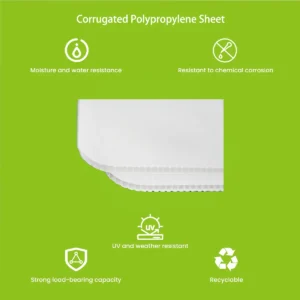
Corrugated polypropylene sheet is a rigid, lightweight plastic panel made from polypropylene (PP) resin. Its defining feature is the twin-wall structure: two flat PP skins connected by a series of parallel hollow channels — called flutes or ribs — running in one direction through the panel’s core. This geometry is what separates corrugated polypropylene from solid plastic sheet: the hollow channels act as structural beams, giving the board stiffness far beyond what the raw material mass would suggest, at roughly one-fifth the weight of an equivalent solid PP panel.
The material is manufactured by a co-extrusion process. Molten PP resin is fed through a flat-sheet die that produces both skins and the fluted core in a single, continuous pass. The flute profile — spacing, height, wall thickness — is set during extrusion and cannot be changed afterward. This is why thickness and density together define the mechanical properties of any given sheet: a 4mm sheet at 0.6 kg/m² has different load capacity than a 4mm sheet at 0.8 kg/m², even though both measure 4mm on a ruler.
How the industry names this material varies significantly by market:
| Trade Name |
Region |
Owned By |
| Coroplast |
USA, Canada |
Coroplast Inc. |
| Correx |
UK, Ireland |
Ariel Plastics |
| Corflute |
Australia, NZ |
Generic term |
| Corriboard |
UK, Ireland |
Generic term |
| Cartonplast |
Germany, Europe |
Generic term |
| Twinplast |
Global |
Several manufacturers |
| Corrugated polypropylene sheet |
Global |
Generic term |
| Fluted polypropylene sheet |
Global |
Generic term |
| PP hollow board |
Global (PPBOXY standard term) |
Generic term |
All of these names refer to the same material: extruded twin-wall polypropylene sheet. The differences are commercial branding, not product specifications. When you specify a board by technical parameters — thickness, density, flute geometry, UV grade, flame rating — the trade name becomes irrelevant.
PPBOXY manufactures corrugated polypropylene sheet at our Shandong production facility under ISO 9001 quality management. All sheet grades comply with REACH and RoHS regulations as standard.
Corrugated Polypropylene Sheet — Standard Specifications
| Specification |
Standard Value |
Custom Range |
| Material |
Polypropylene (PP) homopolymer or copolymer |
Virgin or recycled PP; food-grade PP available |
| Structure |
Twin-wall fluted (corrugated) profile |
Flute spacing 4–6 mm; wall thickness 0.4–0.7 mm |
| Standard sheet size |
1,220 × 2,440 mm (4 × 8 ft) |
Up to 2,100 × 6,000 mm |
| Thickness options |
2 / 3 / 4 / 5 / 6 / 8 / 10 / 12 mm |
Custom thickness available |
| Sheet weight — 4 mm |
~1.78 kg/sheet (0.6 kg/m²) |
Varies with density grade |
| Sheet weight — 5 mm |
~2.22 kg/sheet |
— |
| Color options |
White, black, blue, yellow, red, grey, green, clear |
Custom Pantone — 500 sheet MOQ |
| Surface finish |
Matt (standard), gloss (optional) |
Anti-slip, anti-static, printable corona-treated |
| Corona treatment |
≥ 38 dyne (standard for signage grade) |
Required for ink adhesion |
| Tensile strength |
≥ 18 MPa (MD) / ≥ 16 MPa (TD) |
— |
| Flexural strength |
≥ 22 MPa |
— |
| Impact strength |
≥ 10 kJ/m² (Izod notched) |
— |
| Water absorption |
< 0.01% |
— |
| Operating temperature |
-20°C to +80°C continuous |
-40°C to +100°C short-term |
| UV resistance — standard |
2–3 years outdoor (HB stabiliser) |
— |
| UV resistance — extended |
5+ years outdoor |
+15–25% price premium |
| Flame rating |
HB standard |
UL 94 V-0 available (FR grade) |
| Certifications |
ISO 9001, REACH, RoHS |
FDA 21 CFR 177.1520 (food-grade grade) |
| Printability |
CMYK digital, UV flatbed, screen, flexographic |
— |
| Recyclability |
100% (PP #5) |
— |
| MOQ |
No minimum |
— |
Five Grades of Corrugated Polypropylene Sheet — Which One Do You Need?
Not all corrugated polypropylene sheet is the same material. The base twin-wall structure is identical across grades, but compound additives and surface treatments change the performance envelope significantly. Five distinct grades cover most commercial applications:
Grade 1 — Standard (General Purpose)
Base polypropylene, HB flame rating, standard UV stabiliser (2–3 year outdoor life). This is the default specification for yard signs, temporary packaging, agricultural trays, and short-cycle industrial dividers. It is the lowest-cost grade and available in the widest colour range. Choose Standard when the application is either indoors or outdoor for less than 2 years with no regulatory flame or electrical requirements.
Grade 2 — UV-Stabilised (Long-Outdoor)
Elevated UV-absorber and HALS (hindered amine light stabiliser) package extends outdoor life to 5+ years without significant yellowing, embrittlement, or surface chalking. Required for permanent outdoor signage, building cladding panels, and agricultural greenhouse sidewalls. Price premium over Standard: 15–25%.
Grade 3 — Flame Retardant (FR / UL 94 V-0)
Halogen-free phosphorus-nitrogen flame retardant system achieves UL 94 V-0 (< 10 s self-extinguishing, no drip ignition). Required for construction partitions in IBC/NFPA-regulated buildings, transit vehicle interior panels, and trade-show booth walls under fire safety codes. Limiting Oxygen Index (LOI): 28–32%. See PP Flame Retardant Board for full FR specifications.
Grade 4 — ESD / Anti-Static (10⁹–10¹¹ Ω/sq)
Carbon-black or conductive polymer compound brings surface resistivity into the electrostatic dissipative (ESD) range. Required for packaging electronic components, PCB assembly trays, semiconductor wafer carriers, and clean-room dividers. Available with surface resistivity: anti-static (10⁹–10¹¹ Ω/sq) or conductive (10⁴–10⁶ Ω/sq).
Grade 5 — Food-Grade (FDA / EU Food Contact)
Virgin PP compound without heavy-metal pigments or recycled content. Complies with FDA 21 CFR 177.1520 (indirect food contact) and EU Regulation EC 1935/2004. Required for fruit and vegetable layer pads, beverage bottle tier sheets, food packaging dividers, and agriculture produce trays. Request certificate of compliance with order.
Quick-select table:
| Application |
Recommended Grade |
| Yard signs, construction hoarding |
Standard or UV-Stabilised |
| Permanent outdoor signage, greenhouse walls |
UV-Stabilised |
| Building partitions, transit interiors, trade show walls |
Flame Retardant (V-0) |
| Electronic component packaging, PCB trays |
ESD / Anti-Static |
| Food packaging dividers, beverage layer pads, produce trays |
Food-Grade |
| Standard reusable shipping dividers |
Standard |
| Cryogenic sample storage (vial dividers) |
See Cryobox Dividers page |
Corrugated Polypropylene Sheet vs Cardboard vs PVC Foam vs Solid PP
Corrugated polypropylene sheet competes with four other flat panel materials across signage, packaging, and construction applications. The comparison below uses a 4mm panel at equivalent stiffness for all materials.
| Property |
Corrugated PP Sheet |
Corrugated Cardboard |
PVC Foam (Foamex) |
Solid PP Sheet |
| Weight (4mm) |
~0.6 kg/m² |
~0.5 kg/m² |
~3.0 kg/m² |
~3.6 kg/m² |
| Waterproof |
Yes — < 0.01% absorption |
No — collapses when wet |
Yes |
Yes |
| Outdoor life |
2–5+ years |
1–2 weeks (outdoor) |
5–10 years |
10+ years |
| UV resistance |
Good (stabilised grade: excellent) |
Poor — yellows in days |
Good |
Good |
| Impact resistance |
High — hollow channels absorb shock |
Low — dents and tears |
Medium — brittle at low temp |
Excellent — solid mass |
| Printability |
Good (corona-treated surface) |
Good (but bleeds wet) |
Excellent (smooth face) |
Excellent |
| Machinability |
Score-and-fold, saw, CNC router |
Score-and-fold |
Saw, router, laser |
Drill, mill, machine |
| Chemical resistance |
Good (PP is resistant to most acids/bases) |
Poor — absorbs solvents |
Good |
Excellent |
| Recyclability |
100% PP #5 |
Yes (paper) |
Difficult (PVC) |
100% PP #5 |
| Cost per m² (4mm) |
$$ |
$ |
$$$ |
$$$$ |
| Cost per use (50 cycles) |
$0.02–0.05 |
$0.50–1.50 (1 use) |
$0.06–0.15 |
$0.04–0.10 |
| Best for |
Signage, packaging, construction protection, dividers |
Single-use indoor packaging |
Permanent indoor signage, shop-fit |
CNC-machined parts, permanent fixtures |
Decision guidance:
If the application is outdoor with budget constraints → corrugated polypropylene sheet beats cardboard on durability and PVC on cost.
If the application requires permanent outdoor installation (10+ years) → PVC Foam or aluminium composite panel (ACM) may be more appropriate despite higher upfront cost.
If the application requires precision machining, threading, or structural load-bearing → solid PP sheet or engineering plastics are the better choice.
If the application is single-use indoor packaging at minimum cost → corrugated cardboard remains the cheapest option.
Corrugated polypropylene fills the gap: durable enough for outdoor and repeated-use applications, light and cheap enough to replace cardboard at scale, without the weight or cost of solid plastic panels.
Applications by Industry
Signage and Advertising
Corrugated polypropylene sheet is the global standard substrate for short- and medium-term outdoor signage. The combination of light weight, corona-treated printable surface, and 2–3 year UV resistance makes it the material of choice for real estate yard signs, construction hoarding boards, event directional signage, and retail point-of-purchase displays. Standard application thickness: 3–5 mm. For full signage specifications including wind load ratings by thickness, see PP Hollow Board.
Packaging and Logistics
As a reusable, waterproof, and lightweight packaging substrate, corrugated polypropylene sheet reduces per-cycle packaging costs dramatically versus single-use corrugated cardboard. Applications include: folding packaging boxes for electronics and automotive parts, reusable layer pads and tier sheets for palletised loads, divider inserts for glass and ceramic shipments, and protective packaging for fragile items. For specific box formats, see PP Corrugated Plastic Box or Folded Packaging Box. For layer pads and tier sheets, see Plastic Layer Pads.
Construction and Building Protection
In construction, corrugated polypropylene sheet is used as a temporary surface protector for floors, stairs, countertops, and wall panels during building fit-out or renovation. The 4–6 mm sheet laid flat absorbs foot traffic, tool drops, and paint spills without damaging the finished surface beneath. Flame retardant grades (UL 94 V-0) are required in enclosed areas under fire safety regulations. See PP Flame Retardant Board for FR-grade specifications.
Agriculture
Food-grade and standard corrugated polypropylene sheets are used extensively in agricultural packaging: fruit and vegetable layer pads stacked on pallets, corrugated plastic harvest bins, greenhouse sidewall panels, and shade or windbreak boards. The material tolerates washdown with water and mild sanitisers without absorbing moisture or warping. See Agricultural Packaging Board for crop-specific packaging formats.
Electronics and ESD Packaging
For semiconductor, PCB, and precision component transport, ESD-grade corrugated polypropylene sheet (surface resistivity 10⁹–10¹¹ Ω/sq) eliminates electrostatic discharge damage during handling and transit. Applications include wafer carrier trays, PCB shipping boxes with ESD foam inserts, and anti-static layer pads for stacked component storage.
Medical and Laboratory
In healthcare and laboratory settings, corrugated polypropylene sheet is used for pharmaceutical packaging dividers, medical device tray inserts, and — at cryogenic grades — vial storage dividers for biobanking at -80°C and -196°C. See Pharmaceutical Packaging and Cryobox Dividers for application-specific information.
Corrugated Polypropylene Sheet vs Other PP Board Types — Which Page to Visit
Corrugated polypropylene sheet is the broadest category term. PPBOXY manufactures multiple variants and application-specific formats derived from the same base material. Use this table to find the most relevant page for your specific requirement.
| What you need |
Best PPBOXY page |
| General-purpose 4×8 twin-wall PP sheet for packaging or industrial use |
PP Hollow Sheet |
| Signage board — real estate, advertising, events, construction safety signs |
PP Hollow Board |
| 3mm corrugated sheet for yard signs |
3mm PP Corrugated Sheet |
| 4mm standard thickness sheet |
4mm PP Hollow Sheet |
| 5mm sheet for structural or large-format signage |
5mm Polypropylene Sheet |
| Blue colour corrugated sheet for construction protection |
5mm Blue PP Corrugated Sheet |
| High-density / high-strength PP board for load-bearing applications |
High Strength PP Board |
| Flame retardant corrugated sheet (UL 94 V-0) |
PP Flame Retardant Board |
| Honey comb structure board (maximum compression strength) |
PP Honeycomb Board |
| Printed correx / corriboard signs |
Corriboard / Correx Boards and Signs |
| Weatherproof printed display sheet for outdoor advertising |
Weatherproof Display Sheets |
| Corrugated PP protective sheet for floor/surface protection |
Protective Plastic Corrugated Sheets |
| Layer pads and tier sheets for palletised loads |
Plastic Layer Pads |
| Reusable folding packaging box |
Foldable Packaging Box |
| Custom OEM corrugated PP box |
Custom Plastic Shipping Containers |
| Custom PP board material for your own box production |
Custom PP Board for Packaging |
| Cryogenic vial dividers (-80°C / -196°C) |
Cryobox Dividers |
If your application is not covered above, contact PPBOXY to describe your specific load, temperature, regulatory, and size requirements. We manufacture corrugated polypropylene sheet in all five material grades with no minimum order quantity.
Frequently Asked Questions
Q1: What is corrugated polypropylene sheet made of?
Corrugated polypropylene sheet is made from polypropylene (PP) resin, a semi-crystalline thermoplastic. The raw material is fed through a co-extrusion die that produces two flat skins and a fluted (corrugated) core simultaneously in a single pass. The result is a twin-wall panel where hollow channels run parallel through the core. The standard grade uses virgin PP homopolymer or copolymer; food-grade versions use virgin PP without heavy-metal pigments; ESD grades use carbon-black compounds; flame-retardant grades use halogen-free phosphorus-nitrogen systems.
Q2: Is corrugated polypropylene sheet the same as Coroplast, Correx, or Corflute?
Yes. Coroplast, Correx, Corflute, Corriboard, Cartonplast, and Twinplast are all commercial trade names or regional terms for the same product: extruded twin-wall corrugated polypropylene sheet. The material specifications — thickness, density, flute geometry — are identical across brands. When you order by technical specification rather than brand name, the product is equivalent regardless of which manufacturer supplies it.
Q3: How is corrugated polypropylene sheet different from corrugated cardboard?
The structural principle is similar — both use a fluted core between two flat skins to achieve rigidity at low weight — but the materials perform very differently. Corrugated PP is waterproof (< 0.01% water absorption), while cardboard absorbs moisture and collapses when wet. Corrugated PP is reusable for 50–100+ cycles, while cardboard typically lasts 1–3 uses. Corrugated PP is chemically resistant; cardboard softens in contact with oils, solvents, and humidity. The upfront cost of corrugated PP is 3–5 × higher than cardboard, but the per-use cost is 10–50 × lower for any repeated-use application.
Q4: What thickness of corrugated polypropylene sheet should I use?
Standard application thickness guidelines:
- 2–3 mm: lightweight packaging inserts, layer pads, single-use flat dividers
- 3–4 mm: standard yard signs, trade show display boards, short-cycle packaging boxes
- 4–6 mm: medium-duty packaging boxes, construction surface protection, signage in moderate wind
- 6–8 mm: large-format signage, permanent construction hoarding, structural packaging
- 8–12 mm: load-bearing applications, heavy partitions, high-compression layer pads
If you are ordering for a specific application, our team can confirm the required thickness based on your load, span, and environmental conditions.
Q5: Can corrugated polypropylene sheet be printed on?
Yes. Corrugated polypropylene has a naturally non-polar surface that resists ink adhesion. PPBOXY applies corona treatment (≥ 38 dyne) to signage-grade sheets during extrusion, which oxidises the surface and allows ink to bond correctly. Supported print methods include UV flatbed digital, CMYK digital, screen printing, and flexographic printing. Packaging-grade sheets (non-corona) can be printed using solvent-based screen inks after light flame or corona pre-treatment.
Q6: Is corrugated polypropylene sheet recyclable?
Yes. Corrugated polypropylene sheet is 100% recyclable as PP #5. The single-material construction — no laminates, no adhesives, no mixed polymer layers — means it can be ground, melted, and re-extruded without separation steps. In practice, recycling logistics depend on local collection infrastructure. PPBOXY accepts back used PP hollow sheet from customers in volume — contact us for take-back programme details.
Q7: What is the difference between corrugated polypropylene sheet and fluted polypropylene sheet?
They are the same material under two different names. “Corrugated” describes the wavy internal channel profile when viewed in cross-section. “Fluted” describes the same channels from a different angle — the parallel hollow tubes running lengthwise through the panel. Both terms are used interchangeably in the industry. See also: Polypropylene Fluted Sheet for a dedicated page.
Q8: Is corrugated polypropylene sheet food safe?
Standard grades are not certified for direct food contact, as they may contain pigments or UV additives not approved for food contact. PPBOXY’s food-grade corrugated polypropylene sheet uses virgin PP compound compliant with FDA 21 CFR 177.1520 (indirect food contact) and EU Regulation EC 1935/2004. Food-grade sheets are used for fruit and vegetable layer pads, beverage bottle tier sheets, and produce packaging trays. Request the certificate of compliance at the time of ordering.
 Corrugated Polypropylene Sheet