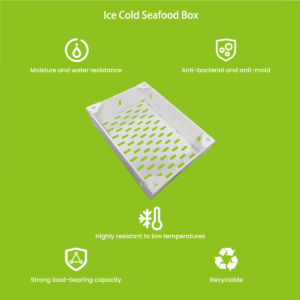
Ice Cold Seafood Box — Built for 0–4°C Iced Fresh Transport
An ice cold seafood box is a waterproof, reusable shipping container engineered specifically for iced-fresh seafood — products stored at 0–4°C using crushed ice or gel packs rather than mechanical refrigeration or blast freezing. Unlike frozen-seafood packaging (designed for −20°C static storage) or general fresh-seafood boxes (designed for ambient or lightly chilled conditions), an ice cold box must solve one challenge that no other packaging faces: continuous ice-melt water management over 24–72 hours of transit.
Every kilogram of ice packed with seafood becomes roughly one liter of meltwater within hours. That water must drain away from the product — without leaking onto pallets below — while the remaining ice continues to keep the catch at food-safe temperature. PPBOXY’s Ice Cold Seafood Box is purpose-built for this exact cycle: load with ice → seal → stack → drain meltwater → replenish ice → repeat.
Specifications
| Attribute |
Value |
| Material |
Polypropylene (PP) corrugated hollow sheet / PP honeycomb sheet |
| Food Contact Grade |
FDA 21 CFR 177.1520 / EU 10/2011 / GB 4806.7 |
| Wall Type |
Twin-wall fluted sheet / Honeycomb sheet (optional) |
| Sheet Thickness |
3 mm, 4 mm, 5 mm (twin-wall) / 5 mm, 8 mm (honeycomb) |
| Temperature Range |
−20 °C to +80 °C (operational); optimized for 0–4 °C iced transport |
| Insulation |
Twin-wall (standard) / Honeycomb (+25–30% vs twin-wall) |
| Waterproof Rating |
100% waterproof (closed-cell PP) |
| Drain Ports |
Integrated (bottom-center / dual-side / perforated base / custom) |
| Drain Port Caps |
Press-fit caps included (seal for dry mode) |
| Melt Rate Reduction |
Up to 30% slower ice melt vs open-top EPS (twin-wall) / 40% (honeycomb) |
| Stack Height |
8–10 layers (standard), 4–6 layers (live product) |
| Reusability |
50–200+ cycles depending on duty level |
| Fold-Flat Volume Reduction |
75–80% |
| Standard Sizes |
400×300×150 mm to 1200×800×400 mm |
| Custom Sizes |
Available (300+ standard molds + fully custom) |
| Colors |
15+ stock colors; custom Pantone matching |
| Printing |
Screen print (standard) / digital print (Corona-treated) |
| ISPM-15 |
Exempt (solid plastic, no wood content) |
| Recyclability |
100% PP recyclable |
| Certifications |
FDA / EFSA / EU 10/2011 / GB 4806.7 / ISO 9001 |
| MOQ |
Contact for details |
| Lead Time |
7–15 business days (standard); 3–5 days (stock sizes) |
The Ice-Melt Challenge: Why Ordinary Boxes Fail
Traditional seafood packaging breaks down at the exact point where ice cold conditions are most demanding:
| Failure Mode |
EPS Styrofoam |
Waxed Cardboard |
PP Corrugated (Ice Cold Box) |
| Meltwater absorption |
⚠️ Seams absorb → structural loss |
❌ Walls absorb → box collapses |
✅ Zero absorption; stays rigid |
| Drainage |
❌ No drain ports; water pools |
❌ No drainage; soggy bottom |
✅ Integrated drain ports; self-draining |
| Re-icing in transit |
❌ Must open box → break cold chain |
❌ Box too wet to reseal |
✅ Drain without opening → ice replenished through top |
| Stack weight on wet box |
❌ Cracks under load when wet |
❌ Compresses when saturated |
✅ No deformation wet or dry |
| After 24h in meltwater |
❌ Seams split; beads detach |
❌ Disintegrates |
✅ Identical to dry condition |
How PPBOXY’s Ice Cold Seafood Box Manages the Melt Cycle
The ice-melt cycle in a PPBOXY Ice Cold Seafood Box works in four continuous stages:
- Pack — Layer product with crushed ice or gel packs inside the waterproof box. The twin-wall PP construction provides passive insulation, slowing ice melt by up to 30% compared to open-top EPS containers.
- Seal & Ship — Close the lid. Meltwater flows downward through the product bed — washing and chilling simultaneously — and exits through integrated drain ports at the base or sides. No need to open the box during transit.
- Drain & Monitor — Meltwater exits through drain ports without opening the box, so cold air stays trapped and internal temperature remains in the 0–4°C safe zone. External temperature indicators or RFID loggers can be mounted on the lid for compliance documentation.
- Replenish & Repeat — At distribution hubs, add fresh ice through the top opening. The box is already empty of standing water (drained), so new ice directly contacts the product. No drying step needed — unlike cardboard that must be replaced after a single wet cycle.
Ice Cold vs Frozen vs Fresh: Which Seafood Box Do You Need?
Not all “cold” means the same thing in seafood logistics. The temperature range and preservation method determine the right box:
| Criterion |
Ice Cold Box (This Page) |
Frozen Shipping Box |
Fresh Seafood Box |
| Temperature |
0–4°C (iced) |
−20°C (blast frozen) |
0–10°C (ambient/cool) |
| Preservation method |
Crushed ice or gel packs |
Mechanical freezing |
Cold room / cool pack |
| Core challenge |
Meltwater management |
Temperature maintenance |
Moisture & bacteria |
| Drainage needed |
✅ Yes — continuous meltwater |
❌ No ice = no melt |
⚠️ Optional (condensation) |
| Insulation |
Twin-wall or honeycomb |
Double-wall insulated |
Single-wall standard |
| Typical product |
Fresh whole fish, shellfish, sashimi-grade |
Frozen fillet blocks, IQF shrimp |
Dried, cured, or lightly chilled seafood |
| Re-icing en route |
✅ Yes — at each hub |
❌ Not applicable |
⚠️ Rarely |
| Best for |
Auction houses, wet markets, HORECA |
Export, long-haul, cold storage |
Short-distance distribution |
| Learn more |
You are here |
Frozen Fish Shipping Box |
Fresh Seafood Packaging Box |
Key Features of the Ice Cold Seafood Box
Integrated Drain Ports for Ice-Melt Management
Every PPBOXY Ice Cold Seafood Box includes factory-cut drain ports positioned at the base or lower sidewalls — exactly where meltwater collects. Unlike aftermarket drilling (which creates sharp edges and weakens the structure), our integrated ports are clean-sealed during die-cutting for smooth edges and zero structural compromise. Available configurations:
| Drain Port Style |
Best For |
Flow Rate |
| Bottom center (single) |
Small boxes, single-species lots |
~2 L/min |
| Dual side ports (left + right) |
Large boxes, mixed loads |
~4 L/min total |
| Perforated base panel |
Shellfish (needs full-base drainage) |
~6 L/min |
All drain ports can be plugged with press-fit caps for dry transport or retail display — one box, two modes.
Twin-Wall & Honeycomb Insulation Options
PPBOXY offers two sheet constructions for ice cold boxes, each optimized for different transit durations:
| Construction |
Insulation Value |
Best For |
Weight |
| Twin-wall fluted sheet (3–5 mm) |
Standard insulation |
Short-haul (6–12 h) |
Lighter |
| PP honeycomb sheet (5–8 mm) |
Enhanced insulation (+25–30% vs twin-wall) |
Long-haul (24–72 h) |
Heavier but stronger |
The PP honeycomb construction is exclusive to this product line — no other PPBOXY seafood box offers it. The hexagonal cell structure traps a layer of still air between the inner and outer walls, providing superior thermal resistance without adding solid material weight. This makes it ideal for export shipments where ice must last 48+ hours without replenishment.
Food-Contact Safe (FDA / EFSA / EU 10/2011)
All PPBOXY ice cold seafood boxes are manufactured from food-grade polypropylene compliant with:
- FDA 21 CFR 177.1520 — Olefin polymers for food contact (USA)
- EU Regulation 10/2011 — Plastic materials in contact with food (Europe)
- EFSA migration limits — Specific and total migration within safe thresholds
- GB 4806.7 — Food contact plastics (China domestic standard)
Critical for ice cold applications: meltwater is in continuous contact with both the product and the box interior for the entire transit duration. Unlike dry-storage packaging, an ice cold box must maintain zero chemical migration under prolonged wet contact — all PPBOXY boxes pass immersion migration testing at 40°C for 10 days (far exceeding the 0–4°C real-world condition).
50–200+ Cycle Reusability
| Usage Intensity |
Estimated Cycle Life |
Typical Buyer |
| Light duty (retail display / wet market) |
150–200+ cycles |
Fish counters, sashimi bars |
| Medium duty (regional distribution) |
80–150 cycles |
Wholesalers, restaurant suppliers |
| Heavy duty (export + multi-hub re-icing) |
50–80 cycles |
International traders, auction houses |
At 50 cycles, the per-trip cost of a PP corrugated ice cold box is 70–85% lower than a single-use EPS foam equivalent — and the box folds flat for the return trip, reducing backhaul freight by 75–80%.
Custom Sizes, Colors & Corona Printing
| Customization |
Options |
Typical Use |
| Size |
300+ standard molds; fully custom dimensions |
Species-specific packing (e.g., long flatfish boxes) |
| Color |
15+ stock colors; custom Pantone match |
Species/grade color coding (e.g., blue=white fish, red=shellfish) |
| Printing |
Screen print (standard) / digital (Corona-treated) |
Handling icons, temperature log zones, traceability QR codes |
| Drain port placement |
Custom-positioned during die-cutting |
Species-specific drainage (e.g., shellfish = full-base perforated) |
| Insulation type |
Twin-wall (standard) / honeycomb (export) |
Transit duration selection |
Seafood Species Best Served on Ice
Not all seafood belongs in a freezer — and not all “fresh” seafood stays fresh without ice. Here are the species categories where iced transport at 0–4°C is the gold standard:
Whole Fish & Fillets (Ice-Packed)
Fresh whole fish — from Atlantic cod to Mediterranean sea bass — is traditionally buried in crushed ice from dock to market. The ice keeps the flesh at 0–2°C, slows bacterial growth by 10x compared to 8°C storage, and maintains the glossy eye and bright gill color that buyers at auction houses and wet markets use as freshness indicators. PPBOXY’s ice cold boxes are designed with elongated dimensions (up to 1200 mm) to accommodate whole round fish without tail-overhang, and drain ports positioned to keep the fish elevated above meltwater.
Shellfish — Oysters, Clams & Mussels
Live bivalve shellfish must remain moist but not submerged during transport. PPBOXY ice cold boxes for shellfish feature a perforated elevated base that allows meltwater to drain below while keeping oysters and clams in a humid — not flooded — environment. The twin-wall insulation slows ice melt, reducing the frequency of re-icing on routes longer than 12 hours.
Crustaceans — Lobster, Crab & Shrimp (Live or Chilled)
Live lobsters and crabs require cool (2–8°C), humid, oxygenated conditions — not freezing. PPBOXY’s ice cold boxes for crustaceans include precision ventilation holes that maintain airflow while ice packs regulate temperature. For chilled (not live) shrimp and prawns, see our dedicated Plastic Corrugated Shrimp Box with solid-wall insulation for cold-chain warehouse storage. For crab-specific handling, see our Crab Packing Box with reinforced drop-tested construction.
Squid, Octopus & Cephalopods
Cephalopods are among the most delicate seafood — their skin tears and discolors easily under rough handling. Iced transport at 0–4°C in smooth-walled PP corrugated boxes prevents skin damage while maintaining the translucent appearance that signals freshness in Asian and Mediterranean markets. The waterproof interior can be hosed down between lots without drying — a critical advantage over cardboard in high-volume squid processing.
Sashimi-Grade Seafood for Retail & Horeca
Sashimi and sushi-grade tuna, salmon, and yellowtail demand unbroken 0–4°C cold chain from processing to display — even a 30-minute excursion above 4°C can disqualify a batch. PPBOXY ice cold boxes with honeycomb insulation maintain sub-4°C for 24+ hours with standard ice loading, making them suitable for the final-mile delivery of sashimi-grade product to restaurants and retail counters. Custom-printed boxes reinforce brand identity for premium HORECA suppliers.
Frequently Asked Questions
What is an ice cold seafood box?
A: An ice cold seafood box is a waterproof, reusable PP corrugated container designed for iced-fresh seafood transport at 0–4°C. Unlike frozen-seafood boxes (−20°C) or general fresh boxes, it is engineered specifically for ice-melt management — with integrated drain ports that let meltwater exit without opening the box, maintaining the cold chain while keeping product elevated above standing water.
How does an ice cold seafood box differ from a frozen seafood box?
A: Temperature and preservation method. An ice cold box maintains 0–4°C using crushed ice or gel packs — ideal for fresh whole fish, live shellfish, and sashimi-grade product. A frozen seafood box maintains −20°C for blast-frozen fillets and IQF product — see our Frozen Fish Shipping Box. Ice cold boxes need drain ports; frozen boxes need insulation. They serve different products and supply chains.
Which seafood species need iced (not frozen) transport?
A: Most fresh-market seafood is best transported on ice, not frozen:
- Whole round fish (cod, sea bass, snapper) → Ice-packed in this box
- Live shellfish (oysters, clams, mussels) → Moist-iced in this box (perforated base)
- Live crustaceans (lobster, crab) → Cool-iced in this box (ventilated) or our Crab Packing Box
- Chilled shrimp/prawns → Plastic Corrugated Shrimp Box (cold-chain warehouse)
- Frozen blocks/IQF → Frozen Fish Shipping Box (−20°C)
How do the drain ports work? Can they be sealed for dry transport?
A: Integrated drain ports are factory-cut during die-cutting for smooth, sealed edges. Meltwater flows through the ports by gravity — no pumping or tilting required. For dry transport or retail display, each port includes a press-fit cap that seals the opening watertight. One box, two modes: drain-open for iced transit, sealed for dry storage or display.
What is the PP honeycomb sheet option, and when do I need it?
A: PP honeycomb sheet is a hexagonal-cell structure that traps a layer of still air between inner and outer walls, providing 25–30% better insulation than standard twin-wall fluted sheet. It is recommended for:
- Export shipments where ice must last 48+ hours without replenishment
- Multi-hub routes with 2–3 re-icing stops
- Tropical climates where ambient heat accelerates ice melt
For short-haul (6–12 h) and regional distribution, standard twin-wall construction is sufficient and lighter.
Is the ice cold seafood box food-contact certified?
A: Yes. All PPBOXY ice cold boxes are manufactured from food-grade polypropylene compliant with FDA 21 CFR 177.1520 (USA), EU Regulation 10/2011 (Europe), and GB 4806.7 (China). For ice cold applications specifically, our boxes pass immersion migration testing at 40°C for 10 days — far exceeding the 0–4°C real-world condition where meltwater is in continuous contact with both the product and box interior.
Can PPBOXY customize drain port positions for different seafood types?
A: Yes. Drain port placement is customizable during die-cutting — not a post-manufacturing modification. Options include:
- Bottom-center single port — standard, suitable for whole fish
- Dual side ports — for large boxes with mixed loads
- Perforated base panel — for shellfish requiring full-base drainage
- Custom positions — specified by the buyer based on product and stacking orientation
 Ice Cold Seafood Box