Why Use Corrugated Plastic Sheets for Site Protection?
Construction sites destroy surfaces. Drywall gets gouged, hardwood floors get scratched, countertops get chipped, and window frames get dented — all before the building is even finished. The cost of surface repair after construction typically runs 2–5% of total project value, and schedule delays from rework can push completion dates by weeks.
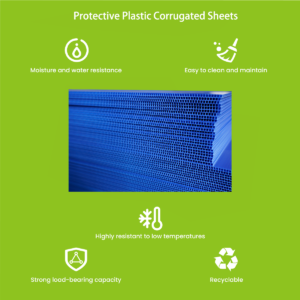
Protective plastic corrugated sheets are purpose-built to prevent this damage. Unlike cardboard sheeting that tears under foot traffic, or plywood panels that scratch the very surfaces they are meant to protect, PP corrugated sheets provide impact absorption without surface transfer — they absorb the blow without passing it through.
Three properties make PP corrugated sheets the standard for construction site protection:
1. Impact Absorption Without Surface Transfer
PP corrugated board has a fluted twin-wall structure that acts as a micro-shock absorber. When a dropped tool or foot impact hits the sheet, the flutes compress and rebound, dissipating energy before it reaches the protected surface. Plywood, by contrast, transfers impact directly through its rigid mass — a 2 kg wrench dropped from waist height onto plywood over a marble floor will chip the marble; the same drop onto a 4 mm PP corrugated sheet leaves the marble undamaged.
- Drop test performance: 4 mm PP corrugated sheet absorbs 85%+ of impact energy from a 2 kg drop at 1.5 m height (ASTM D5420 modified)
- No surface transfer: PP’s surface hardness (Shore D 65–75) is lower than most finished surfaces — it will not scratch hardwood, stone, or glass even under sliding loads
- Rebound after compression: PP recovers >90% of its original thickness after 50 compression cycles at 50% deflection — plywood permanently dents under the same conditions
2. 100% Waterproof — No Staining, No Warping
Cardboard protection sheets are destroyed by a single rain event or accidental spill. Even “water-resistant” treated cardboard degrades after 48 hours of humidity exposure, leaving rust stains on light-colored surfaces from its metal staple bindings. PP corrugated sheets absorb zero water:
- Moisture absorption: <0.02% (vs. cardboard at 6–9%) — PP is effectively waterproof
- No staining: PP contains no metal fasteners, no adhesive residues, and no sizing agents that could leach onto protected surfaces
- Wet-work compatible: PP sheets can be used directly over wet concrete, fresh tile grout, and recently painted surfaces without adhesion or staining — cardboard and kraft paper cannot make this claim
- Mold-proof: PP does not support mold growth, even when stored damp for weeks — cardboard develops mold within 72 hours at >80% relative humidity
3. Reusable 50–200+ Times — Dramatic Cost Reduction
The economics of PP protection sheets vs. cardboard are decisive over any project longer than one week:
| Cost Factor |
PP Corrugated |
Cardboard |
Plywood |
| Unit cost (4×8 ft sheet) |
$4–8 |
$1–3 |
$12–25 |
| Uses before replacement |
50–200+ |
1–3 |
5–15 |
| Cost per use |
$0.02–0.16 |
$0.33–3.00 |
$0.80–5.00 |
| Disposal cost per sheet |
$0 |
$0.50–1.50 |
$2–5 |
| Surface damage rate (with protection) |
<0.5% |
2–5% |
1–3% |
Break-even: A PP sheet at 6.00lasting100usescosts6.00lasting100usescosts0.06/use — vs. cardboard at 2.00lasting2uses=2.00lasting2uses=1.00/use. PP becomes cheaper after just 4 uses. On a typical 6-month construction project, a single PP sheet replaces 50–100 cardboard sheets.
Material Comparison: PP Corrugated vs. Cardboard vs. Plywood vs. Masonite
| Property |
PP Corrugated |
Cardboard |
Plywood |
Masonite |
| Waterproof |
✅ 100% |
❌ |
⚠️ Surface only |
❌ Swells |
| Impact Absorption |
✅ Fluted core |
❌ Crushes |
❌ Transfers |
❌ Cracks |
| Surface Safe (no scratch) |
✅ |
✅ |
❌ Rough back |
⚠️ Gritty |
| Stain Risk |
✅ Zero |
❌ Rust/adhesives |
⚠️ Sap/resin |
⚠️ Oil |
| Mold Resistant |
✅ |
❌ 72 hrs at 80% RH |
⚠️ |
❌ |
| Weight (4×8 ft, 4mm) |
1.2–1.8 kg |
0.8–1.2 kg |
9–14 kg |
7–10 kg |
| Reusable |
✅ 50–200+ |
❌ 1–3 |
⚠️ 5–15 |
❌ 1–5 |
| Recyclable |
✅ (#5 PP) |
✅ |
⚠️ Treated wood |
❌ |
| Cut to Fit On-Site |
✅ Utility knife |
✅ |
❌ Saw required |
❌ Saw required |
| Typical Cost/Sheet |
$4–8 |
$1–3 |
$12–25 |
$8–15 |
Decision rule: If your construction project lasts more than one week, involves any wet work, or protects any stain-sensitive surface (marble, hardwood, light-colored tile), PP corrugated protection sheets are not optional — they are the minimum viable protection. Cardboard fails on water; plywood fails on weight, cost, and scratch risk.
Looking for general-purpose PP sheet material (not specifically for site protection)? Visit our PP Corrugated Sheet page for the full material overview, or our Polypropylene Corrugated Sheet page for specification-grade PP board.
Specifications
| Parameter |
Value |
| Material |
Polypropylene (PP) corrugated board |
| Wall Type |
Twin-wall / Fluted |
| Thickness Range |
2–12 mm (standard: 2, 3, 4, 5, 6, 8, 10, 12 mm) |
| Standard Sheet Size |
1220 × 2440 mm (4 × 8 ft) |
| Custom Size Range |
300 × 300 mm to 2440 × 1220 mm |
| Density |
0.90–0.91 g/cm³ |
| Weight (4×8 ft, 4 mm) |
1.2–1.8 kg |
| Point Load (4 mm) |
80 kg (25 mm diameter) |
| Distributed Load (4 mm) |
800+ kg/m² on rigid substrate |
| Moisture Absorption |
<0.02% (ASTM D570) |
| Impact Energy Absorption |
85%+ (2 kg drop at 1.5 m) |
| Chemical Resistance |
Latex paint, acrylic sealers, tile grout, concrete, ethanol, isopropanol |
| Temperature Range |
-20°C to +80°C |
| Flammability |
UL 94 HB (FR grade available) |
| Surface Options |
Smooth / Anti-slip embossed / Corona-treated |
| Colors |
White (standard), Blue, Clear, Custom Pantone |
| Custom Printing |
✅ Screen / UV Digital |
| Pre-creased Folds |
✅ Door handles, corners, stair noses |
| Reusability |
50–200+ cycles |
| Recycling Code |
#5 PP |
| Food Contact |
✅ FDA 21 CFR 177.1520 / EU 10/2011 |
| MOQ |
None |
Types of Protective Corrugated Plastic Sheets
Not all site protection is the same. Different construction phases and surface types require different sheet configurations. PPBOXY manufactures five distinct protection formats, each optimized for a specific protection challenge:
| Protection Type |
Best For |
Typical Thickness |
Key Feature |
Size |
Learn More |
| Floor Cover Sheets |
Hardwood, tile, concrete floor protection during construction |
2–5 mm |
High load capacity (800+ kg/m²), anti-slip texture |
4×8 ft standard |
— |
| Wall Guard Panels |
Drywall, painted walls, corridor impact protection |
3–5 mm |
Vertical roll-out format, tape-free installation |
Custom roll lengths |
— |
| Window Mask Sheets |
Window frames, glass edges, sill protection |
2–3 mm |
Low-adhesion surface, zero residue on glass |
Cut-to-fit |
Weatherproof Display Sheets |
| Countertop Wraps |
Kitchen counters, vanities, lab surfaces |
3–4 mm |
Chemical-resistant top layer, sealed edges |
Custom sizes |
Corrugated Plastic Layer Pad |
| Door Skin Protectors |
Interior/exterior door surfaces, frame edges |
2–3 mm |
Form-fitting, pre-creased for door handle cutouts |
Standard door sizes |
— |
Protection type selection rule: If you are protecting a horizontal walking surface, you need Floor Cover Sheets (load capacity is critical). If you are protecting a vertical surface from impact, you need Wall Guard Panels (roll-out format saves installation time). If you are protecting glass or transparent surfaces, you need Window Mask Sheets (low adhesion prevents residue). If you are protecting work surfaces from chemicals and spills, you need Countertop Wraps (sealed edges prevent seepage).
Need waterproof board for non-construction applications? Our Waterproof Hollow Board covers packaging, signage, and general waterproofing scenarios.
Features & Specifications
Impact Resistance & Load Capacity
PP corrugated protection sheets are engineered to absorb the point loads and distributed loads common on construction sites — from foot traffic and tool drops to material staging and equipment rolling:
- Point load resistance: 4 mm sheet withstands 80 kg point load over 25 mm diameter without puncture (vs. cardboard at 15 kg)
- Distributed load capacity: 800+ kg/m² for 4 mm sheet on rigid substrate — sufficient for foot traffic, light carts, and material staging
- Drop test: 2 kg steel ball dropped from 1.5 m onto 4 mm sheet over marble — zero damage to marble (cardboard: 3/5 drops cause chipping)
| Thickness |
Point Load Max |
Distributed Load |
Best For |
| 2 mm |
40 kg |
300 kg/m² |
Wall guards, window masks, light surface covers |
| 3 mm |
60 kg |
500 kg/m² |
Countertop wraps, door skins, low-traffic floor covers |
| 4 mm |
80 kg |
800 kg/m² |
Floor covers, heavy-traffic areas, material staging |
| 5 mm |
100 kg |
1,000 kg/m² |
Stair protection, elevated work platform undershields |
Waterproof & Chemical Resistance
Construction sites are wet environments — fresh concrete, wet tile grout, paint overspray, and weather exposure are routine. PP corrugated sheets handle all of them:
- Moisture absorption: <0.02% — effectively zero (cardboard: 6–9%)
- Waterproof: 100% waterproof — no swelling, no warping, no loss of structural integrity after continuous immersion
- Chemical resistance: Resistant to common construction chemicals — latex paint, acrylic sealers, tile grout, concrete splash, and mild solvents (ethanol, isopropanol)
- Wet-work safe: Can be placed directly over wet surfaces without adhesion or staining — critical for tile and stone installation protection
- Mold-proof: No mold growth even after 30 days at 90% RH — cardboard develops visible mold colonies within 72 hours
Easy Cut & Install — No Power Tools Required
One of PP corrugated sheet’s greatest advantages on construction sites is its installability without power tools:
- Cut with utility knife: Score-and-snap method cuts sheets to any shape in seconds — no saw, no dust, no noise. Plywood and masonite require circular saws, producing noise complaints and airborne dust.
- Flex to fit: PP sheets flex around corners, columns, and curved surfaces — rigid materials like plywood and masonite cannot conform to non-flat geometries.
- Lightweight handling: A 4×8 ft sheet at 4 mm thickness weighs 1.2–1.8 kg — one person can carry and position multiple sheets. The same size plywood weighs 9–14 kg.
- Tape-free installation options: For wall protection, PP sheets can be interlocked using tab-and-slot systems or held in place by compression fit — no adhesive tape required, zero residue on painted surfaces.
Cost-Effective & Reusable
| Cost Factor |
PP Corrugated |
Cardboard |
Plywood |
| Unit cost (4×8 ft) |
$4–8 |
$1–3 |
$12–25 |
| Uses before replacement |
50–200+ |
1–3 |
5–15 |
| Cost per use |
$0.02–0.16 |
$0.33–3.00 |
$0.80–5.00 |
| Labor to install (per sheet) |
30 sec |
1 min (taping) |
3 min (saw + position) |
| Labor to remove (per sheet) |
15 sec |
30 sec (debris cleanup) |
2 min (heavy panel) |
| Disposal cost |
$0 (recyclable) |
$0.50–1.50 |
$2–5 |
Break-even: PP becomes cheaper than cardboard after 4 uses. On a typical 6-month project with 50 sheets, switching from cardboard to PP saves $3,000–8,000 in material and disposal costs alone — before counting the labor savings from faster installation and removal.
At end-of-life, PP is fully recyclable as #5 plastic. PPBOXY offers bulk take-back for large construction projects.
Customization Options
PPBOXY manufactures protective corrugated sheets to your project specifications:
- Custom sizes: Cut to any dimension from 300×300 mm to 2440×1220 mm (4×8 ft)
- Thickness range: 2 mm, 3 mm, 4 mm, 5 mm, 6 mm, 8 mm, 10 mm, 12 mm
- Colors: White (standard for floor protection — visible damage indicator), Blue (high-traffic zone marking), Clear (visibility of protected surface), Custom Pantone
- Surface texture: Smooth (wall/window), Embossed anti-slip (floor), Corona-treated (for printed branding or safety markings)
- Pre-creased folds: Door handle cutouts, corner wraps, stair-nose profiles
- Printed options: Company logo, safety warnings, no-step zones, project identification — via screen printing or UV digital
For custom-cut round protectors for pipes, drums, and cylindrical items, see our PP Corrugated Protectors page.
Applications by Protection Scenario
New Construction Floor Protection
During new construction, finished floors face their highest risk window — the period between installation and handover when every trade walks, rolls, and stages materials across the surface. PP corrugated floor cover sheets protect hardwood, tile, marble, polished concrete, and epoxy coatings during this critical phase.
Typical use: 4 mm floor cover sheets taped at seams with PP-compatible tape, laid over finished floors from rough-in through punch list. Anti-slip embossed texture prevents worker slips even when wet.
Related product: PP Corrugated Sheet for standard sheet material specifications
Renovation & Remodeling
Renovation projects have unique protection challenges: existing finishes must be protected from demolition debris, paint overspray, and plumbing leaks — all while the building remains partially occupied. PP corrugated sheets are lightweight enough for single-person deployment in tight renovation spaces, and their waterproof construction handles accidental water events that would destroy cardboard protection.
Typical use: Wall guard panels in hallways and corridors, countertop wraps during kitchen remodels, floor covers during bathroom tile replacement
Related product: Waterproof Hollow Board for wet-area and waterproofing applications
Window & Door Frame Protection
Windows and doors are among the most expensive and damage-prone items on a construction site. Glass edges chip from tool contact, frames get scratched from material staging, and sills collect construction debris. PP corrugated window mask sheets provide low-adhesion, zero-residue protection that can be removed without solvents or scraping.
Typical use: 2–3 mm window mask sheets cut to frame profiles, door skin protectors with pre-creased handle cutouts
Related product: Weatherproof Display Sheets for outdoor-exposed window and door protection during extended construction
Pipe, Duct & Subsoil Protection
PP corrugated sheets serve as protective barriers in underground and subsoil applications — wrapping pipes and ducts to prevent backfill damage, separating utility runs, and providing a waterproof membrane between soil and below-grade structures. PP’s chemical resistance handles soil acidity and groundwater exposure that degrades cardboard and untreated wood.
Typical use: Pipe wrap sleeves, duct chase liners, subsoil separation membranes, utility crossing barriers
Related product: Polypropylene Corrugated Sheet for specification-grade underground applications
Frequently Asked Questions
Q1: What is the difference between “Protective Plastic Corrugated Sheets” and “PP Corrugated Sheet”?
Protective Plastic Corrugated Sheets are PP corrugated sheets specifically selected and configured for construction site surface protection — floor covers, wall guards, window masks, and countertop wraps. Our PP Corrugated Sheet page covers the full range of PP corrugated sheet applications (signage, packaging, general use). If you already know you need site protection, this page gives you the scenario-specific guidance you need.
Q2: Can PP corrugated protection sheets handle heavy foot traffic?
Yes. A 4 mm PP corrugated floor cover sheet supports 800+ kg/m² distributed load on a rigid substrate — more than sufficient for foot traffic, light carts, and material staging. For heavy equipment traffic (forklifts, scissor lifts), use 5 mm or thicker sheets. The anti-slip embossed texture provides traction even when wet, making PP sheets safer than smooth plywood or masonite on construction sites.
Q3: How do PP protection sheets compare to cardboard protection board?
PP corrugated sheets outperform cardboard in every metric that matters on a construction site:
- Waterproof: PP absorbs <0.02% moisture vs. cardboard at 6–9%. A single rain event destroys cardboard; PP is unaffected.
- Reusable: PP lasts 50–200+ uses vs. cardboard at 1–3. Break-even at 4 uses.
- Impact: PP absorbs 85%+ of impact energy; cardboard crushes and transfers force.
- Mold: PP is mold-proof; cardboard develops mold in 72 hours at >80% humidity.
- Staining: PP leaves zero residue; cardboard’s adhesives and metal staples can stain light surfaces.
Q4: What thickness do I need for floor protection?
- 2–3 mm: Low-traffic areas, wall covers, window masks — foot traffic only, no material staging
- 4 mm: Standard floor protection — foot traffic, light carts, material staging (most common choice)
- 5 mm+: Heavy-traffic areas, stair protection, areas with equipment carts or pallet jacks
For a typical new construction project with finished hardwood or tile floors, 4 mm is the recommended standard.
Q5: Can PP corrugated protection sheets be cut on-site?
Yes — this is one of their biggest advantages. PP sheets can be cut to any shape with a standard utility knife using the score-and-snap method. No power tools, no dust, no noise. This allows rapid on-site customization around columns, doorways, staircases, and irregular floor plans. Plywood and masonite require circular saws, which produce noise complaints and airborne dust on occupied sites.
Q6: Are PP corrugated protection sheets recyclable?
Yes. PP is recyclable as #5 plastic through standard municipal and industrial recycling streams. Unlike cardboard (which is often contaminated with construction adhesives, paint, and moisture, making it ineligible for recycling), PP sheets remain clean and recyclable even after 100+ uses. PPBOXY offers bulk take-back for large construction projects.
Q7: What about round or cylindrical surface protection?
For protecting pipes, drums, cans, and other curved surfaces, see our PP Corrugated Protectors — round die-cut discs specifically engineered for cylindrical and contoured items. Flat sheets protect flat surfaces; round protectors conform to curves.
 Protective Plastic Corrugated Sheets