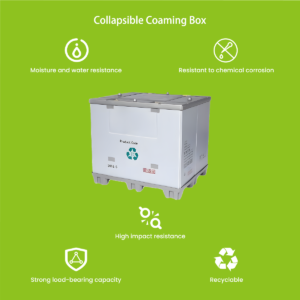
什么是可折叠箱框?——适用于重型闭环物流的蜂窝式可循环周转箱
可折叠包边箱是一种可循环使用的工业容器,由三个集成部件组成:带叉车进出口的不可折叠塑料底托盘、顶部边缘带有凸起包边圈的可折叠聚丙烯(PP)蜂窝板侧壁,以及兼作箱盖和堆垛面的不可折叠塑料顶托盘。 “箱沿”(coaming)一词源自船舶工程领域——在该领域中,舱口箱沿是指围绕船舶甲板开口、用于防止海水渗入的凸起边缘——该术语描述了该箱体的标志性结构特征:一个抬高的周边边缘,既能将内装物固定在原位,又能与上方堆叠箱体的底座相互咬合。.
PPBOXY 生产由聚丙烯蜂窝板制成的可折叠舷墙箱 ——这种材料在同等重量下,其抗压强度是标准波纹聚丙烯板的3–5倍(抗压强度≥0.8 MPa,而波纹中空板的抗压强度约为0.15–0.25 MPa)。 蜂窝芯将垂直载荷分散到数千个六边形单元中,使单个舷墙箱能够承载50–300公斤,而该箱体在空载时的重量却不到15公斤。.
当箱子不使用时,蜂窝状壁面会向内塌陷,顶层托盘可套入底层托盘——从而使箱体高度降低75–82%。 四个折叠后的箱子所占体积与一个展开后的箱子相当,在闭环供应链中可将回程运费降低约80%。.
| 产品 |
材料 |
承载能力 |
坍塌比 |
舷墙边缘 |
转到 |
| 可折叠舷墙箱 |
PP蜂窝板 + 塑料托盘 |
50–300 公斤 |
75–82%(4:1 回程比) |
✅ 是 — 可防止载荷转移 |
本页面 |
| 可折叠托盘箱 |
PP蜂窝板侧壁 + HDPE托盘底板 |
200–500 公斤 |
82%(5.5:1 回程比) |
❌ 不——笔直的墙壁 |
可折叠托盘箱 → |
| PP 波纹塑料箱 |
波纹聚丙烯板 |
5–30 公斤 |
因类型而异 |
❌ 否——标准箱式墙体 |
PP 波纹塑料箱 → |
| 可折叠瓦楞纸手提袋 |
波纹聚丙烯(PP)+钢带 |
10–50 公斤 |
60% (2.5:1) |
❌ 不——手提包 |
可折叠瓦楞纸手提袋 → |
| 可堆叠储物箱 |
波纹聚丙烯(硬质、不可折叠) |
30–150 公斤 |
不适用(不可折叠) |
❌ 否 — 开放性龋洞 |
可堆叠塑料储物盒 → |
技术规格
| 参数 |
规格 |
| 产品 |
可折叠舷墙箱 — PP蜂窝结构可循环工业箱 |
| 墙体材料 |
PP(聚丙烯)蜂窝板,六边形芯材 |
| 蜂窝单元直径 |
8 / 10 / 12 毫米(根据载荷要求而定) |
| 壁厚 |
8 / 10 / 12 / 15 毫米 |
| 抗压强度(墙体) |
≥ 0.8 MPa(蜂窝结构)——3–5×波纹聚丙烯 |
| 底座和盖子材质 |
不可折叠塑料托盘(PP/HDPE) |
| 舷墙边缘高度 |
20–50 毫米(定制)——墙体顶边带有凸起的边缘 |
| 内部体积 |
自定义 |
| 承载能力(静载) |
50–300 公斤(视壁厚和蜂窝密度而定) |
| 承载能力(动态/堆叠) |
200–800 公斤(4层堆垛中的最底层箱) |
| 堆叠高度 |
最多可堆叠4个单元(带舷墙互锁装置) |
| 坍塌比 |
75–82% 折叠后高度缩减 |
| Return Ratio |
~4:1 (4 collapsed boxes occupy 1 deployed box volume) |
| Empty Box Weight |
8–15 kg (varies by size and wall thickness) |
| 吸水率 |
< 0.01% (PP — fully waterproof) |
| 工作温度 |
−20 °C 至 +80 °C |
| 耐化学性 |
Resistant to oils, mild acids, alkalis, solvents |
| 抗紫外线性能 |
UV-stabilized (standard); extended UV grade available |
| 可燃性 |
HB(标准);提供符合 UL 94 V-0 阻燃等级的产品 |
| 可回收性 |
100% PP #5 (walls + pallets) |
| 自定义 |
Size, color, coaming height, logo/branding, RFID tag recess, drainage holes, fork entry direction |
| 最小起订量 |
无最低起订量 |
| 交货期 |
15–25 business days (custom); 7–10 days (repeat order) |
The Coaming Rim — How a Raised Edge Transforms Container Performance
The coaming rim is not cosmetic — it is a load-security and stack-stability feature that distinguishes this container from every other PP box in PPBOXY’s catalog.
Load Retention
The raised perimeter edge (typically 20–50 mm high) creates a physical barrier that prevents cylindrical, spherical, or loose-packed contents from rolling or sliding off the box walls during transport. In automotive parts logistics — where machined metal components with rounded edges are stacked loose in returnable containers — a standard straight-wall box relies entirely on friction and packing density to prevent load shift during truck braking or forklift maneuvering. A coaming rim eliminates this risk mechanically: the lip catches and redirects any load movement back into the container.
Stack Interlock
When boxes are stacked, the coaming rim of the lower box nests into a matching recess in the upper box’s bottom pallet. This creates a positive mechanical interlock — not just friction stacking — that resists lateral slip during transport. In a 4-high stack traveling on a truck bed, coaming interlock prevents the cascade failure mode where one shifted box causes the entire stack to topple.
Edge Rigidity
The coaming rim also serves as a structural stiffener. A straight-wall honeycomb panel resists vertical compression well but can deflect laterally under side impact. The folded or molded rim along the top edge creates a closed-section beam that resists bending in both directions — making the box walls significantly more resistant to forklift tine strikes and warehouse handling damage.
For buyers considering Foldable Pallet Boxes: The pallet box uses HDPE base + PP honeycomb walls in a larger format (600×400 to 1200×1000 mm) optimized for pallet-scale loads in food, beverage, and agricultural supply chains. The coaming box is purpose-built for the mid-range load segment (50–300 kg) where load security, not just load capacity, determines whether a returnable container program succeeds. If your parts slide, shift, or need to be individually separated within the container, the coaming box’s rim and the option for internal dividers address those requirements directly.
Honeycomb vs Corrugated — Why the Wall Material Matters at 50–300 kg
Collapsible coaming boxes use PP honeycomb board rather than the corrugated PP sheet used in lighter-duty folding boxes. The material choice is driven by the load range:
| 属性 |
PP Honeycomb Board (Coaming Box) |
PP Corrugated Sheet (Standard Folding Box) |
| 结构 |
Hexagonal cellular core between flat skins |
Parallel fluted channels between flat skins |
| 抗压强度 |
≥ 0.8 MPa |
≈ 0.15–0.25 MPa |
| Strength Advantage |
3–5× higher |
基线 |
| Load Direction |
Isotropic — equal strength in all directions |
Anisotropic — strong along flutes, weaker across |
| Impact Distribution |
Multi-axial — hexagonal cells distribute force radially |
Unidirectional — flutes channel force along one axis |
| Weight (10 mm panel, 1 m²) |
~1.8–2.2 kg |
~1.5 kg |
| Weight Penalty |
~20–40% heavier |
基线 |
| 防水 |
✅ < 0.01%吸收 |
✅ < 0.01%吸收 |
| 最适合 |
Returnable industrial containers, heavy parts logistics, automotive supply chains |
Light packaging, e-commerce boxes, single-use or short-cycle containers |
| Typical Service Life |
200–500+ 次循环 |
50–200个循环 |
The honeycomb structure’s isotropic strength is particularly important for coaming boxes because they experience multi-directional loads: vertical compression from stacking, lateral impact from forklift handling, and outward pressure from loose-packed contents pressing against walls during transport. Corrugated PP handles vertical compression along the flute direction well, but its cross-flute strength is significantly lower — a weakness that honeycomb’s hexagonal geometry eliminates entirely.
Collapsible Coaming Box vs Foldable Pallet Box vs Corrugated PP Box — Which Returnable Container Fits Your Supply Chain?
| 维度 |
Collapsible Coaming Box (This Page) |
可折叠托盘箱 |
PP 波纹塑料箱 |
| 墙体材料 |
PP蜂窝板 |
PP蜂窝板 |
波纹聚丙烯板 |
| Base |
Non-collapsible plastic pallet (bottom) |
HDPE pallet (bottom only) |
No pallet — flat corrugated PP base |
| Top |
Non-collapsible plastic pallet (lid + stacking surface) |
Optional lid (not standard) |
Open top or fold-over flaps |
| 舷墙边缘 |
✅ Yes — load retention + stack interlock |
❌ 否 |
❌ 否 |
| 承载能力 |
50–300 公斤 |
200–500 公斤 |
5–30 公斤 |
| Standard Footprint |
Custom (no standard) |
600×400, 800×600, 1000×800, 1200×1000 mm |
400×300、500×350、600×400、800×600 毫米 |
| 坍塌比 |
75–82% (4:1) |
82% (5.5:1) |
60–80% (varies by type) |
| 叉车通行 |
Bottom pallet fork channels |
HDPE base fork channels |
No — manual carry only |
| Food-Safe Options |
On request |
✅ Yes — food-grade available |
On request |
| Best Application |
Automotive parts, electronics, precision machinery — mid-weight, load-security-critical |
Food, beverage, agriculture — pallet-scale, high-volume |
E-commerce, light industrial, one-way export |
| 使用寿命 |
200–500+ 次循环 |
200–500+ 次循环 |
50–200个循环 |
Decision guidance:
- If you ship machined metal parts, electronic subassemblies, or loose components that shift during transit → Coaming Box (rim locks load in place).
- If you ship bulk produce, bottled beverages, or bagged agricultural products on standard pallets → Foldable Pallet Box.
- If your load is under 30 kg and you prioritize lowest per-box cost over return logistics → PP Corrugated Plastic Box.
- If you need both load security AND forklift handling for mid-weight parts (50–300 kg) in a closed loop → Coaming Box is the only product in the range with both features.
Applications — Where Coaming Boxes Outperform Every Other Returnable Container
Automotive Parts Logistics
Tier-1 and Tier-2 automotive suppliers move thousands of components — brake calipers, bearing assemblies, injection-molded trim pieces, wiring harnesses — between manufacturing sites and OEM assembly plants daily. These parts are heavy (5–50 kg per unit), often oily or greased, and must arrive without surface damage. The coaming box addresses all three constraints: honeycomb walls support stacked loads of engine components without deflection; the waterproof PP material tolerates cutting fluid and grease exposure without degradation; and the coaming rim prevents heavy cylindrical parts from rolling off during line-side delivery. Custom internal dividers and foam inserts transform a single coaming box into a multi-part kitting container for just-in-sequence assembly.
Electronics & Precision Instrument Shipping
Printed circuit board assemblies, server racks, optical instruments, and medical device modules require packaging that is rigid, static-safe, and clean-room compatible. PP honeycomb is inherently anti-static at surface resistivity 10⁹–10¹¹ Ω/sq in ESD-grade configurations. The coaming rim protects precision edges from forklift contact, and the top pallet lid provides full enclosure — important for clean-room transport between facilities. Unlike wooden crates, PP coaming boxes generate zero particulate shedding.
Industrial Machinery & Heavy Equipment Parts
Hydraulic cylinders, pump housings, gear assemblies, and replacement turbine components — heavy, high-value, irregularly shaped — are shipped between manufacturers, distributors, and end users. The coaming box’s 50–300 kg load rating accommodates most industrial spare parts, while the collapsible design means distributors can store empty boxes compactly between shipments instead of dedicating warehouse floor space to permanent crates.
Closed-Loop Retail & Wholesale Distribution
Retail distribution centers moving goods between central warehouses and store locations benefit from the coaming box’s return logistics efficiency. Collapse after delivery, stack 4:1, return on the same truck that brought the next shipment. Custom branding on the box exterior serves as a rolling advertisement and asset tracker throughout the supply chain.
Aerospace & Defense Logistics
High-value, traceable, and often export-controlled components require containers that are durable, tamper-evident, and fully documented. Coaming boxes can be fitted with RFID tag recesses, tamper-evident seal points, and unique serial numbers printed directly on the PP surface — supporting the full chain-of-custody documentation required in defense and aerospace logistics.
Which PPBOXY Industrial Container Fits Your Operation?
| 您需要准备什么 |
最佳 PPBOXY 页面 |
为什么 |
| Returnable bin for 50–300 kg parts with load-security coaming rim |
本页面 |
Honeycomb walls + dual pallets + coaming interlock |
| Pallet-scale returnable container (200–500 kg) for bulk food/ag loads |
可折叠托盘箱 → |
HDPE base, standard pallet sizes, food-safe grade |
| Lightweight folding box for e-commerce or light industrial (5–30 kg) |
PP 波纹塑料箱 → |
6 box types compared, lowest per-unit cost |
| Hand-carry tote for workshop WIP transport (10–50 kg) |
可折叠瓦楞纸手提袋 → |
Steel band reinforcement, hand holes |
| Rigid non-collapsible storage container for warehouse racking |
可堆叠塑料储物盒 → |
Open cavity, stackable 6–10 high |
| Custom OEM shipping container built to customer spec |
定制塑料运输箱 → |
Full OEM/ODM, any size, insert, closure type |
| PP honeycomb sheet material for your own fabrication |
PP蜂窝板 → |
Sheet sizes, cell diameters, technical data |
常见问题解答
Q: What is a coaming box and how is it different from a standard collapsible box?
A coaming box has a raised perimeter edge (the “coaming rim”) along the top of its walls — typically 20–50 mm high — that performs three functions: it prevents contents from sliding off during transport, it interlocks with the base of the box stacked above for positive stack stability, and it stiffens the wall panels against lateral impact. Standard collapsible boxes have flat-top walls with none of these features. The coaming rim is a load-security feature, not a structural afterthought.
Q: Why is PP honeycomb board used instead of corrugated PP?
PP honeycomb board delivers 3–5× the compression strength of corrugated PP sheet (≥ 0.8 MPa vs ≈ 0.15–0.25 MPa). This is necessary for the coaming box’s 50–300 kg load range — corrugated PP would buckle under the stacking loads that honeycomb handles routinely. Honeycomb’s isotropic strength (equal in all directions) also handles the multi-directional forces from loose-packed contents pressing outward against the walls during transport — a load case that corrugated PP’s anisotropic structure handles poorly.
Q: What is the “non-collapsible pallet at the top and bottom”?
该箱体包含两个不可折叠的硬质塑料托盘:一个位于底部(设有供叉车和手推车进出的叉口通道),另一个位于顶部(在运输过程中用作箱盖,在堆叠时用作堆放面)。 这种双托盘设计是船舷箱的独特之处——大多数可折叠集装箱只有底托盘,甚至根本没有托盘。当箱体折叠时,顶部托盘套入底部托盘,折叠后的蜂窝状壁板被夹在两者之间。.
Q: How much space do collapsed coaming boxes save?
可折叠的蜂窝状壁板向内折叠,使箱体高度减少75–82%。四个折叠后的箱体所占体积约等于一个展开状态的箱体。 在闭环供应链中,空箱需退回以供重新装载,与退回刚性不可折叠容器相比,这种4:1的退回比例可将退货运费降低约80%。.
问:有哪些尺寸可供选择?
Coaming boxes are manufactured to customer-specified dimensions — there are no off-the-shelf standard sizes because the coaming rim height, wall thickness, cell diameter, and pallet dimensions are all tuned to the specific load, stack height, and handling equipment of each customer’s supply chain. PPBOXY’s engineering team works from your internal dimensions, load weight, and stacking requirements to specify the optimal configuration. MOQ for custom-designed coaming boxes: 50 units.
Q: Can I add branding or RFID tracking to coaming boxes?
是的。PPBOXY 提供以下服务:将徽标和品牌标识直接印制在 PP 蜂窝板或托盘上(采用 UV 数字印刷或丝网印刷); 在托盘顶部或底部模压出 RFID 标签凹槽;为每件产品印制唯一的序列号或条形码,以便进行资产追踪;按产品线或工厂进行颜色编码;以及用于放置纸质运单或看板卡的定制标签架。汽车供应链中使用的围框式包装箱通常集成了 RFID 技术,用于“按序交付”的追踪。.
Q: Are coaming boxes suitable for outdoor storage?
是的。PP蜂窝板墙体和塑料托盘的吸水率低于0.01%,且经过紫外线稳定处理,适合户外使用。舷墙箱可存放在院内或装卸码头等户外区域,不会发生翘曲、膨胀或老化。 若需在紫外线强度高的气候条件下进行长期户外储存,请指定增强型抗紫外线等级(材料成本增加15–25%)。该防水材料还可承受高压水枪清洗,适用于对卫生要求较高的应用场景。.
问:最低订购量是多少?
标准配置的订单起订量为10件。定制设计的舷墙箱(新的内部尺寸、特定舷墙高度、定制托盘配置)起订量为50件。请向我们的工程团队提供您的货物、尺寸和装卸要求,以便进行设计咨询和报价。.