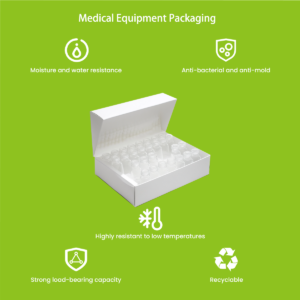
Medical Equipment Packaging — The Crate That Replaces Wood for Global Medical Equipment Export
An MRI magnet assembly weighs 4,000 kg. A CT gantry ships in a crate the size of a small car. An X-ray tube — fragile, expensive, irreplaceable in the supply chain — travels from a German factory to a Nigerian hospital via ocean container, truck, and rough tertiary road. At every handoff, the crate is the only thing between a $500,000 piece of medical equipment and destructive shock, vibration, and moisture.
The medical equipment industry has used wood crates for a century — not because wood is optimal, but because there was no viable alternative for loads exceeding 100 kg. PPBOXY’s heavy-duty PP corrugated medical equipment packaging changes that. Fabricated from 6–12 mm twin-wall PP sheet with internal PP honeycomb bracing, it delivers equivalent or superior crush strength to plywood crating at 40% less weight, is fully waterproof, generates zero wood splinters or ISPM-15 pest risk, and is 100% recyclable at end of life.
This page covers heavy-duty PP packaging for large medical equipment. For packaging of small surgical instruments, implants, and diagnostic kits, see Medical Device Packaging →. For custom-engineered packaging with full ISO 13485 validation, see Custom Medical Device Packaging →.
| Equipment Type |
Packaging Requirement |
Best PPBOXY Solution |
转到 |
| MRI, CT, X-ray, ultrasound |
Shock/vibration, heavy load, export crating |
PP honeycomb-braced heavy-duty box |
本页面 |
| Surgical instruments, implants, kits |
Sterile barrier, particulate control |
Standard PP medical boxes |
Medical Device Packaging → |
| Custom device-specific packaging |
Engineered to device CAD, ISO 13485 validated |
Custom engineering service |
定制医疗器械包装 → |
| Pharmaceuticals, medicines |
Temperature-controlled, tamper-evident |
药用级聚丙烯容器 |
PP 医药包装 → |
技术规格
| 参数 |
规格 |
| 产品 |
Medical Equipment Packaging — heavy-duty PP corrugated crating system |
| 材料 |
6–12 mm twin-wall corrugated polypropylene (PP) + PP honeycomb board internal bracing |
| Structural Design |
PP outer box + internal PP honeycomb bracing/cushioning + custom foam insert nests (PE, PU, EVA) |
| 承载能力 |
50–500+ kg per container |
| 标准尺寸 |
Custom — built to equipment dimensions (no standard sizes for medical equipment crating) |
| Compression Strength (Honeycomb Brace) |
≥ 0.8 MPa |
| Shock Absorption |
PP honeycomb + optional PE/PU foam — tested per ISTA 3A / ASTM D4169 |
| 吸水率 |
< 0.01% — fully waterproof; ocean container condensation will not degrade crate |
| Weight vs Plywood Crate |
~40% lighter — reduces freight cost and handling injury risk |
| ISPM-15 (Wood Packaging) |
Exempt — PP is not wood; no fumigation, no heat treatment, no stamp required |
| 颗粒物的产生 |
Zero wood splinters, zero fiber shedding — compatible with medical device clean room receiving |
| Forklift & Pallet Jack |
Integrated PP base with fork-entry channels; optional PP pallet base |
| 耐化学性 |
Resistant to disinfectants, cleaning agents, mild solvents |
| 温度范围 |
−20 °C 至 +80 °C |
| 可回收性 |
100% PP #5 — crate body + honeycomb bracing; foam inserts recyclable per material type |
| 自定义 |
Equipment-specific internal fixturing, foam nest CNC routing, shock indicators, tilt indicators, RFID tags, branding |
| 文档 |
Material certifications, ISTA/ASTM test reports (performed through partner lab), ISPM-15 exemption letter |
| 最小起订量 |
1 unit (prototype); 10 units (production) |
| 交货期 |
20–40 business days (custom design + testing); 10–15 days (repeat order) |
PP Crating vs Wood Crating — The Case for Switching Medical Equipment Export Packaging
The medical equipment industry’s reliance on wood crating is a habit, not an engineering decision. PP delivers measurable improvements in every dimension relevant to high-value equipment export:
| 维度 |
Wood Crate (Plywood) |
PP Corrugated Crate |
| Weight (1 m³ crate) |
~80–120 kg |
~50–70 kg (−40%) |
| 防水 |
❌ Absorbs moisture — warps, swells, molds |
✅ < 0.01% absorption — ocean condensation has zero effect |
| ISPM-15 Compliance |
❌ Requires fumigation or heat treatment + stamp |
✅ Exempt — no wood, no pest risk |
| ISPM-15 Cost |
$50–150 per shipment (fumigation cert) |
$0 |
| Particulate |
Wood splinters, sawdust — contamination risk for medical equipment |
Zero particulate — clean room receiving compatible |
| Nail/Screw Damage Risk |
Protruding fasteners can scratch equipment during unpacking |
No fasteners — interlocking PP design |
| 可回收性 |
❌ Mixed material (wood + nails + steel strapping) → landfill |
✅ 100% PP #5 single-material stream |
| Custom Fixturing |
Plywood partitions, foam inserts — labor-intensive assembly |
CNC-routed PP honeycomb + foam nests — precision fit |
| Disposal Cost at Destination |
$50–200 (construction waste or special handling) |
$0 — recyclable in local PP stream |
| Aesthetics/Professionalism |
Industrial, rough appearance |
Clean white surface, professional presentation |
The ISPM-15 Problem International Standards for Phytosanitary Measures No. 15 (ISPM-15) requires all wood packaging material used in international trade to be heat-treated or fumigated and stamped with a compliance mark. Non-compliant wood packaging is rejected at the destination port — the entire shipment is quarantined, re-exported, or destroyed at the exporter’s expense. PP packaging is categorically exempt from ISPM-15 because it contains no wood. For medical equipment exporters shipping to regions with strict biosecurity enforcement (Australia, New Zealand, EU), eliminating ISPM-15 risk is worth the per-crate cost differential alone.
Medical Equipment Supply Chain — Factory to Hospital, via Ocean and Road
Factory → Port (Domestic Truck)
The crated equipment travels from the manufacturing facility to the export port. PP crating’s 40% weight reduction versus wood lowers domestic freight cost and reduces the risk of handler injury during loading. The clean white PP exterior is visibly distinct from wood crates on a loading dock — reducing the chance of misrouting.
Ocean Container (2–8 Weeks)
Inside the container, the crate is exposed to temperature swings, condensation, and salt air. Wood absorbs this moisture — warping, swelling, and potentially developing mold that contaminates the equipment surface. PP absorbs zero moisture — the crate interior remains dry regardless of container conditions. ISPM-15 exemption eliminates the risk of customs rejection at the destination port.
Destination Port → Hospital (Truck + Final Mile)
The crate is offloaded and transported to the hospital or clinic. PP crating handles forklift handling, truck vibration, and final-mile maneuvering through hospital corridors (narrower and cleaner than warehouse aisles). The crate exterior is clean — hospital receiving departments do not need to worry about wood splinters, insects, or soil contamination on their loading dock.
Unpacking & Installation
The PP crate opens without nail pullers or crowbars — interlocking panels separate cleanly. No sharp fasteners risk scratching the equipment surface. The crate is disassembled and recycled as PP #5 or returned for reuse. Wood crates require nail removal, splinter cleanup, and disposal as construction waste.
常见问题解答
Q: What is the difference between medical equipment packaging and medical device packaging?
Medical equipment packaging handles large, heavy capital equipment — MRI machines, CT scanners, X-ray systems, ultrasound units, therapeutic devices — that weigh 50–500+ kg and ship in crate-sized containers. Medical device packaging handles small precision devices — surgical instruments, implants, diagnostic kits — that fit in handheld or tray-sized boxes. Equipment packaging is about shock/vibration protection and export crating; device packaging is about sterile barrier integrity and particulate control.
Q: Can PP crating really replace a wood crate for a 500 kg medical device?
Yes. PPBOXY’s heavy-duty PP crating uses 6–12 mm corrugated PP panels with internal PP honeycomb bracing. The honeycomb core (≥ 0.8 MPa compression strength) distributes load across the crate structure. For equipment exceeding 500 kg, we specify thicker panels, additional bracing points, and an integrated PP pallet base for forklift handling. Each crate design is reviewed against the equipment’s weight, center of gravity, and handling method before production.
Q: Is PP crating ISPM-15 exempt for international shipping?
Yes — categorically. ISPM-15 applies only to wood packaging material. PP contains no wood and requires no fumigation, heat treatment, or compliance stamp. PPBOXY provides an ISPM-15 exemption letter with each export shipment. For medical equipment exporters, this eliminates the risk of customs rejection, quarantine, or re-export at the destination port — a risk that costs $5,000–50,000+ per incident depending on equipment value and logistics rerouting.
Q: Can the packaging be tested to ISTA or ASTM distribution standards?
Yes. PPBOXY designs medical equipment crating to be compliant with ISTA 3A (packaged products for parcel delivery system shipment) and ASTM D4169 (standard practice for performance testing of shipping containers and systems). Physical testing is coordinated through a partner ISTA-certified laboratory. Test reports are provided as part of the packaging validation documentation package.
Q: How is the equipment secured inside the PP crate?
Equipment is secured using a combination of CNC-routed PP honeycomb bracing (structural support that transfers load to the crate walls), custom-cut PE/PU/EVA foam nests (shaped to the equipment geometry for vibration isolation), and PP retention straps (securing the equipment to the crate base). The fixturing is designed using your equipment CAD file or 3D scan. No nails, screws, or metal fasteners are used — the entire crate + fixturing system is disassembled without tools at the destination.
问:最低订购量是多少?
We do not impose a minimum order requirement. Our production capabilities accommodate everything from prototype samples to full-scale manufacturing, allowing us to align with your specific volume needs at every stage.