Why PP Packaging for Pharmaceuticals?
Pharmaceutical packaging is not a logistics decision — it is a compliance decision. Every material that contacts or encloses a drug product must satisfy regulatory requirements for safety, traceability, and stability. Polypropylene (PP) corrugated packaging has become the standard for pharmaceutical companies not because it is inexpensive, but because it is the only common packaging material that simultaneously meets sterilization, zero-leachable, and traceability requirements.
Three properties make PP indispensable in pharmaceutical supply chains:
1. Full Regulatory Traceability — Single-Polymer Transparency
PP corrugated board is a single-polymer system — one resin, one material, no adhesive layers, no hidden contaminants. This structural simplicity is its greatest regulatory advantage:
- Batch traceability: Every PPBOXY pharmaceutical packaging batch can be traced from resin lot number through extrusion, conversion, and shipment — satisfying FDA 21 CFR Part 211 traceability requirements and EU GMP Annex 1 documentation standards.
- No hidden inputs: Cardboard corrugated board contains adhesives between flutes and liners, sizing agents in the paper, and potential residual bleaching chemicals. Each of these is an uncontrolled variable in a compliance audit. PP has none of them.
- Documentation-ready: Each shipment includes a Certificate of Compliance (CoC) documenting resin lot, manufacturing date, dimensional tolerances, and test results. In pharmaceutical supply chains, compliance without documentation is non-compliance.
2. Zero Leachables — USP Class VI Certification
USP Class VI (USP <87> and <88>) is the highest biological reactivity classification for plastics. It certifies through in-vivo testing that a material causes no systemic toxicity, no intracutaneous reactivity, and no implantation effects. PP achieves this certification. Cardboard cannot.
The reason is structural: cardboard contains adhesives (often formaldehyde-based), sizing agents (alkyl ketene dimer), and lignin-based compounds — all of which can off-gas, migrate, or leach into pharmaceutical products under conditions of elevated temperature or humidity. PP, as a pure hydrocarbon polymer with no additives beyond stabilizers and anti-static agents, produces zero extractables under USP <661> testing protocols.
实际意义: PP pharmaceutical boxes can safely contact tablets, capsules, and diagnostic reagents in direct-contact scenarios where cardboard would require a secondary barrier (polybag, foil pouch) — adding cost, complexity, and waste to the packaging process.
3. Sterilizable — All Three Primary Methods
PP is compatible with all three pharmaceutical sterilization methods — autoclave, gamma irradiation, and EtO gas. Cardboard fails all three:
- Autoclave (121°C, 15 psi): Cardboard absorbs moisture and loses 80%+ structural rigidity. PP maintains full dimensional stability.
- Gamma irradiation (25 kGy): Cardboard undergoes cellulose chain scission, becoming brittle and discolored. PP cross-links at the surface but retains mechanical properties.
- EtO gas (400–1,200 mg/L): Cardboard’s porous structure traps EtO residues, requiring extended aeration (48–72 hours) to reach safe levels. PP’s non-porous surface allows aeration in 8–12 hours.
Material Comparison: PP vs. Cardboard vs. Glass vs. HDPE
| 属性 |
PP 瓦楞板 |
纸板 |
Glass |
HDPE |
| USP VI类 |
✅ |
❌ |
✅ |
✅ |
| FDA 21 CFR 211 Compliant |
✅ |
⚠️ 部分 |
✅ |
✅ |
| Zero Leachables |
✅ |
❌ |
✅ |
✅ |
| Autoclave (121°C) |
✅ |
❌ |
✅ |
⚠️ 110°C max |
| Gamma Irradiation (25 kGy) |
✅ |
❌ |
✅ (tints) |
✅ |
| EtO Sterilizable |
✅ |
❌ (traps gas) |
✅ |
✅ |
| 吸湿性 |
<0.02% |
6–9% |
0% |
<0.01% |
| Breakage Risk |
低 |
低 |
高 |
低 |
| Weight (equivalent volume) |
光 |
光 |
沉重 |
光 |
| 可回收 |
✅ (#5 PP) |
✅ |
✅ |
✅ (#2 HDPE) |
| Typical Cost/Unit |
$2–8 |
$0.50–2 |
$5–15 |
$1.50–6 |
决策规则: If your pharmaceutical packaging requires sterilization, zero-leachable certification, or full regulatory traceability, PP is not one option among many — it is the minimum viable material. Cardboard fails on all three counts simultaneously.
Comparing all pharmaceutical packaging materials? For a broader overview covering PP, cardboard, glass, and other options, visit our 药品包装 hub page.
Types of PP Pharmaceutical Packaging
PP pharmaceutical packaging is not a single product — it encompasses five distinct form factors, each optimized for different product types and supply chain stages. Understanding these forms helps you specify the right packaging for your application.
| Form Factor |
最适合 |
Typical Size Range |
承载能力 |
Key Compliance |
了解更多 |
| Boxes |
Tablet & capsule cartons, OTC products |
200×150×100 mm – 600×400×400 mm |
5–25 kg |
FDA, GMP, ISO 11607 |
— |
| Containers |
Bulk API, raw material storage |
400×300×200 mm – 1200×800×600 mm |
15–50 kg |
FDA, 21 CFR 211, USP <661> |
Storage & Transport Boxes |
| Trays |
Vial trays, ampoule carriers, sampling kits |
150×100×30 mm – 400×300×50 mm |
1–10 kg |
USP Class VI, ISO 11607 |
— |
| Dividers |
Vial separation, ampoule isolation |
Custom per container |
— |
FDA, GMP |
PP 瓦楞隔板 |
| Vial Trays |
2 mL–50 mL vial carriers, cryobox inserts |
133×133 mm – 270×270 mm |
96–336 vials |
USP Class VI, ISO 11607 |
冷冻盒隔板 |
Form factor selection rule: If your product is a finished dosage form (tablets, capsules), you need a Box. If it is a bulk material (API, excipients), you need a Container. If it is a fragile item requiring individual protection (vials, ampoules), you need a Tray 或 Vial Tray. If you need to isolate items within a container, you need Dividers.
Need a non-PP option? 我们的 药品包装 hub page covers all material types and helps you compare PP with cardboard, glass, and other options.
技术规格
| 参数 |
值 |
| 材料 |
聚丙烯(PP)瓦楞板 |
| 树脂等级 |
聚丙烯均聚物,FDA 21 CFR 177.1520 |
| USP分类 |
USP VI类(USP 、) |
| 吸湿性 |
<0.02% (ASTM D570) |
| 墙体类型 |
Twin-wall / Fluted |
| 厚度范围 |
2–8 mm (standard: 3 mm, 4 mm, 5 mm) |
| 密度 |
0.90–0.91 克/立方厘米 |
| 工作温度 |
-40°C to +135°C |
| 高压灭菌器公差 |
121°C,15 psi,30 分钟 |
| Gamma Irradiation Tolerance |
Up to 25 kGy |
| EtO Sterilization |
兼容 |
| Surface Resistivity (Anti-Static) |
10⁹–10¹¹ Ω/sq (IEC 61340-5-1) |
| 可燃性 |
UL 94 V-2 (with FR additive) |
| 抗紫外线性能 |
(with UV absorber additive) |
| 耐化学性 |
Ethanol, isopropanol, acetone, acids pH 2–12, bases pH 2–14 |
| 食品接触 |
FDA 21 CFR 177.1520 / EU Regulation 10/2011 |
| Recycling Code |
#5 PP |
| 承载能力 |
5–50 kg (varies by form factor and thickness) |
| 定制印刷 |
Flexographic / Screen / UV Digital |
| 自定义颜色 |
(Pantone matching available, MOQ applies) |
| 符合性证书 |
每批产品均包含 |
| 最小起订量 |
200 pcs (standard) / 500 pcs (custom) |
Features & Specifications
Regulatory Compliance Built In
PP pharmaceutical packaging from PPBOXY is designed to meet or exceed the five core regulatory frameworks governing pharmaceutical packaging:
| 标准 |
范围 |
PP合规性 |
Relevance |
| FDA 21 CFR Part 211 |
Current GMP for Finished Pharmaceuticals |
✅ Full |
Traceability, documentation, quality control |
| USP VI类 |
Biological Reactivity — In Vivo |
✅ 已认证 |
Zero leachables, safe for direct contact |
| USP <661> |
Plastic Packaging Systems |
✅ Compliant |
Extractables and leachables testing |
| ISO 11607 |
Packaging for Terminally Sterilized Medical Devices |
✅ Compliant |
Sterilization compatibility, seal integrity |
| EU GMP Annex 1 |
Manufacture of Sterile Medicinal Products |
✅ Compliant |
Cleanroom-compatible, particulate control |
Every PPBOXY pharmaceutical packaging batch ships with a Certificate of Compliance (CoC) documenting resin lot, manufacturing date, and test results — because in pharmaceutical supply chains, compliance without documentation is non-compliance.
Moisture & Chemical Resistance
Moisture is the single most common cause of pharmaceutical product degradation — from effervescent tablet disintegration to gelatin capsule softening to diagnostic reagent dilution. PP corrugated packaging provides an effective moisture barrier:
- Moisture absorption: <0.02% (vs. cardboard at 6–9%) — PP absorbs virtually no water even at 95% relative humidity
- Vapor transmission rate: <0.5 g/m²/day at 38°C/90% RH — pharmaceutical-grade barrier performance
- Chemical resistance: Immune to common pharmaceutical solvents (ethanol, isopropanol, acetone), acids (pH 2–12), and bases (pH 2–14)
This means PP pharmaceutical boxes can safely store moisture-sensitive products — effervescent tablets, gelatin capsules, diagnostic test strips, and hygroscopic APIs — without degradation from ambient humidity or chemical exposure.
Anti-Static & ESD Protection
Static discharge is an invisible threat in pharmaceutical packaging. For products containing electronic components — insulin pens, auto-injectors, diagnostic devices, and electronic dose counters — electrostatic discharge (ESD) can cause immediate failure or latent damage that manifests after distribution.
PPBOXY’s PP pharmaceutical packaging incorporates anti-static agents during resin compounding (not surface coating), providing permanent ESD protection:
- Surface resistivity: 10⁹–10¹¹ Ω/sq (static-dissipative range per IEC 61340-5-1)
- Decay time: <2 seconds at 50% RH (vs. untreated PP at >60 seconds)
- Permanence: Anti-static properties do not degrade with washing, wiping, or repeated use
For products requiring full ESD-safe classification (e.g., implantable device packaging), we offer conductive-grade PP with surface resistivity of 10⁶–10⁸ Ω/sq. 联系我们 for specifications.
灭菌兼容性
PP pharmaceutical packaging is compatible with all three primary pharmaceutical sterilization methods — a critical advantage over cardboard, which fails all three:
| 方法 |
Conditions |
PP |
纸板 |
Effect on Packaging |
| Autoclave |
121°C, 15 psi, 15–30 min |
✅ |
❌ |
Cardboard absorbs moisture, loses 80%+ rigidity |
| Gamma Irradiation |
25 kGy, room temp |
✅ |
❌ |
Cardboard undergoes chain scission, becomes brittle |
| EtO Gas |
400–1200 mg/L, 37–63°C |
✅ |
⚠️ |
Cardboard traps EtO residues in porous structure |
Autoclave note: PP withstands autoclave temperatures up to 135°C for short cycles. For extended cycles (>30 min), we recommend our high-temperature PP grade (Vicat softening point 155°C). 联系我们 for specifications.
For flame-retardant and UV-protected variants, see our 波纹塑料垫层 with special treatment options (UV, FR, ESD, Corona).
Cost-Effective & Sustainable
While PP pharmaceutical packaging has a higher unit cost than cardboard, its total cost of ownership is significantly lower when factoring in reusability and compliance savings:
| 成本因素 |
PP 瓦楞板 |
纸板 |
Difference |
| Unit cost |
$2.00–8.00 |
$0.50–2.00 |
PP 3–4× higher |
| 更换前的行程次数 |
50–200+ |
1–3 |
PP 25–100× more |
| 每次行程费用 |
$0.01–0.16 |
$0.17–2.00 |
PP 10–100× lower |
| Compliance documentation |
Included (CoC) |
Extra cost |
PP saves $50–200/batch |
| Product damage rate |
<0.5% |
2–5% |
PP saves $500–5000/shipment |
Break-even: A PP pharmaceutical box that costs 4.00andlasts100tripscosts4.00andlasts100tripscosts0.04/trip — vs. a cardboard box at 1.00lasting1trip=1.00last在g1trip=1.00/trip. PP becomes cheaper after just 5 trips.
At end-of-life, PP is fully recyclable as #5 plastic, and PPBOXY offers a take-back program for bulk quantities. For our standard reusable pharmaceutical boxes, the typical ROI payback period is 8–12 weeks in a closed-loop distribution system.
Applications by Sector
Pharmaceutical Manufacturing
In pharmaceutical manufacturing facilities, PP packaging serves as the primary container for finished dosage forms — tablets, capsules, and soft gels — moving from production lines to QC holding areas to warehouse staging. PP’s zero-leachable certification (USP Class VI) ensures no contamination risk during the 24–72 hour holding period typical in GMP environments.
Typical use: Tablet carton boxes, capsule shipping containers, QC sample trays
相关产品: Storage & Transport Boxes for warehouse-to-distribution-center logistics
Biologics & Vaccines
Biologics and vaccines present unique packaging challenges: temperature sensitivity (2–8°C for most vaccines, -20°C for mRNA), strict cold-chain compliance, and zero-tolerance for product damage. PP pharmaceutical packaging is compatible with cold-chain requirements — PP maintains full structural integrity down to -40°C (no cold-crack), unlike cardboard which becomes brittle below 0°C.
Typical use: Vial trays for 2 mL–50 mL vaccine vials, cryobox inserts for -20°C storage, insulated container inserts
相关产品: 冷冻盒隔板 for ultra-low temperature vial organization
医疗器械包装
Medical devices — from diagnostic kits to surgical instruments — require packaging that maintains sterility from manufacturing to point of use. PP corrugated packaging meets ISO 11607 requirements for terminally sterilized medical device packaging, providing the seal integrity and microbial barrier properties that regulatory bodies demand.
Typical use: Diagnostic kit boxes, instrument trays, implant packaging containers
相关产品: 定制医疗器械包装 for device-specific solutions
Clinical Trials & Research
Clinical trial materials (CTMs) require packaging that is both GMP-compliant and tamper-evident — regulatory inspectors must be able to verify that investigational products have not been compromised. PP pharmaceutical boxes can be sealed with tamper-evident closures and printed with protocol numbers, batch codes, and expiry dates for full traceability.
Typical use: CTM shipping boxes, sample collection trays, kit components packaging
相关产品: 快递箱 for last-mile clinical sample delivery
常见问题解答
Q1: What is the difference between “PP Pharmaceutical Packaging” and “Pharmaceutical Packaging”?
PP Pharmaceutical Packaging refers specifically to packaging made from polypropylene (PP) corrugated board — a single-material, FDA-grade, USP Class VI-certified option. Our 药品包装 page covers all pharmaceutical packaging materials (PP, cardboard, glass, HDPE) and helps you compare options. If you have already determined that PP is your preferred material, this page gives you the technical depth you need.
Q2: Is PP pharmaceutical packaging FDA-approved?
PP as a material is FDA-compliant for food and pharmaceutical contact (21 CFR 177.1520). Packaging made from PP is FDA-compliant when manufactured under GMP conditions (21 CFR Part 211). PPBOXY provides a Certificate of Compliance (CoC) with every batch documenting regulatory conformance. Note: FDA does not “approve” packaging — it regulates the manufacturing process and material compliance.
Q3: Can PP pharmaceutical packaging be sterilized?
Yes. PP is compatible with all three primary pharmaceutical sterilization methods: autoclave (121°C, 15 psi), gamma irradiation (25 kGy), and EtO gas (400–1200 mg/L). This is a critical advantage over cardboard, which fails all three sterilization methods. For extended autoclave cycles (>30 min), we offer a high-temperature PP grade (Vicat softening point 155°C).
Q4: What does USP Class VI certification mean for pharmaceutical packaging?
USP Class VI (USP <87> and <88>) is the highest biological reactivity classification for plastics. It certifies that PP does not cause systemic toxicity, intracutaneous reactivity, or implantation effects in biological testing. For pharmaceutical packaging, this means zero leachables and zero extractables — no contamination of drug products through material contact. Cardboard cannot achieve USP Class VI due to adhesives, sizing agents, and lignin-based leachables.
Q5: What form of PP pharmaceutical packaging do I need?
It depends on your product type:
- Finished dosage forms (tablets, capsules, OTC) → Boxes (200–600 mm)
- Bulk materials (API, excipients) → Containers (400–1200 mm, 15–50 kg)
- Fragile items (vials, ampoules) → Trays 或 Vial Trays (with individual cavities)
- Internal separation (vials within containers) → Dividers (PP 瓦楞隔板)
For vial-specific packaging at cryogenic temperatures, see our 冷冻盒隔板.
Q6: How does PP pharmaceutical packaging compare to cardboard in moisture protection?
PP absorbs <0.02% moisture vs. cardboard at 6–9%. In practical terms, a PP pharmaceutical box stored at 95% relative humidity for 30 days gains <0.5 g of water — a cardboard box in the same conditions gains 50–150 g, enough to cause effervescent tablet disintegration, gelatin capsule softening, and diagnostic reagent dilution. For moisture-sensitive pharmaceuticals, PP is not optional — it is necessary.
Q7: Is PP pharmaceutical packaging recyclable?
Yes. PP is recyclable as #5 plastic (polypropylene) through standard municipal and industrial recycling streams. PPBOXY also offers a take-back program for bulk quantities of used pharmaceutical packaging — we collect, clean, and reprocess the material into non-pharmaceutical-grade PP products, keeping it out of landfills. A single PP box reused 100 times and then recycled has a carbon footprint 90% lower than 100 cardboard boxes used once and discarded.
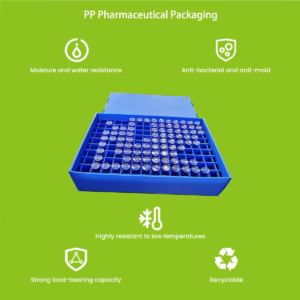 PP 医药包装