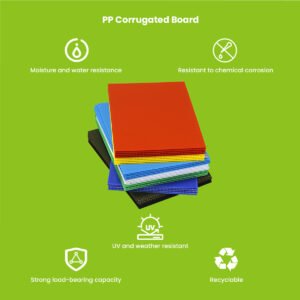
PP Corrugated Board — Three Traditional Materials, One Replacement
Cardboard absorbs water and collapses. Wood is heavy, splinters, and requires ISPM-15 compliance for export. Metal sheets corrode, conduct electricity, and weigh 7× more than an equivalent PP panel. PPBOXY’s PP corrugated board — a twin-wall extruded polypropylene panel — addresses all three material failures in a single product.
The board’s defining characteristic is its twin-wall (fluted) structure: two flat PP skins connected by parallel internal ribs running lengthwise through the panel. This geometry delivers structural rigidity at approximately one-fifth the weight of an equivalent solid PP panel — and at 40–60% less material cost. The hollow channels also provide passive thermal insulation and impact absorption that solid sheets lack.
This page covers the standard PP corrugated board format. For specialized variants — flame-retardant, honeycomb, high-density, signage-grade, food-grade — use the navigation table below to find the most relevant detail page. For the complete overview of all PP sheet types including non-corrugated formats, see PP Sheet →.
| What You Need |
Best PPBOXY Page |
Go To |
| Standard PP corrugated board — general-purpose |
Waterproof, lightweight, 2–12 mm, 4×8 ft |
This page |
| High-density corrugated board — heavy-duty |
Higher density, higher tensile strength |
PP Corrugated Sheet → |
| Signage-grade hollow board — print-ready |
Corona-treated surface, wind load rated |
PP Hollow Board → |
| Flame-retardant corrugated board — UL 94 V-0 |
Halogen-free FR, EN 13501-1 B-s1,d0 |
PP Flame Retardant Sheet → |
| Honeycomb board — maximum compression |
Hexagonal core, ≥ 0.8 MPa |
PP Honeycomb Board → |
| Food-grade corrugated board |
FDA 21 CFR 177.1520, EU 1935/2004 |
Corrugated Polypropylene Sheet → (food-grade grade) |
| All sheet types — navigation hub |
Compare all 8 PP sheet structures |
PP Sheet → |
技术规格
| Parameter |
Specification |
| Product |
PP Corrugated Board — twin-wall polypropylene panel |
| 材料 |
Polypropylene (PP) — virgin or recycled grades |
| 结构 |
Twin-wall corrugated (fluted) — two flat skins + parallel internal ribs |
| Standard Sheet Size |
1,220 × 2,440 mm (4 × 8 ft) |
| Custom Sheet Size |
Up to 2,100 × 6,000 mm |
| Thickness Range |
2, 3, 4, 5, 6, 8, 10, 12 mm |
| Weight (4 mm, 4×8 ft) |
~1.78 kg per sheet (0.6 kg/m²) |
| Density |
0.55–0.92 g/cm³ (varies by thickness and grade) |
| Tensile Strength |
≥ 18 MPa (machine direction) |
| Flexural Strength |
≥ 22 MPa |
| Impact Resistance |
≥ 10 kJ/m² |
| Water Absorption |
< 0.01% |
| Operating Temperature |
−20 °C to +80 °C continuous |
| UV Resistance |
Standard: 2–3 years outdoor; Extended: 5+ years |
| Flame Rating |
HB (standard); UL 94 V-0 available (FR grade) |
| 颜色选项 |
White, black, blue, yellow, red, grey, green, clear; custom Pantone (MOQ) |
| Surface Finish |
Matte (standard); Glossy, anti-slip, anti-static, corona-treated (optional) |
| 可回收性 |
100% PP #5 |
| Fabrication |
Knife-cut (score & snap), circular saw, CNC router, die-cut, heat bend, weld |
| Certifications |
ISO 9001, REACH, RoHS |
| 最小起订量 |
无最低限额 |
| Lead Time |
5–10 business days (standard) |
PP Corrugated Board vs Cardboard vs Wood vs Metal — The Replacement Case
| Property |
PP Corrugated Board |
Corrugated Cardboard |
Plywood |
Sheet Metal (Steel/Al) |
| Weight (4 mm, 1 m²) |
~0.6 kg |
~0.5 kg |
~2.5 kg |
~7.8 kg (steel) / ~2.7 kg (aluminium) |
| 防水 |
✅ < 0.01% absorption |
❌ Absorbs — collapses |
⚠️ Warps, rots |
✅ (steel rusts without coating) |
| Chemical Resistance |
✅ Acids, alkalis, oils, solvents |
❌ Absorbs — degrades |
⚠️ Limited |
⚠️ Corrodes (steel) |
| Electrical Conductivity |
❌ Non-conductive — safe near electrical |
❌ Non-conductive |
❌ Non-conductive |
⚠️ Conductive — shock hazard |
| ISPM-15 Required (Export) |
❌ No — exempt |
❌ No |
✅ Yes — fumigation + stamp |
❌ No |
| 可回收性 |
✅ PP #5 |
✅ Paper |
❌ Mixed (glue + wood) |
✅ Metal (energy-intensive) |
| Machinability |
✅ Hand tools, CNC, weld |
✅ Hand cut |
✅ Woodworking tools |
❌ Requires metalworking tools |
When to switch from cardboard to PP:
- The application involves moisture, outdoor exposure, or wet environments
- The board is handled/reused multiple times (3+ cycles = PP cheaper per use)
- Weight matters but structural integrity must be maintained when wet
When to switch from wood to PP:
- Export shipments where ISPM-15 compliance adds cost and risk
- Applications where splinters, nails, or wood dust are unacceptable
- Weight reduction is a priority (−75% vs plywood)
When to switch from metal to PP:
- Electrical safety requires non-conductive material
- Corrosion is a recurring maintenance cost
- Weight reduction enables manual handling instead of mechanical lifting
Applications
Packaging & Logistics
PP corrugated board is the standard substrate for reusable industrial packaging: folding boxes, divider inserts, layer pads, protective packaging, and returnable containers. At 50+ reuse cycles, the per-trip cost drops below cardboard. Waterproof properties protect contents from rain and condensation during transport. For complete box solutions, see PP Corrugated Plastic Box →.
Signage & Display
Twin-wall PP board is the global standard for short-to-medium-term outdoor signage: real estate signs, political campaign signs, construction site boards, retail POS displays. The 4 mm corona-treated white board accepts UV digital and screen printing. For signage-specific specifications including wind load ratings and printing methods, see PP Hollow Board →.
Construction Protection
Temporary surface protection during building construction and renovation: floor protection sheets, wall guards, door and window coverings. The 4–6 mm board laid flat absorbs foot traffic, tool drops, and paint spills. Flame-retardant grade required for enclosed areas. See PP Flame Retardant Sheet → for FR-grade specifications.
Industrial Fabrication
PP corrugated board is used as a raw material for fabricated products: automotive interior panels, protective equipment housings, partition walls, reusable dunnage, and custom industrial components. The board can be CNC-routed, die-cut, scored-and-folded, heat-bent, and welded. For high-strength applications, see PP Corrugated Sheet → (high-density grade).
常见问题解答
Q: What is the difference between PP corrugated board and PP corrugated sheet?
In PPBOXY’s catalog, the terms are used interchangeably for the base twin-wall material. “Board” is typically used when the product is a finished or semi-finished panel; “sheet” is used when the product is raw material for cutting and fabrication. The material is identical — twin-wall extruded polypropylene. For the high-density variant with elevated tensile and flexural strength, see PP Corrugated Sheet →.
Q: How does PP corrugated board compare to cardboard on cost?
PP costs 3–5× more per sheet upfront than cardboard. The cost advantage emerges through reuse: after 3–5 uses, the PP board’s per-use cost drops below cardboard’s single-use cost. After 50–100 uses, the per-use cost is 0.02–0.05versus0.02–0.05versus0.50–1.50 for a new cardboard sheet each time. For any repeated-use application, PP is the lower-cost material over the product lifecycle.
Q: Can PP corrugated board be used outdoors permanently?
Standard PP corrugated board with UV stabilizers lasts 2–3 years outdoors without significant fading or embrittlement. For permanent outdoor installations (5+ years), specify the extended-life UV grade (+15–25% material cost). Black and grey colors offer the best UV longevity; translucent and white sheets have slightly shorter outdoor life.
Q: Is PP corrugated board recyclable?
Yes — 100% as PP #5. The twin-wall structure is mono-material polypropylene — no laminates, adhesives, or mixed polymers. It can be ground, melted, and re-extruded into new PP sheet without separation steps. Cardboard with tape and labels is mixed-material and often landfilled. Wood with glue and nails cannot be recycled.
Q: What is the standard sheet size and minimum order quantity?
We do not impose a mandatory MOQ. Our production capabilities are designed to accommodate a broad spectrum of order volumes, ranging from prototype quantities to full-scale mass production, ensuring we align with your specific operational needs.